
Starting a Private Practice After Qualifying: A UK Therapist’s Blueprint

Article by
Martin Hogg
I help Private Practice counsellors in the UK set up and grow an ethical Private Practice they love, work with their ideal clients, and earn the income they deserve. All without guesswork and burnout. I have been a private practice counsellor myself for over 20 years, specialising in anger management. I set up a not-for-profit social enterprise, Citizen Coaching and Counselling, which delivers thousands of counselling sessions a year to adults and young people in Birmingham. I am a registered BACP Counsellor and the author of three books, My Anger Coach, My Anxiety Coach and My Relationship Coach. These are available on Amazon.
You don't need a polished empire or a five-year plan to start seeing clients. Most therapists think they need a perfect website and a decade of experience before they can open their doors, but the truth is much simpler. If you are starting a private practice after qualifying uk regulations and marketing can feel like a mountain, but you really only need a "skateboard" version of a business to get moving. It's about being functional and helpful, not perfect.
I know that "marketing" often feels like a dirty word in our world. You might be worried about sounding unethical or feel that nagging sense of imposter syndrome telling you that you're just faking it. I've been there, and I promise you don't need to be a sales guru to build a successful room. This guide is a practical, jargon-free blueprint designed to take you from newly qualified to a confident practice owner without the marketing headache.
We will cover the essential legal must-haves like your £52 ICO fee and BACP requirements, alongside a simple way to find your first three clients using tools like the Counselling Directory. By the end, you'll have a clear path to get your practice off the ground and into the real world where you can actually help people.
Key Takeaways
- Shake off the idea that marketing is "icky" by reframing it as a simple way to help the right people find the support they need.
- Build a "skateboard" version of your business with a clear checklist of UK essentials, from professional insurance to keeping your BACP or NCPS house in order.
- Understand why starting a private practice after qualifying uk is more about having a clear "one-sentence offer" than a perfect, expensive website.
- Learn how to use the "big two" UK directories effectively to get your first three clients through the door without a massive marketing headache.
- Set fees and cancellation policies that actually work for you, helping you avoid burnout and the common trap of the sliding scale race to the bottom.
The Transition: From Newly Qualified to Private Practice Owner
The final diploma session ends, the champagne is flat, and suddenly you're staring at a blank calendar. It's the "Now What?" moment. You've spent years learning how to hold space, but nobody taught you how to pay for one. If you are starting a private practice after qualifying uk training usually leaves a gap where the business logic should be. You know the professional landscape for UK therapists is complex, but knowing the BACP ethical framework won't help you with your tax return or your SEO.
The biggest hurdle is often the word "marketing." It feels icky, like you're selling double glazing instead of therapy. I want you to flip that. Marketing is simply helping people find you. If someone is in distress and you can help them, it's actually your job to make sure they know you exist. Starting a private practice after qualifying uk therapists often wait for "the right time," but waiting for perfection is your biggest enemy. A "rough and ready" website that's live today is worth ten times more than a perfect site that's still "under construction" in six months.
Beating Imposter Syndrome in the Early Days
That feeling of being a "fake" is actually a good sign. It shows you care deeply about your ethics and your clients. In your first six months of trading, focus on being "good enough" rather than a master practitioner. You're building a foundation, not a cathedral. Set realistic expectations; your goal for the first quarter is to get your systems in place, not necessarily to have a waiting list of fifty people. Trust your training, but give yourself permission to be a beginner in business.
The Mindset Shift: You Are Now a Social Entrepreneur
You are balancing clinical integrity with the reality of a mortgage. This is where clinical supervision ends and business coaching begins. While your supervisor keeps your clients safe, something like the Private Practice Success membership keeps your business healthy. People connect with people, not corporate logos. Use your real voice and keep your content human. It builds more trust than any polished facade ever could. You don't need a corporate identity; you just need to be a visible, helpful human being.
The Skateboard Model: Your Essential UK Setup Checklist
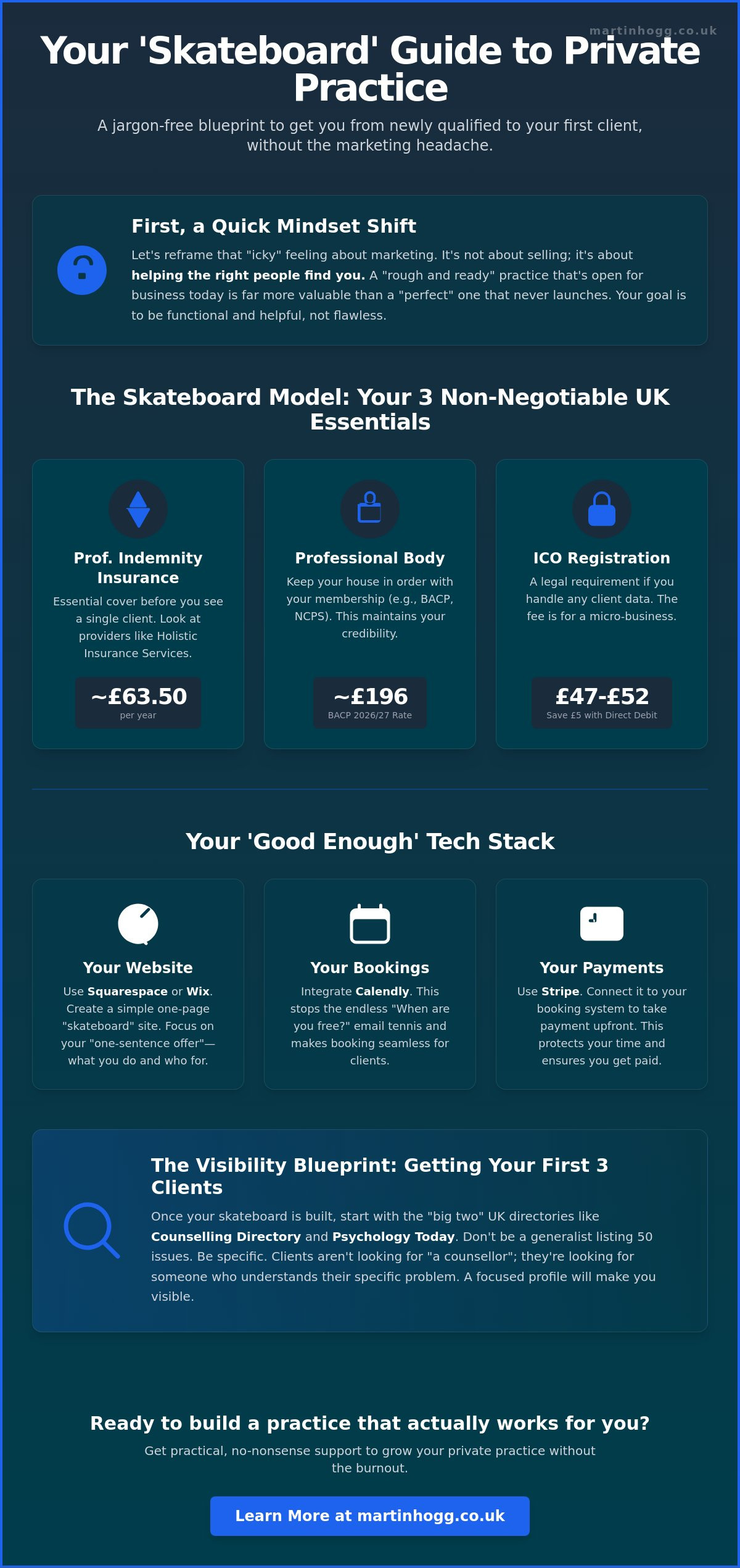
Setting up doesn't have to be a slog. I see many people get stuck in "analysis paralysis" before they've even seen a single client. While you can look up official government advice on writing a business plan, you probably don't need a twenty-page document yet. You need a skateboard. A skateboard is the simplest version of your business that actually moves. When you are starting a private practice after qualifying uk regulations are the first things to tick off to get that momentum.
You need three non-negotiables before you open your doors. First, Professional Indemnity Insurance. Companies like Holistic Insurance Services usually charge around £63.50 for a standard qualified therapist's policy. Second, your professional body membership; for example, the BACP individual membership is £196 for the 2026/27 year. Finally, you must register with the ICO. If you're handling client data, it's a legal requirement. The fee is £52 for a micro-business, but you can save £5 if you pay by direct debit.
The Tech Stack for New Practitioners
If you're starting a private practice after qualifying uk based therapists often overspend on tech. You don't need a bespoke developer. Use Squarespace or Wix to build a one-page site that focuses on your "one-sentence offer." Keep it simple. Integrate Calendly for bookings and Stripe for payments. This stops the endless "When are you free?" email tennis and ensures you get paid on time. For a deeper look at these tools, check out my Counselling Private Practice UK: A Practical Guide.
Clinical Supervision and Ethical Foundations
Your supervisor from your placement might not be the right fit for your new venture. You want someone who understands the commercial landscape of private work without compromising clinical ethics. They can help you refine your therapy contract. Keep this document robust but readable; no one wants to sign a legal manifesto in their first session. If you'd like a community to help sense-check these steps, the Private Practice Success Membership is a great place to start.
The Practice Visibility Blueprint: Getting Your First Clients
Once your "skateboard" is ready, you need to put it where people can see it. Most therapists make the mistake of trying to be everything to everyone. They list fifty different issues they can work with, hoping to catch someone. In reality, being a generalist makes you invisible online. If you are starting a private practice after qualifying uk clients aren't looking for a "counsellor"; they're looking for someone who understands their specific pain. This starts with your "one-sentence offer." It defines exactly who you help and how you do it, such as "I help overwhelmed new dads find their feet again."
Your "About Me" section on directories like Psychology Today or the Counselling Directory shouldn't actually be about you. It sounds counterintuitive, but a client in distress doesn't care where you did your level 4 diploma yet. They want to know if you understand why they can't sleep at 3:00 am. Lead with their struggle. When they read your profile, they should feel like you've been reading their private diary. This builds immediate trust before they've even clicked the contact button.
Optimising Your Directory Profiles
The "big two" directories are your primary referral engines in the UK. To stand out, you need to master the "above the fold" rule. This means your most important information and your contact button must be visible without the user having to scroll down. Pay attention to your title and description tags; these are the short snippets Google shows in search results. If you want a deeper dive into the mechanics of this, I've written a guide on How to Get Counselling Clients UK which breaks this down further.
Content for the Fearful: Rough and Ready Wins
You don't need to be a social media influencer to get clients. Use Canva to create simple, helpful posts that answer common questions your clients have. Keep it "rough and ready." A quick, honest video or a helpful tip written in plain English beats a polished, corporate-looking graphic every time. People connect with people. Your biggest competitive advantage is your humanity, not your branding. If you're ready to get serious about being seen, you can join our Practice Visibility Blueprint community for step-by-step support.
Sustainable Growth: Avoiding Burnout and Scaling Up
Getting your first few clients is a rush, but the real challenge is making sure you're still standing a year from now. When you are starting a private practice after qualifying uk therapists often fall into the trap of the "sliding scale." You feel guilty charging a full rate because you're new, so you offer discounts to everyone. This is a fast track to resentment. If you charge £30 an hour but your overheads and tax take half, you'll have to work double the hours to survive. Avoid the race to the bottom. Set a fee that reflects your value and stick to it.
Financial boundaries are just as important as clinical ones. If a client cancels at the last minute or forgets to pay, it isn't just a "missed connection," it's a hole in your budget. Handle these moments with grace but firmness. Having a clear policy in your contract means you don't have to make awkward decisions on the fly. You're running a business, and businesses need predictable income to stay healthy.
The biggest threat to your new practice isn't a lack of clients; it's isolation. Private practice can be incredibly lonely. You don't have a staff room to vent in or a colleague to grab coffee with. This is why I built the Private Practice Success Membership. It's a space where you can get practical advice and support from people who actually understand the clinical and commercial sides of the work. Don't try to do this alone.
Managing Your Energy, Not Just Your Time
It's tempting to fill every gap in your calendar the moment the phone starts ringing. Resist that urge. Taking on a massive caseload in your first month is a recipe for disaster. You need time to process the work, manage your admin, and actually have a life. If you feel the walls closing in, take a look at my Therapist Burnout: A Practical Guide to Recovery for some grounded advice on resetting your pace.
Planning for the Future: CPD and Specialisation
As you grow, choose your learning wisely. Don't just collect certificates for the sake of it. Pick CPD that actually helps you build a niche and grow your business. Specialising in things like Anger Management or Working with Men can set you apart from the sea of generalists. For a look at how to pick the right path, check out my CPD for Counsellors UK: A Practical Guide. Focus on what makes you useful, and the growth will follow.
Your Journey From Diploma to Doorstep
Moving from a student mindset to a business owner is a big leap, but you don't have to jump without a net. We've covered how to get your "skateboard" moving with the right UK legalities and why a simple directory profile beats a complex website every time. Remember, starting a private practice after qualifying uk is less about being perfect and more about being present for the people who are looking for exactly what you offer.
The technical bits like ICO registration and setting fees are just the foundation. The real growth happens when you stop trying to do everything alone. If you want to skip the trial and error, I'd love to help you. My Private Practice Success Membership gives you access to a supportive community of UK therapists, BACP-endorsed workshops, and the full Practice Visibility Blueprint system to help you get found.
You've done the hard work of qualifying. Now, it's time to make sure you actually get to do the work you've trained for. Join the Private Practice Success Membership and get the support you need to grow. You've got this, and I'm here to help you make it happen.
Frequently Asked Questions
Do I need to register as self-employed with HMRC immediately?
You don't have to register the moment you qualify, but you must do it by 5 October following the end of the tax year in which you started trading. For many, it's easier to get it done early so it doesn't become a looming task. Keep in mind that for the 2026/27 tax year, your first £12,570 of income is tax-free under your Personal Allowance.
How much should I charge for a 50-minute session as a newly qualified therapist?
Avoid the temptation to be the cheapest person on the Counselling Directory. Look at what others in your area are charging and aim for the middle of that range. If you set your fees too low, you'll struggle to cover your supervision and CPD costs. Your fee should reflect your professional training and the reality of your business overheads.
Is it better to rent a room or work online when starting out?
Working online is usually the best way to start because it keeps your overheads at almost zero. Renting a physical room adds a fixed weekly cost that can feel heavy when your diary is still empty. I suggest starting online to get your first few clients, then looking for a room once you have a steady income to cover the rent.
What insurance do I need for private practice in the UK?
You must have Professional Indemnity and Public Liability insurance before you see your first client. A typical annual premium for a qualified therapist is around £63.50, which usually includes malpractice and products liability with a £5,000,000 limit. This is a non-negotiable part of your professional setup and keeps both you and your clients protected.
How many clients do I need to see to make private practice sustainable?
Most therapists find that 12 to 15 clients per week is the ideal balance for a full-time income. If you are starting a private practice after qualifying uk based therapists often forget to factor in the time spent on admin, marketing, and supervision. Sustainability isn't just about the number of sessions; it's about making sure your fee covers your life without you burning out.
Disclaimer
The information provided on this blog is for general informational purposes only and is not intended to be a substitute for professional medical or mental health advice, diagnosis, or treatment. Reading this content does not create a therapist-client relationship.


