
Starting and Growing a Private Practice: A Practical Guide for UK Counsellors
You’ve done the training, put in the long hours at an agency or the NHS, and honed your clinical skills. You are a good therapist. But there’s a quiet, persistent thought that you could be doing more—on your own terms. The dream of starting a private practice is often followed by a wave of anxiety: the finances, the admin, the fear of finding clients, and the uncomfortable feeling of having to "sell" yourself.
It’s a conflict I see all the time. You became a therapist to help people heal, not to become a businessperson. The idea of marketing can feel pushy, unethical, and completely at odds with your core values.
This guide is built on a simple but powerful idea: building a successful private practice is an ethical extension of your clinical work, not a departure from it. It's about creating a safe, professional space where you can do your best work and making sure the people who need you most can find you. This is your practical, no-nonsense roadmap to transitioning from an overwhelmed employee to a confident and thriving practice owner.
What is a private practice in the UK therapeutic context?
In simple terms, starting a private practice means you are no longer an employee; you are the owner of a business providing therapeutic services directly to clients, outside of frameworks like the NHS or large charities. This involves a significant shift in mindset. You move from being responsible for just the clinical work to overseeing the entire "business of therapy"—from client communications and record-keeping to finances and professional growth.
But with this responsibility comes incredible freedom. You gain complete autonomy over your clinical specialisms, the hours you work, and the therapeutic approach you use. You get to build something that is a true reflection of your professional values and passions.
The benefits of independent practice for counsellors
- Reclaim Your Time and Prevent Burnout: You set your own diary. This gives you greater control over your work-life balance, allowing you to build a schedule that energises you rather than drains you, protecting you from the burnout so common in agency work.
- Focus on the Work You Love: You have the freedom to choose a niche or a specific client group you feel most passionate about helping. This allows you to deepen your expertise and find more meaning in your day-to-day clinical work.
- Create a Sustainable and Rewarding Career: Moving into private practice often comes with a significantly higher earning potential compared to standard agency or charity pay scales, allowing you to build a financially stable and long-term career.
Common misconceptions for beginners
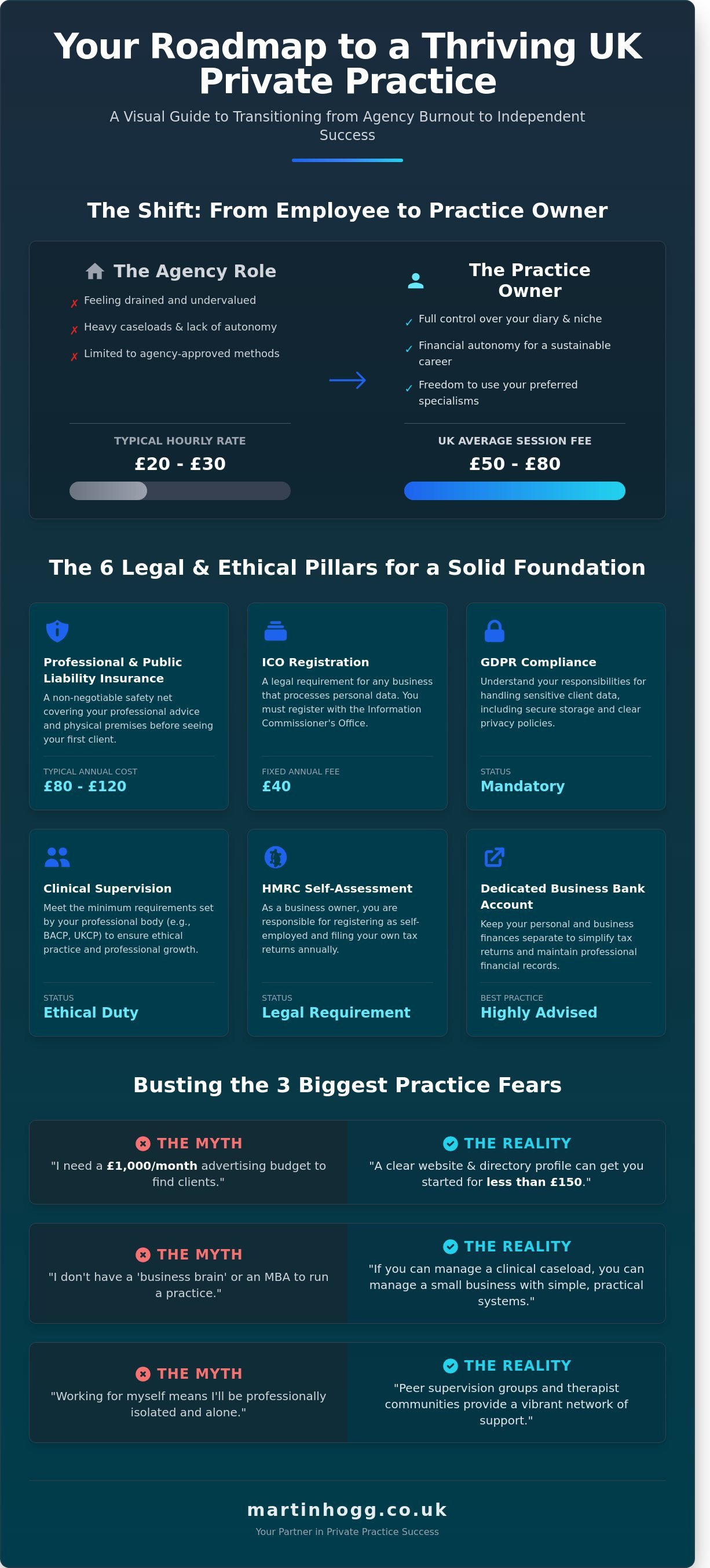
- "You need a huge marketing budget to find clients." This is a myth. In therapy, trust is your greatest currency. The truth is that authentic connection and a clear, helpful presence will attract far more of your ideal clients than expensive advertising ever could.
- "You have to be 'business-minded' to succeed." The core skills you already possess—empathy, active listening, building rapport, and clear communication—are your most powerful business assets. Success comes from applying these therapeutic skills in a new context, not from becoming a cut-throat entrepreneur.
- "Private practice means working in total isolation." While you are an independent practitioner, you never have to be alone. Building a strong network of peers for support, referrals, and collaboration is a cornerstone of a healthy and sustainable private practice.
The legal and ethical pillars of a British private practice
- Explain the necessity of professional indemnity insurance and public liability cover.
- Detail the requirement for clinical supervision as per BACP or UKCP ethical frameworks.
- Summarise the importance of GDPR compliance for storing sensitive client notes.
- Briefly mention registering with the Information Commissioner’s Office (ICO).
Registering with HMRC and managing finances
- The difference between being a Sole Trader and a Limited Company for therapists.
- Setting up a separate business bank account to keep finances organised.
- Planning for tax and National Insurance contributions from the outset.
Ethical marketing and the BACP guidelines
- How to promote your services without making "claims of cure" or being exploitative.
- The role of honest, transparent pricing in building trust with prospective clients.
- Ensuring your professional boundaries remain intact while increasing your visibility.
Overcoming the fear of "Selling" your therapy services
- Identify why therapists often feel a conflict between healing and charging a fee.
- Reframe marketing as "Visibility": helping the right people find the support they need.
- Discuss the impact of "imposter syndrome" when first setting your private practice rates.
- Encourage a solution-focused mindset regarding your business growth.
Comparing directory listings vs. personal branding
- The pros and cons of relying solely on the Counselling Directory or Psychology Today.
- Why a personal website allows you to show your personality and therapeutic "colour".
- Building a brand that feels authentic to your clinical style and values.
The ethics of the "Discovery Call"
- How to use initial enquiries to assess clinical suitability rather than just "closing a sale".
- Setting expectations early to ensure a better therapeutic alliance.
- A discovery call is a mutual assessment of fit, designed to see if you are the right therapist for the client and if they are the right client for you.
The Practice Visibility Blueprint: 5 steps to growth
- Identify your niche: Who are the clients you are best equipped to help?
- Optimise your digital presence: Ensure your website speaks directly to the client’s pain.
- Network locally: Building relationships with GPs, schools, and other Birmingham-based professionals.
- Content creation: Using blogs or videos to demonstrate your expertise and empathy.
- Consistency: Why small, daily actions lead to long-term practice success.
Defining your ideal client avatar
- Moving beyond generic "counselling" to specific issues like anger management or trauma.
- Understanding the language your clients use when they search for help online.
- Internal link opportunity: Niche Marketing for Birmingham Counsellors.
Local visibility in the West Midlands
- The power of being a "local expert" in Birmingham or your specific town.
- Leveraging local SEO to appear when people search for "therapist near me".
- Participating in community events or workshops to build professional rapport.
Scaling your success with the Private Practice Membership
- Introduction to Martin Hogg’s Private Practice Success Membership as the ultimate support hub.
- The value of peer support in reducing the isolation of working for yourself.
- How structured coaching can accelerate your growth and save years of trial and error.
- Positioning ongoing CPD as a tool for both clinical excellence and business authority.
What to expect from one-to-one coaching
- Bespoke strategies tailored to your specific stage of practice development.
- Accountability and encouragement from someone who has been where you are.
- Internal link opportunity: One-to-One Practice Growth Coaching.
Joining a community of like-minded practitioners
- Sharing resources, templates, and "what works" with a UK-wide network.
- Accessing live training sessions on everything from SEO to working with men.
- CTA: Join the Private Practice Success Membership today.
Frequently Asked Questions
How much does it cost to start a private practice in the UK? Initial costs typically include professional insurance, ICO registration, professional body membership, clinical supervision, and potentially website hosting or room rental. A starting budget of £500-£1500 is a realistic estimate, depending on your choices.
Do I need to register with the ICO for my therapy practice? Yes. If you are processing sensitive client data (which as a therapist, you are), you must register with the Information Commissioner's Office (ICO) and pay the annual data protection fee.
How do I find my first client when starting out privately? Your first client often comes from your existing network. Inform former colleagues, your supervisor, and local GPs that you are starting a private practice. A basic profile on a directory like the Counselling Directory can also be an effective starting point.
Is it better to be a sole trader or a limited company for a therapy practice? Most therapists in the UK start as a sole trader due to its simplicity and lower administrative burden. A limited company offers greater financial protection but comes with more complex accounting. It's wise to consult with an accountant to decide what's right for your situation.
How many clients do I need to make a private practice viable? This depends entirely on your fees and your desired income. Calculate your monthly business and personal outgoings, then work backwards. For example, to earn £3000 a month charging £60 per session, you would need to see approximately 12-13 clients per week.
What insurance do I need for a private counselling practice? You must have professional indemnity insurance, which covers you in case of a claim made against you by a client. Public liability insurance is also highly recommended, especially if you see clients in person.
Can I run a private practice from my own home? Yes, many therapists run successful practices from home. You'll need to ensure you have a confidential, professional space. You should also check with your mortgage provider or landlord and inform your home insurance provider.
How do I set my fees for private therapy sessions? Research what other qualified therapists in your local area are charging for similar services. Consider your level of experience, specialist training, and running costs. Your fee should reflect your expertise and allow you to run a sustainable practice.


