Staying Human in the Age of AI: A Guide for UK Private Practice Counsellors
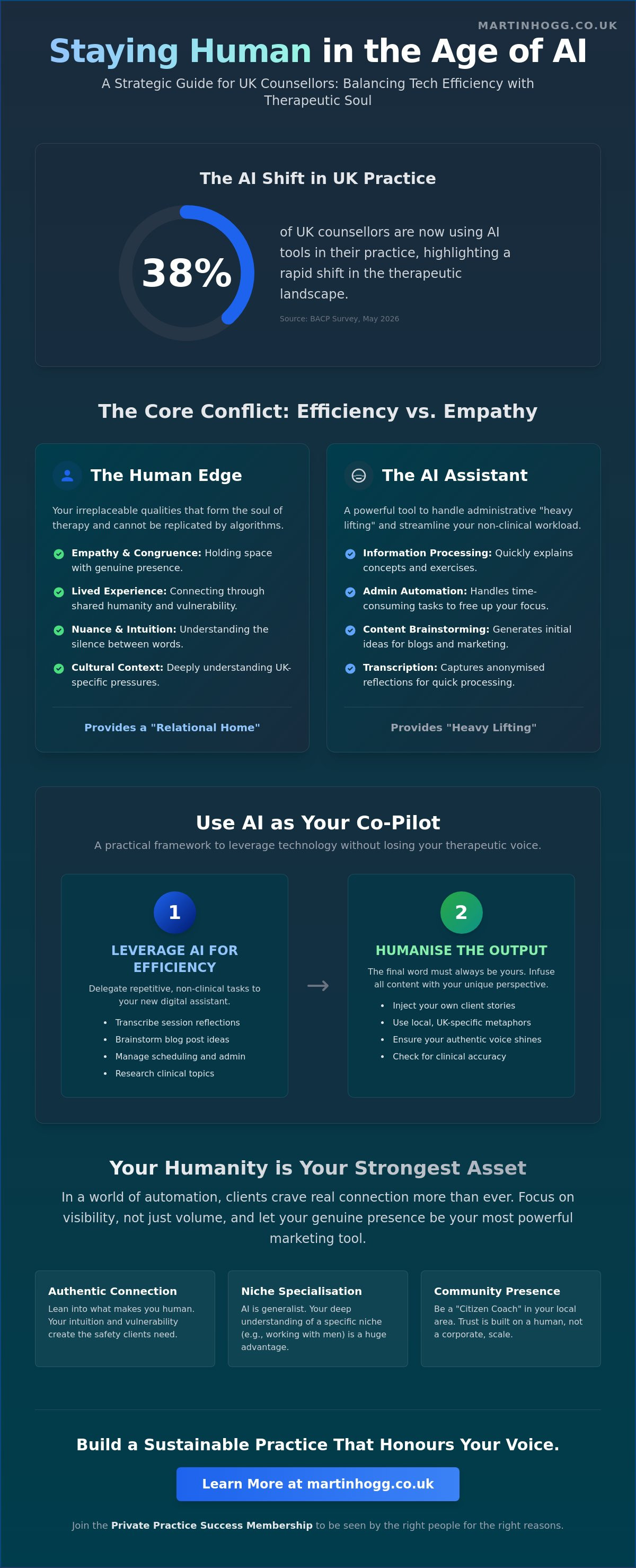
Did you know that 38% of counsellors in the UK are now using AI in their practice? This figure, from a May 2026 BACP survey, might feel a bit unsettling if you have spent your career valuing the deep, unscripted nuances of human connection. I understand the worry that your marketing might start to sound robotic or the fear that your years of clinical experience are being squeezed by a piece of software. Staying human in the age of AI is not about ignoring these new tools, but about ensuring they serve your purpose without diluting your presence.
It is okay to feel a bit overwhelmed by the constant stream of new tech, especially with regulations like the Data (Use and Access) Act 2025 changing how we handle information. I want to help you find a clear boundary between the efficiency of tech and the soul of therapy. You will learn how to protect the core of your work while using modern tools to build a visible, sustainable practice. We are going to look at practical ways to save time on your admin and marketing, giving you the confidence that your unique human voice remains your greatest professional asset.
Key Takeaways
- Reaffirm the importance of core therapeutic conditions like empathy and congruence that no algorithm can ever truly replicate.
- Learn why staying human in the age of AI involves leaning into your unique niche to provide the authentic connection modern clients are searching for.
- Discover how to use AI for time-consuming admin tasks while keeping your marketing content grounded in your own metaphors and UK-specific phrasing.
- Focus on building a sustainable practice through visibility rather than volume, ensuring your human presence remains your strongest selling point.
The Rise of Synthetic Minds: Why Counsellors Feel the AI Pressure
It is perfectly natural to feel a sense of unease when you see headlines about the rapid growth of AI in mental healthcare. Many of us worry that our life's work is being turned into a commodity, or that the deep, messy process of therapy is being reduced to a series of automated prompts. This pressure often triggers a sense of self-doubt. You might wonder if a machine that never sleeps and processes data in seconds could eventually make the human therapist feel redundant.
For us, staying human in the age of AI means returning to the foundations of our training. It is about the core therapeutic conditions; empathy, congruence, and unconditional positive regard. These are not just clinical concepts; they are deeply felt human experiences. A machine can simulate a sympathetic response, but it cannot "be" with a client in their darkest moments. The soul of your practice is found in your lived experience and your ability to relate person to person. The Human Edge in therapy is the ability to hold space for nuance and shared suffering.
The Difference Between Information and Connection
AI is incredibly efficient at providing information. It can explain the mechanics of a panic attack or suggest a grounding exercise with perfect accuracy. However, information is not the same as healing. Only a human can provide a "relational home" for a client's pain. Connection happens in the silence between words and in the shared understanding that comes from two people sitting together. A bot can give advice, but it cannot offer the safety of being truly seen and understood.
The Perfectionism Trap
I often see counsellors falling into the trap of perfectionism, feeling they must be as "correct" as an algorithm to stay relevant. In reality, your human flaws are a vital part of the therapeutic alliance. Clients do not need a perfect, polished version of a therapist. They need someone real who understands what it is like to struggle. Your vulnerability and your genuine presence are exactly what make you irreplaceable.
The Paradox of Connection: Why Your Humanity is Your Greatest Asset
The more our lives are lived through screens and algorithms, the more we crave something real. It's a bit of a paradox. While automation makes things faster, it often leaves people feeling more isolated. This is where your humanity becomes your most powerful tool. Staying human in the age of AI isn't just a nice idea; it's a commercial and clinical necessity. When everything else feels synthetic, the "analogue" presence of a real person in a room becomes incredibly precious.
One way to strengthen this is by leaning into your specific niche. For example, working with men requires a level of intuition and shared understanding that a general AI model simply cannot replicate. AI works on averages and patterns. It doesn't understand the subtle shift in a man's voice when he's finally ready to talk about something difficult. By being a "Citizen Coach", a real person active in your local community rather than a distant clinical figure, you offer a level of trust that a global tech company never will.
Breaking the Stigma with Directness
Many clients, particularly those who have felt let down by rigid systems, appreciate a straight-talking, no-nonsense approach. A programmed bot follows a script. It can't be spontaneous, and it certainly can't use humour or a well-timed challenge to break through a client's defences. There are real dangers of AI therapy regarding nuance and safety, especially if a machine misses the subtle cues of a person in crisis. Your ability to be direct and authentic creates a bridge that a machine cannot build.
Our shared UK cultural context is another huge advantage. You understand the specific pressures of the NHS, the local idioms, or the unique stresses of living in the West Midlands. This shared history makes your practice deeply relevant. If you're looking for support in building this kind of authentic presence, you might find our Private Practice Success Membership a helpful place to start. It's about being seen by the right people for the right reasons.
Practical Steps to Use AI Without Losing Your Voice
The trick to staying human in the age of AI is to treat these tools as your assistant, not your replacement. I use technology to handle the "heavy lifting" of admin so I can spend more time focusing on my clients. For example, you can use transcription tools to capture your own anonymised session reflections. This allows you to process your thoughts quickly without the friction of typing. You can also use AI to brainstorm initial blog ideas when you're feeling stuck, but the final word must always be yours.
When you use an automated tool to help with writing, you must humanise the output. A recent APA survey on AI in therapy highlighted that while tools are reshaping the profession, practitioners remain rightfully cautious about clinical empathy. I recommend editing every piece of content to include your own stories, local metaphors, and UK-specific phrasing. To verify that your marketing still sounds like "you" before hitting publish, read the text aloud and ask yourself if you would actually say those words to a colleague over a cup of tea.
Refining Your Practice Visibility
You can use modern tools to help with SEO for therapists without turning your website into a cold, corporate landing page. Use tech to find the questions people are asking, then answer them in your own warm, inviting voice. I've found that incorporating video and audio on your site is one of the best ways to prove your humanness. Prospective clients want to hear your tone and see your expressions before they decide to trust you with their story.
Setting clear boundaries is essential for your professional integrity. Never let a machine handle a therapeutic response or simulate clinical empathy. These are sacred spaces that require a real person. If you want to learn how to integrate these tools while keeping your practice deeply personal, consider joining our Private Practice Success Membership. We focus on practical growth that respects the heart of the counselling relationship.
Building a Sustainable, Human-Centred Practice in 2026
Success in private practice isn't about shouting the loudest or having the most automated social media feed. I've always believed it's better to be deeply seen by the right clients than vaguely noticed by many. People are becoming wary of the "perfect" digital facade. They want to see the person behind the practitioner. Focusing on visibility over volume allows you to attract clients who are looking for exactly what you offer, rather than just anyone who clicks a link. Staying human in the age of AI is about clinical integrity as much as it is about marketing.
To keep your practice strong, you need to invest in your own CPD for counsellors. While an algorithm can store vast amounts of data, it cannot replicate the clinical intuition you develop through experience and targeted learning. Keeping your skills sharp ensures your presence stays grounded. It's also vital to join a community of like-minded professionals. Private practice can be a lonely road, and the shift towards digital tools can increase that sense of isolation if you aren't careful. We need each other to stay balanced.
The Practice Visibility Blueprint
I developed a structured growth plan because I know how loud the "tech noise" can get. It is easy to feel like you're falling behind if you aren't using every new gadget, but a solid plan helps you stay focused on what truly matters. Achieving private practice success in 2026 depends on your ability to be more yourself, not more like a machine. When you show up as a real person, you build a level of trust that no bot can touch.
Your Next Steps
If you're ready to take the next step, check the Martin Hogg calendar for our upcoming human-led workshops. These spaces are designed to help you get your practice back on track without losing your voice. The future of therapy is safe in human hands. Your empathy, your story, and your presence are the very things that will always make your work essential. You've got this.
Your Presence is Your Professional Power
The rise of new technology doesn't have to be a threat to your career. If you focus on the core therapeutic conditions and lean into your unique niche, you'll find that clients value your authentic presence more than ever. Staying human in the age of AI is really about letting the software handle the mundane tasks so you can devote your energy to the profound, messy work of healing. You are the expert in the room; no amount of code can replace your clinical intuition.
I've spent over 20 years running a successful UK private practice and delivering BACP-endorsed workshops. I know that the most effective marketing is simply being yourself. My coaching is practical and results-focused, designed to help you build a practice that feels right for you. Ready to grow your practice without losing your soul? Join the Private Practice Success Membership today.
The world needs your human voice and your compassionate support. Let's work together to get your practice back on track so you can focus on what you do best. You have everything you need to thrive in this new era.
Common Questions About AI in Private Practice
Will AI eventually replace human counsellors and therapists?
AI will not replace us because it lacks the capacity for genuine empathy and shared human suffering. While machines are excellent at identifying patterns, they cannot "be" with a person in a meaningful way. The therapeutic relationship is built on a foundation of trust and presence that only a human can provide. Staying human in the age of AI means recognising that your lived experience is something an algorithm can never replicate.
Is it ethical to use AI to help write my therapy blog or website copy?
It is ethical to use these tools for brainstorming or structuring your thoughts, provided the final voice is yours. Think of it as a digital assistant that helps with the initial heavy lifting of content creation. However, you must always edit the output to ensure it reflects your clinical values and unique way of working. Misleading a client into thinking a machine-generated response is your own personal empathy would cross an ethical line.
How can I tell if my marketing has become too corporate or robotic?
The simplest test is to read your copy aloud to a colleague or a friend. If the sentences feel stiff or use jargon you would never say in a real conversation, it has likely become too robotic. Real connection in marketing comes from your own stories, metaphors, and local West Midlands phrasing. If you sound more like a clinical manual than a supportive guide, it is time to inject more of your personality back into the text.
What are the best ways to protect client confidentiality when using digital tools?
You must ensure every tool you use is GDPR-compliant and never upload identifiable client data into any open AI platform. Under the Data (Use and Access) Act 2025, we have clear obligations to handle information with extreme care. Always check the privacy settings of your software and stick to end-to-end encrypted services for any communication. Being practical and protective of your client's data is a vital part of staying human in the age of AI.
How do I explain my use of technology to my clients if they ask?
Transparency is the best way to handle these conversations. You can explain that you use certain tools to manage the administrative side of your practice more efficiently. This allows you to stay focused and fully present during their sessions without being bogged down by paperwork. Reassure them that the actual work of therapy remains a strictly human-to-human process. Being honest about your tools shows that you value both modern efficiency and the sanctity of the therapeutic space.

Article by
Martin Hogg
I help Private Practice counsellors in the UK set up and grow an ethical Private Practice they love, work with their ideal clients, and earn the income they deserve. All without guesswork and burnout. I have been a private practice counsellor myself for over 20 years, specialising in anger management. I set up a not-for-profit social enterprise, Citizen Coaching and Counselling, which delivers thousands of counselling sessions a year to adults and young people in Birmingham. I am a registered BACP Counsellor and the author of three books, My Anger Coach, My Anxiety Coach and My Relationship Coach. These are available on Amazon.
Disclaimer
The information provided on this blog is for general informational purposes only and is not intended to be a substitute for professional medical or mental health advice, diagnosis, or treatment. Reading this content does not create a therapist-client relationship.


