
The Importance of CPD for Therapists: Why Ongoing Learning is Your Practice’s Secret Engine

Article by
Martin Hogg
I help Private Practice counsellors in the UK set up and grow an ethical Private Practice they love, work with their ideal clients, and earn the income they deserve. All without guesswork and burnout. I have been a private practice counsellor myself for over 20 years, specialising in anger management. I set up a not-for-profit social enterprise, Citizen Coaching and Counselling, which delivers thousands of counselling sessions a year to adults and young people in Birmingham. I am a registered BACP Counsellor and the author of three books, My Anger Coach, My Anxiety Coach and My Relationship Coach. These are available on Amazon.
What if your annual CPD requirement wasn't a regulatory tax you pay to stay registered, but the primary tool for building the clinical authority that actually attracts your ideal clients? It's easy to see those 30 hours a year as a bit of a burden. I've been there myself; sitting in a draughty hall or staring at a Zoom screen, wondering if the cost of the course will ever actually translate into more people sitting in my therapy room. You want to feel more confident, but sometimes training just feels like it's feeding your imposter syndrome instead of fixing it.
I agree that it's frustrating when professional development feels disconnected from the reality of running a business. However, understanding the true importance of cpd for therapists can change your entire outlook on your practice. I'm going to show you how to stop treating training as a chore and start using it as the secret engine for your growth. We will explore how to choose courses that help you build a specific niche, make your profile stand out on the Counselling Directory, and ultimately ensure your learning pays for itself through increased clinical confidence and client safety.
Key Takeaways
- Understand how CPD acts as a clinical safety net, ensuring you use evidence-based methods that keep both you and your clients safe.
- Learn to identify the clinical pains in your practice so you can choose training that solves real problems rather than just filling a folder with certificates.
- Explore the importance of cpd for therapists in building visibility, turning new skills into searchable keywords on your Psychology Today or Counselling Directory profiles.
- Adopt the skateboard model of learning by starting with small, practical workshops that provide immediate wins for your practice without the overwhelm.
- Discover how niche training helps you move from being a generalist to a specialist, allowing you to justify higher fees and attract your ideal clients.
Why CPD is the Safety Net for Both You and Your Clients
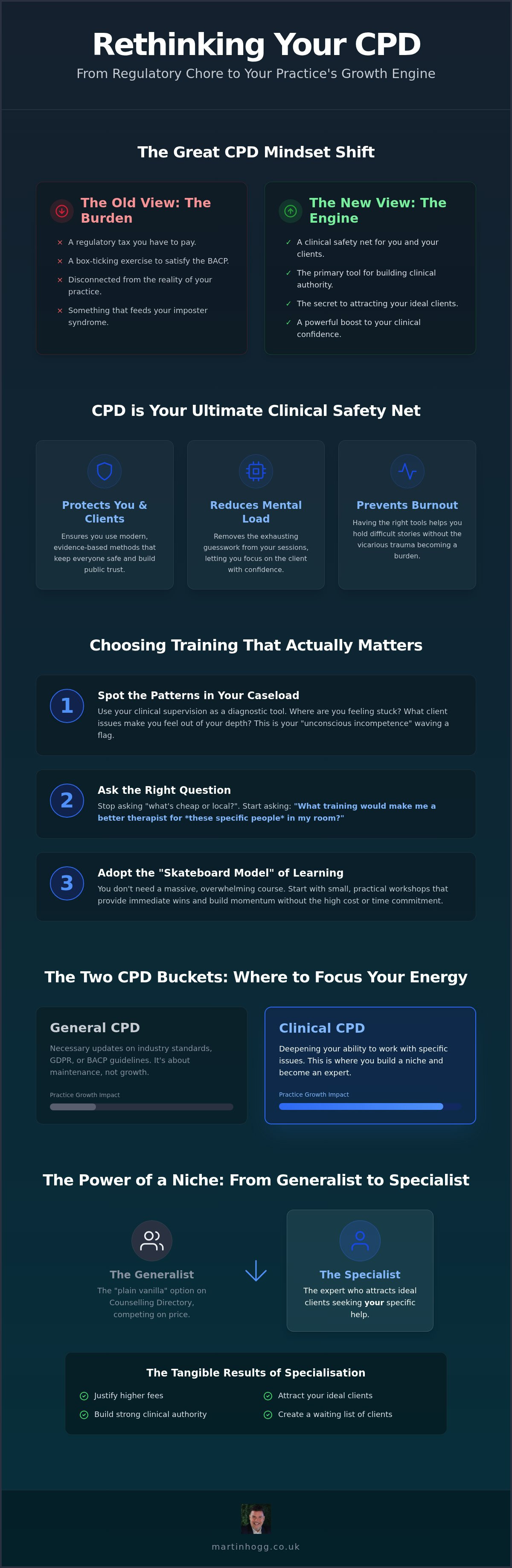
I'll be honest; most of us treat our CPD log like a tax return. We leave it until the last minute and then scramble to find enough hours to satisfy the BACP or NCPS. But if we shift our perspective, we see that Continuing Professional Development is the systematic maintenance of our skills. It’s the safety net that stops us from falling into the trap of using outdated, dusty practices that don't serve our clients. For registered members, that 30-hour annual requirement is a professional standard that builds public trust, but more importantly, it builds your own internal stability.
Staying current with Continuing Education in Psychotherapy isn't just about theory. It’s a practical way to reduce your mental load. When you have a solid grasp of modern, evidence-based frameworks, you aren't second-guessing yourself in every session. This clinical confidence is a massive factor in preventing therapist burnout, as it removes the exhausting guesswork from your working day. Understanding the importance of cpd for therapists means recognising that our learning journey never really ends; it just evolves to meet the needs of the people sitting across from us.
The Ethical Imperative: Beyond the BACP Audit
Admitting you have a gap in your knowledge isn't a sign of weakness; it's the mark of a high-quality practitioner. We all have moments where a client brings something to the room that makes us feel slightly out of our depth. Identifying these gaps is an ethical necessity. By proactively seeking training for complex cases, you protect yourself from the vicarious trauma that often comes from feeling helpless. When you have the right tools, you can hold difficult stories without they themselves becoming a burden you carry home.
Reflective Practice: The Heart of Professional Growth
Your clinical supervision is the best place to start. Instead of just picking a random course because it’s cheap or nearby, use your supervision time to spot patterns in your caseload. If you find yourself avoiding certain topics with clients, that’s your "unconscious incompetence" waving a red flag. Moving toward mastery requires a structured learning cycle. It’s about turning that shaky "I think I know what I'm doing" feeling into a grounded sense of authority. When you use CPD to address the real-world challenges in your room, the importance of cpd for therapists becomes a tangible asset rather than a regulatory chore.
Identifying the Gaps: Choosing Training That Actually Matters
I’ve seen plenty of therapists treat their CPD like a stamp collection. They sign up for a random workshop because it's cheap or local, just to tick a box. But if you want a practice that actually grows, you need to stop collecting hours and start identifying the specific clinical "pains" your clients are bringing into your room. Are you struggling to help people with deep-seated anger? Do you find yourself stuck when working with couples? This is where the real importance of cpd for therapists lies. It’s about solving the problems that keep you awake at night.
I find it helpful to split your learning into two buckets: Clinical CPD and General CPD. General CPD is about staying abreast of industry changes, GDPR, or new BACP guidelines. It’s necessary, but it rarely helps you build a niche. Clinical CPD, on the other hand, is where you deepen your ability to work with specific issues. Research on the Impact of Continuing Education shows that staying current with specialised approaches significantly improves client outcomes. Instead of panicking in December, use the BACP Register template to plan your year with intention. Look at your caseload and ask; "What training would make me a better therapist for these specific people?"
Deepening Clinical Skills: Why Niches Matter
Being a "generalist" is often a marketing trap. When you try to help everyone, you end up being the "plain vanilla" option on the Counselling Directory. Deep-dive training in underserved areas allows you to move from being one of many to being the expert. When you specialise, you aren't just another counsellor; you’re the person who knows exactly how to handle a specific struggle. This clinical authority is what allows you to eventually raise your fees and build a waiting list of people who specifically want your help.
The 'Working with Men' Example
Take working with men as an example. Many men are skeptical of traditional "talk therapy" and might find the usual therapist clichés a bit off-putting. If you haven't had specific training in this area, your intake and assessment process might inadvertently push them away. Specialised CPD can show you how to adapt your language and approach to engage men more effectively. It’s a practical shift that turns a difficult session into a breakthrough. If you're looking for a supportive environment to discuss these practice-building shifts, you might find our private practice community a helpful place to start.
How CPD Pays for Itself: The Link Between Learning and Visibility
I often hear counsellors complain that training is too expensive. I get it. When you're building a practice, every penny counts. But I want you to stop seeing CPD as a cost and start seeing it as your marketing department. The real importance of cpd for therapists is that every new certificate you earn is essentially a new keyword for your Psychology Today or Counselling Directory profile. If you don't have the training, you can't tick the box. If you don't tick the box, you simply won't show up in the search results when a client is looking for help with a specific, painful issue.
Specialising through CPD allows you to step away from the "race to the bottom" on pricing. Generalists often feel they have to keep their fees low to compete with everyone else on the list. Specialists, however, are sought out for their specific expertise. When you can demonstrate that you've invested in advanced training, you can justify higher fees because you're providing a higher level of targeted support. This is a core part of effective marketing for therapists uk; it's about positioning yourself as the obvious solution to a client's specific problem.
Building Your One-Sentence Offer
One of the easiest wins from your CPD is using it to sharpen your "One-Sentence Offer." This is a clear statement of who you help and how you help them. For example, instead of saying "I'm a person-centred counsellor," you can say, "I help men manage anger without losing their relationships." This feels like a service rather than a sales pitch. When your offer is backed by BACP-endorsed training, it builds immediate trust. People connect with people who clearly understand their struggle and have the tools to help.
Standing Out on Directories
Most clients don't go to a directory and search for the word "counselling." They search for their pain. They search for "anger management," "bereavement," or "anxiety." If your profile is a generic list of every issue under the sun, you'll get lost in the noise. By listing your specific, high-quality CPD, you catch the eye of someone looking for an expert. Don't be afraid to create "rough and ready" content like a quick blog post about what you learned on your latest course. It shows you're active, engaged, and knowledgeable. If you want to dive deeper into these visibility strategies, come and join us in the Private Practice Success Membership.
Building a Sustainable Habit: CPD Without the Overwhelm
I've seen too many therapists burn themselves out by trying to complete a massive, multi-year diploma while juggling a full caseload. Instead of trying to build a metaphorical Rolls Royce from day one, I recommend adopting the "skateboard model" for your learning. Start with a small, focused workshop that solves one immediate problem in your room. If that provides value, you can add the handlebars and wheels later. You don't always need a five-day certificate course when a two-hour module can give you the "easy win" you need for your current clients.
The secret to staying on top of your requirements is to schedule your learning exactly like a client appointment. If it's in your diary, it happens; if it isn't, you'll be scrambling in a state of "audit panic" the month before your registration renewal. By breaking your 30 hours down into monthly chunks, the importance of cpd for therapists shifts from a looming deadline to a manageable, rhythmic part of your professional life. Record your reflections as you go, rather than trying to remember what you learned six months ago.
Isolation is one of the biggest hurdles when building a counselling private practice uk. When you're working alone, professional development can feel like just another weight on your shoulders. However, learning alongside others keeps you motivated and provides a level of peer reflection that you simply can't get from a textbook. It turns a solitary chore into a shared experience of growth.
Joining a Support Network
This is why community is so vital. Memberships like the Private Practice Success Membership are designed to provide ongoing, bite-sized learning that fits into a busy schedule. Instead of trekking to a distant conference, you can access targeted support and peer reflection from your own office. It makes the importance of cpd for therapists feel practical and achievable, providing a safe space to discuss the clinical and business challenges we all face.
Realistic Next Steps for Your Practice
I'd like you to start with a quick audit of your current skills. Where do you feel a bit "wobbly" when a client brings a specific topic to the room? Don't overthink it; just identify one area where a bit more knowledge would boost your confidence. Your next step is simple: book one piece of training this quarter that aligns with the specific clients you actually want to work with. Focus on depth rather than just ticking boxes, and you'll find your practice starts to feel much more stable.
Turning Your Learning Into Growth
We have explored how professional development is far more than a box-ticking exercise for your annual audit. It is the clinical safety net that keeps your skills sharp and the marketing engine that makes your profile stand out to the people who need you most. By choosing training that solves the actual pains your clients bring into the room, you move from being a generalist to a sought-after specialist. This shift doesn't just protect your clients; it protects your own wellbeing by giving you the confidence to handle complex cases without the heavy mental load of guesswork.
Embracing the importance of cpd for therapists means seeing every hour as an investment in a more sustainable, profitable practice. You don't have to navigate this journey alone or feel overwhelmed by expensive, abstract courses that don't translate to real-world results. If you want practical, UK-focused support from a therapist who has actually built a thriving practice, I would love to see you inside our group. You can join the Private Practice Success Community for BACP-endorsed training and growth support. Let's turn those required hours into a practice you are proud of. You have got this.
Frequently Asked Questions
Is CPD mandatory for all therapists in the UK?
Technically, the titles "counsellor" and "psychotherapist" are not legally protected, so there is no law. However, if you want to be a member of a professional body like the BACP or the NCPS, it is absolutely mandatory. These organisations require evidence of ongoing learning to maintain your registration and insurance. Beyond the rules, it is an ethical necessity for safe practice. Skipping it is a disservice to the people paying to sit in your room.
How many hours of CPD do I need for BACP registration?
You are expected to complete at least 30 hours of Continuing Professional Development every year as a registered BACP member. This doesn't all have to be formal workshops or expensive conferences. The focus is on how the activity helps you work more effectively in the room. It is vital to keep a rolling log of these hours throughout the year so you aren't panicking if you are selected for a random audit.
Does reading therapy books or listening to podcasts count as CPD?
Yes, personal study like reading or listening to professional podcasts definitely counts as "unstructured" CPD. The key is that you must reflect on what you've learned and how it applies to your practice. Simply finishing a book isn't enough; you need to record how it changed your thinking or approach. This highlights the importance of cpd for therapists as a way to stay curious and informed outside of the classroom.
Can business coaching for therapists count towards my CPD hours?
Business coaching can count towards your hours if it directly improves the way you deliver your service or manage your professional obligations. Learning about GDPR, ethical marketing, or practice management is essential for a safe and sustainable business. If the coaching helps you reach underserved clients or manage your caseload more effectively, it is a valid and practical part of your professional growth.
What is the difference between Clinical and General CPD?
Clinical CPD focuses on deepening your skills for specific issues, such as trauma, bereavement, or anger management. General CPD covers broader industry requirements like safeguarding updates, legal changes, or data protection. Understanding the importance of cpd for therapists involves balancing both. You need the general updates to stay safe and compliant, but you need the clinical depth to build a niche that actually attracts clients.
Disclaimer
The information provided on this blog is for general informational purposes only. It is also not intended to be a substitute for professional medical or mental health advice, diagnosis, or treatment. Reading this content does not create a therapist-client relationship.


