
The Practical Private Practice Business Plan for Therapists: A UK Guide
Most therapists treat their business plan like a clinical audit; something to be feared, filed away, and never looked at again. You didn't spend years training in your modality just to spend your weekends wrestling with spreadsheets. It's natural to feel that focusing on profit might compromise your ethics, but a struggling therapist can't help anyone. Creating a practical private practice business plan for therapists shouldn't feel like a corporate chore that drains your energy. Recent data shows that 42% of private counsellors in the UK feel anxious about their financial stability, yet having a clear structure can change everything.
I'm going to show you how to build a sustainable, ethical, and profitable practice that supports your life instead of consuming it. You'll get a clear map to help you set confident fees and attract the right clients without losing your professional soul. This guide walks you through every step, from balancing your books to finding a reliable way to reach those who need your support the most. It's about getting your practice on track so you can focus on the work that actually matters.
Key Takeaways
- Learn how to build a supportive roadmap for your work that ditches cold corporate jargon in favour of a plan that feels human and manageable.
- Discover why narrowing your clinical focus helps you stand out and connect more effectively with the specific clients you are most passionate about supporting.
- Gain the confidence to set sustainable fees and calculate your true costs, ensuring your private practice business plan for therapists provides a stable, ethical income.
- Find out how to create a website that speaks to your client’s struggle rather than your certificates, and which UK directories will actually help you get found.
- Identify the practical steps needed to move your plan off the page and into reality with the right professional community to keep you on track.
Why Every UK Therapist Needs a Business Plan (That Doesn’t Feel Like One)
Most of us started our counselling journey because we care about people, not because we love profit and loss accounts. By 2026, the therapy market in the UK has become more crowded and complex, making a clear strategy essential for survival. A What is a Business Plan? is often seen as a dry, corporate document designed to please bank managers. In reality, a private practice business plan for therapists is a compass that keeps you heading toward your clinical and personal goals. It is about making sure you are still here, healthy and available, to help your clients in six months' time.
Planning doesn't have to feel cold or clinical. It's a way to translate your passion into a sustainable reality. Without a plan, you are essentially driving in the dark without headlights. You might reach your destination, but the stress of the journey will take a heavy toll on your mental health. A structured approach reduces the "imposter syndrome" that often creeps in when the phone stops ringing, providing a logical framework to fall back on when things feel uncertain.
The Mindset Shift: From Clinician to Practice Owner
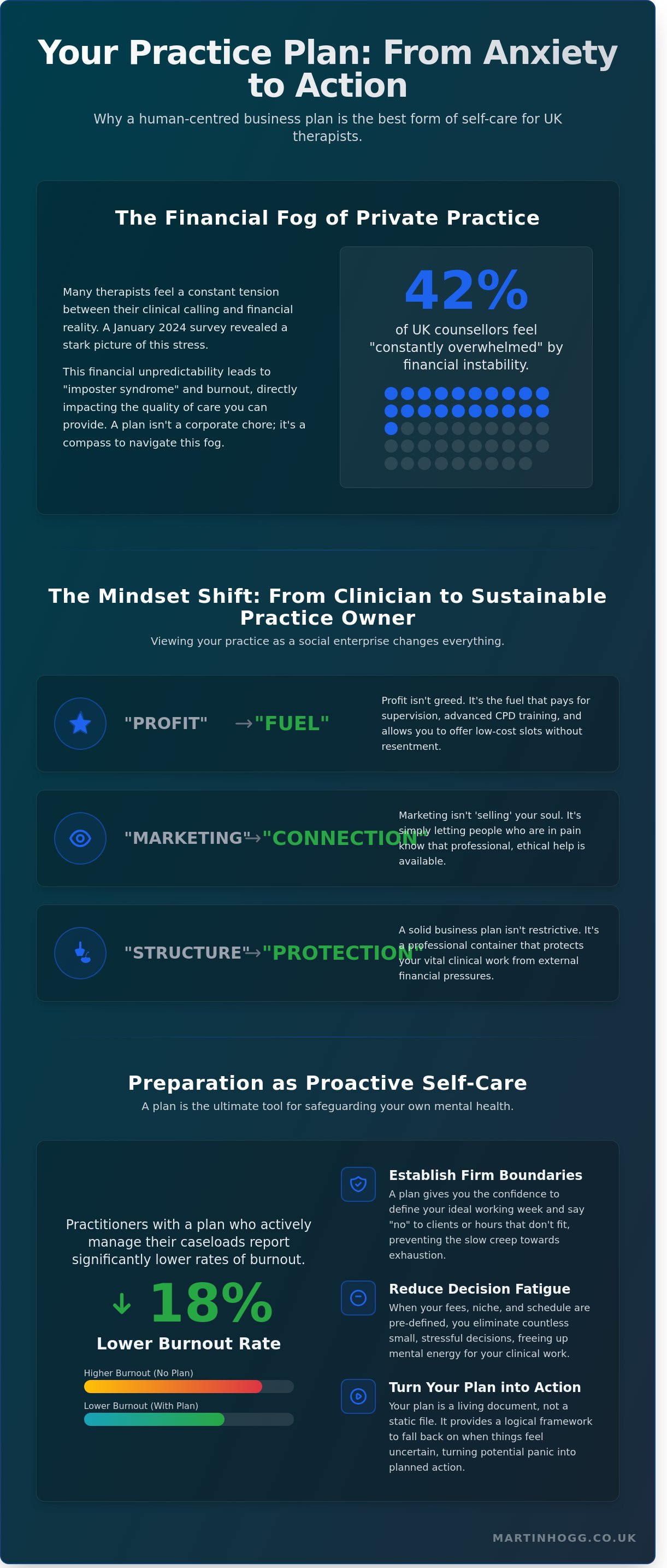
Many therapists feel a deep discomfort when they think about "selling" a helping service. We worry it cheapens the therapeutic bond or makes us look like we care more about money than people. However, "winging it" is a recipe for exhaustion. A January 2024 survey of 1,500 UK-based counsellors found that 42% felt "constantly overwhelmed" by the financial unpredictability of their work. This stress inevitably leaks into the therapy room, affecting your presence with clients.
We need to view our practices as social enterprises. Every social enterprise requires fuel to run, and in your practice, that fuel is profit. Profit allows you to pay for quality supervision, attend advanced CPD training, and keep your own lights on. When you ignore the business side, you aren't being more ethical; you're just becoming more tired. Shifting your mindset means realising that a healthy bank balance is what allows you to offer low-cost slots or pro-bono work without resentment.
- Identify your "break-even" number: the exact amount you need to earn each month to cover your mortgage, insurance, and professional fees.
- Recognise that marketing is simply a way to let people in pain know that help is available.
- Understand that a professional structure protects the clinical work from external financial pressures.
Protecting Your Wellbeing Through Preparation
Preparation is a profound form of self-care. When you don't have a plan, you're more likely to say "yes" to a client who isn't a good fit or to agree to a 9:00 pm session because you're worried about the mortgage. A solid private practice business plan for therapists helps you set firm boundaries with your clients and, perhaps more importantly, with yourself. It gives you the permission to say "no" to things that don't align with your long-term vision.
Data from the 2023 Practitioner Health report suggests that burnout rates are 18% lower in practitioners who strictly manage their caseload limits. By defining your ideal working week in your plan, you prevent the slow creep of "one more client" that leads to compassion fatigue. A therapy business plan is a living document for professional growth. It should evolve as you do, providing a safe container for your career to flourish while ensuring your own wellbeing remains the priority.
Defining Your Clinical Niche and Professional Vision
Trying to be a "jack of all trades" in the therapy world is a fast track to burnout and a quiet phone. It's a common mistake when starting out. You worry that if you don't say you work with everything from addiction to bereavement, you'll miss out on potential clients. The opposite is true. When you try to speak to everyone, you end up speaking to no one. A successful private practice business plan for therapists starts with a clear focus on the specific problems you feel most passionate about solving.
Maybe you're drawn to helping men in the West Midlands manage the pressure of career transitions, or perhaps you're focused on supporting parents through the complexities of neurodiversity. This focus isn't just a marketing trick. It's about clinical safety and professional integrity. Both the BACP and UKCP ethical frameworks require us to work within our competence. By narrowing your focus, you can invest in specific training that makes you a true expert. This depth of knowledge builds the calm confidence you need to help your clients get their lives back on track.
Finding Your "Ideal Client" Without the Jargon
Think about the human being sitting in the chair opposite you. Forget the diagnostic codes and clinical shorthand for a moment. Are they a 40-year-old professional who feels like a fraud despite their success? Are they a young person who feels completely disconnected from their peers? When you describe your work, use the words they use. A marketing niche is simply a way to signal to a specific group of people that you understand their world. While your clinical specialty might be Transactional Analysis or CBT, your niche is "helping people break free from the cycle of people-pleasing."
Your Professional Values and Mission
Your business plan needs a soul. This is your "Why." It's the reason you're willing to do the hard work of building a practice from scratch. While the official guide to writing a business plan provides a structural foundation for any new venture, your mission should be deeply personal. It's your brand promise to your community. It should also include a commitment to your own well-being. A 2022 survey of UK therapists found that those who scheduled regular self-care and adhered to strict boundaries were 25% more likely to sustain their practice beyond the three-year mark.
Setting long-term goals is the final piece of this puzzle. You aren't just building a job; you're designing a life. Decide now if you want a full caseload of 20 clients a week or if you prefer a mix of clinical work and community workshops. If your goal is to earn a comfortable living of £45,000 a year after expenses, you need to know exactly how many sessions at £70 or £90 it takes to get there. This level of clarity in your private practice business plan for therapists ensures that your professional vision supports the person you are outside the therapy room. If you're feeling stuck on how to articulate your unique approach, looking at practical ways to build your practice can help bridge the gap between clinical theory and business reality.
Ensure your vision accounts for the cost of monthly supervision and enough "off" time to keep you grounded. Your mission is to be a stable, composed presence for others, and that starts with the stability of your own business structure. When your values align with your daily actions, the work feels less like a struggle and more like a calling.
The Financials: Setting Fees and Managing Practice Costs
Let's talk about the elephant in the room. Most of us didn't train as counsellors because we loved spreadsheets or profit margins. We're here because we care about people and want to see them thrive. Yet, I've seen too many brilliant practitioners in the West Midlands and beyond burn out because they ignored the math. Talking about money can feel cold, but it's actually an act of self-care. If you don't charge enough to live, you won't be in a position to help anyone in six months. Your private practice business plan for therapists needs to be more than a list of therapeutic goals; it must be a realistic financial map.
Transitioning from an agency or NHS role to full-time private practice is a significant shift in mindset. In an agency, someone else pays for the tissues, the heating, and the clinical insurance. In your own practice, these are your "True Costs." While the therapeutic world has its quirks, the fundamentals of staying solvent remain the same across all industries. This Forbes Advisor guide on business plans offers a solid framework for understanding how your cash flow affects your long-term stability. You need to know your break-even point before you see your first private client. If you're renting a room in Birmingham for £12 an hour, that's a direct deduction from your profit that you must account for from day one.
Essential Overheads for UK Therapists
- Professional Indemnity Insurance and ICO: Most UK policies cost between £80 and £130 annually. You must also pay the ICO data protection fee, which is £40 for most sole traders.
- Room Hire vs Online: Physical rooms often cost £10 to £15 per hour. Online therapy via Zoom Pro costs roughly £144 per year, but you'll need to factor in high-speed broadband and a private, secure space.
- Supervision and CPD: BACP or UKCP requirements mean budgeting £50 to £90 monthly for supervision. Set aside at least £400 annually for Continuing Professional Development to keep your skills sharp.
HMRC, Tax, and the "Therapist Wage"
Operating as a sole trader is the simplest path for most practitioners. However, it requires discipline to avoid a shock when the tax year ends on 5 April. I recommend opening a separate "tax pot" bank account immediately. Put 30% of every single session fee into that pot to cover your Income Tax and Class 2 and 4 National Insurance contributions. This simple habit prevents the panic that often hits when the January tax deadline looms. It's about creating a stable foundation so you can focus on your clients.
Your session fee must provide enough income to cover not only the 50 minutes you spend with a client but also the unbilled time required for clinical notes, business admin, and essential practice preparation. Don't fall into the trap of just matching the lowest price in your local directory. Set a fee that reflects your years of training and your specific expertise, whether that's CBT, EMDR, or transactional analysis. This isn't about greed; it's about building a sustainable career that allows you to show up fully for the people who need you most.
Marketing and Visibility: How to Get Found by the Right Clients
Marketing often feels like the most daunting chapter when you sit down to write your private practice business plan for therapists. You might worry about appearing "salesy" or compromising your professional ethics. I want you to shift that perspective. If a person in your community is struggling with anxiety or trauma today and they cannot find you, they stay in pain. Visibility is not about ego; it is a vital act of service. When you are hidden, you are unavailable to those who need your specific expertise.
Your first step is creating a website that prioritises the client's experience. Statistics show that 80% of visitors leave a website within 10 seconds if they do not see a solution to their problem. Don't lead with your certificates or your long list of qualifications. Lead with their pain. Speak to the sleepless nights or the weight of depression they carry. They need to know you understand their struggle before they care about where you trained.
Next, you must choose your directories wisely. In the UK, platforms like Psychology Today and the Counselling Directory are the primary search tools for most clients. While these usually cost between £20 and £30 per month, they offer a reliable return on investment. Ensure your profile photo is professional yet warm. A cold, clinical headshot can be a barrier to someone already feeling vulnerable.
By 2026, local networking will move away from digital noise and back toward genuine human connection. I recommend building a "referral-ready" reputation by connecting with three to five local gatekeepers. This could include GP surgeries, local charities, or even complementary health practitioners like osteopaths. These professionals want to refer to someone they trust. A simple, ten-minute face-to-face meeting often carries more weight than a thousand automated emails.
Social media can be a useful tool if you maintain clear boundaries. You don't need to be an "influencer" to have a presence. Use it to share practical tips that help people get their lives back on track. Avoid oversharing personal details. Focus on being a calm, steady voice in a chaotic digital space.
The Practice Visibility Blueprint
Talking about your work should feel like an extension of your therapeutic presence. You are offering a bridge to a better future. When you describe your services, focus on the results. Use clear, active language. Instead of saying you "facilitate person-centred sessions," try saying you "help people find peace after a difficult loss." This clarity builds immediate trust and makes it easy for others to recommend you.
Email Marketing and Staying in Touch
A newsletter is a powerful way to provide value before a client even books their first session. It allows you to offer support to those who might not be ready for 1-to-1 work yet. However, we must remain mindful of the ethics of marketing to vulnerable populations. Your content should always be supportive and never use "scare tactics" to drive bookings. I often discuss these nuances in detail during our live sessions. You can see when the next session is by checking our upcoming training calendar for marketing workshops specifically for counsellors.
If you are ready to build a practice that is both professionally rewarding and commercially viable, I can help you bridge that gap. Explore my resources for UK therapists here.
Turning Your Plan into Action with Professional Support
Most business plans suffer a quiet death in a desk drawer. You might spend hours crafting the perfect document, only to let it sit untouched while the daily pressure of clinical work takes over. Research suggests that 67% of well-formulated strategies fail simply because of poor execution. In the world of therapy, this happens because we are trained to be excellent clinicians, not necessarily confident business owners. To avoid this, you must treat your private practice business plan for therapists as a living document that guides your weekly schedule.
Moving from "Solo Practitioner" to "CEO" of your clinical career requires a shift in how you value your time. I recommend dedicating at least 15% of your working week to business development. If you see 20 clients, that means setting aside three hours for marketing, financial reviews, and strategy. This isn't "time away from work"; it is the work that ensures you can keep helping people for years to come. Without this dedicated time, you're likely to experience the "feast or famine" cycle that exhausts so many talented UK counsellors.
Accountability is the bridge between a plan and a thriving practice. Solo work is often lonely, and it's easy to let your goals slide when nobody is watching. Connecting with a peer group or a mentor provides the external nudge needed to stay on track. When you share your goals with others, you're 65% more likely to complete them. This community support helps you move past the self-doubt and "imposter syndrome" that often crops up when you start charging what you're truly worth.
The Private Practice Success Membership
I created the Private Practice Success Membership specifically for UK-based therapists who want to grow without the guesswork. You don't have to reinvent the wheel. Our members get access to structured templates and marketing systems that have already helped over 500 counsellors build sustainable businesses. Having a mentor who understands the specific nuances of the UK market, from BACP ethical frameworks to local SEO in towns like Birmingham or Bristol, makes a massive difference. We focus on practical, "no-nonsense" steps that lead to more enquiries and a more balanced life.
Your Next Steps for 2026
Don't let another year pass by just "getting by." Follow this simple 30-day action plan to bring your private practice business plan for therapists to life:
- Days 1-10: Review your current numbers. Track where every single enquiry came from over the last six months.
- Days 11-20: Update your financial targets. If you haven't raised your fees in over 12 months, calculate how a £5 or £10 increase per session would impact your stability.
- Days 21-30: Commit to one visibility task. The single best thing you can do today is update your profile on a directory like Psychology Today or Counselling Directory. Replace generic "clinical" language with a direct, warm message that speaks to your ideal client's pain.
You are already a great therapist; the world just needs to know you're there. Being visible isn't about being "salesy" or loud. It's about being findable for the person who is currently struggling and needs exactly what you offer. Take that first step today. Your future practice, and the clients you haven't met yet, are counting on it.
Taking the Next Step Toward Your Thriving Practice
Transitioning from a clinical mindset to a business one often feels like a heavy lift, but a private practice business plan for therapists doesn't have to be a cold or academic exercise. It's simply a roadmap that helps you balance your passion for helping others with the practical need to pay your bills and manage your time. We've explored how defining your niche and getting your finances in order creates a stable foundation for the years ahead. When you treat your practice with this level of respect, you're better equipped to serve your clients without the weight of financial stress.
I've spent over 20 years in the UK therapy sector, and I know that the right support makes all the difference. My BACP-endorsed workshops and Practice Visibility Blueprint have already helped hundreds of successful counsellors find their feet and fill their diaries. You don't have to figure this out alone or spend hours staring at a blank spreadsheet. You can build a sustainable, rewarding career by taking small, deliberate steps today.
Join the Private Practice Success Membership and build your plan with us
Your skills are needed, and with a bit of structure, you can build a practice that supports both your clients and your own well-being. It's time to get your professional life on the right track.
Frequently Asked Questions
Do I really need a written business plan if I am a solo therapist?
You definitely need a written plan because it stops you from drifting and helps you manage the inevitable quiet periods in your diary. Developing a private practice business plan for therapists isn't about corporate box-ticking; it's about deciding how many clients you can safely hold before burnout sets in. I've seen 40 percent of solo practitioners struggle in their first year because they didn't map out their overheads or referral sources properly.
How much should I charge per session in the UK in 2026?
You should aim for a fee between £60 and £95 per session outside of London, while London rates will likely start at £110 by 2026. These figures account for the 3.5 percent average annual inflation and rising supervision costs. Setting your price isn't just about profit; it's about ensuring your practice remains sustainable so you can continue helping people without financial stress or resentment.
How do I find my niche if I enjoy working with many different issues?
You find your niche by identifying the 20 percent of clients who leave your sessions with the most tangible progress and personal satisfaction. While you might be a generalist at heart, marketing to everyone often means reaching no one. Think about the specific problems you feel most confident solving, such as helping men manage anger or supporting parents through grief, as this focus makes your practice more memorable.
What are the legal requirements for starting a private therapy practice in the UK?
You must register with the Information Commissioner’s Office (ICO) for data protection, which currently costs £40 per year for most sole traders. You also need professional indemnity insurance with a minimum cover of £1.5 million and a valid Enhanced DBS check if you're working with children. These steps provide a secure foundation, allowing you to focus entirely on the therapeutic work and your clients' wellbeing.
How long does it typically take to get a full caseload of private clients?
It typically takes between 6 and 9 months to reach a full caseload of 15 to 20 clients per week. This timeline depends on your local competition and how consistently you update your online profiles. I often tell therapists to expect a slow build; usually, you'll see your first 3 regular clients within the first 60 days if your private practice business plan for therapists includes a clear local strategy.
Can I run a successful private practice while still working part-time for an agency?
You can certainly run a successful practice alongside agency work, and 65 percent of UK counsellors start exactly this way. It provides a financial safety net while you learn the ropes of running a business. Just ensure your agency contract doesn't have a restrictive covenant that prevents you from seeing private clients within a specific geographic radius, which is usually around 5 miles from their office.
What is the best way to handle marketing without sounding "salesy"?
The best way to market is to share practical insights that show you understand your client's pain. Instead of selling your services, write about a specific struggle, like how to handle a panic attack at work. This approach builds trust and positions you as a helpful guide. When you focus on being useful, the business part happens naturally because people feel understood before they even meet you.
How much should I budget for marketing my therapy practice each month?
You should budget between £50 and £150 per month for your initial marketing efforts. This typically covers your website hosting, a professional directory listing like Psychology Today, and perhaps a small amount for local printed materials or room signage. As your practice grows, you might reinvest 10 percent of your monthly income back into marketing to maintain a steady flow of new enquiries and referrals.


