
The Practice Visibility Blueprint: How to Get Counselling Clients in the UK

Article by
Martin Hogg
I help Private Practice counsellors in the UK set up and grow an ethical Private Practice they love, work with their ideal clients, and earn the income they deserve. All without guesswork and burnout. I have been a private practice counsellor myself for over 20 years, specialising in anger management. I set up a not-for-profit social enterprise, Citizen Coaching and Counselling, which delivers thousands of counselling sessions a year to adults and young people in Birmingham. I am a registered BACP Counsellor and the author of three books, My Anger Coach, My Anxiety Coach and My Relationship Coach. These are available on Amazon.
What if marketing your practice didn't feel like you were trying to sell a used car to someone who doesn't even want to drive? Most of us started our training because we wanted to help people, not because we wanted to spend our weekends worrying about how to get counselling clients or deciphering the latest technical jargon. It’s exhausting to sit by the phone waiting for a directory notification that never comes; it makes you feel more like a pushy salesperson than a therapist.
I know that feast or famine cycle well, and I understand how overwhelming things like SEO or meta tags can feel when you just want to be in the room with a client. I'm going to show you how to move from passive directory listings to an active system that brings a steady stream of private pay clients to your practice. We'll look at a simple, repeatable blueprint for visibility that builds your confidence, proving that rough and ready content usually beats a polished corporate image every time.
Key Takeaways
- I'll show you why the "wait and hope" directory trap fails and how to start taking an active, intentional role in your practice growth.
- Master how to get counselling clients by using the "skateboard model" to build a simple, effective website that speaks directly to your ideal client.
- Understand why choosing a specific niche is the fastest way to attract private pay clients who are already searching for your exact help.
- See how the Practice Visibility Blueprint replaces marketing overwhelm with a repeatable, 20-minute daily routine that keeps your diary full.
The Passive Directory Trap: Why Waiting for the Phone to Ring Fails
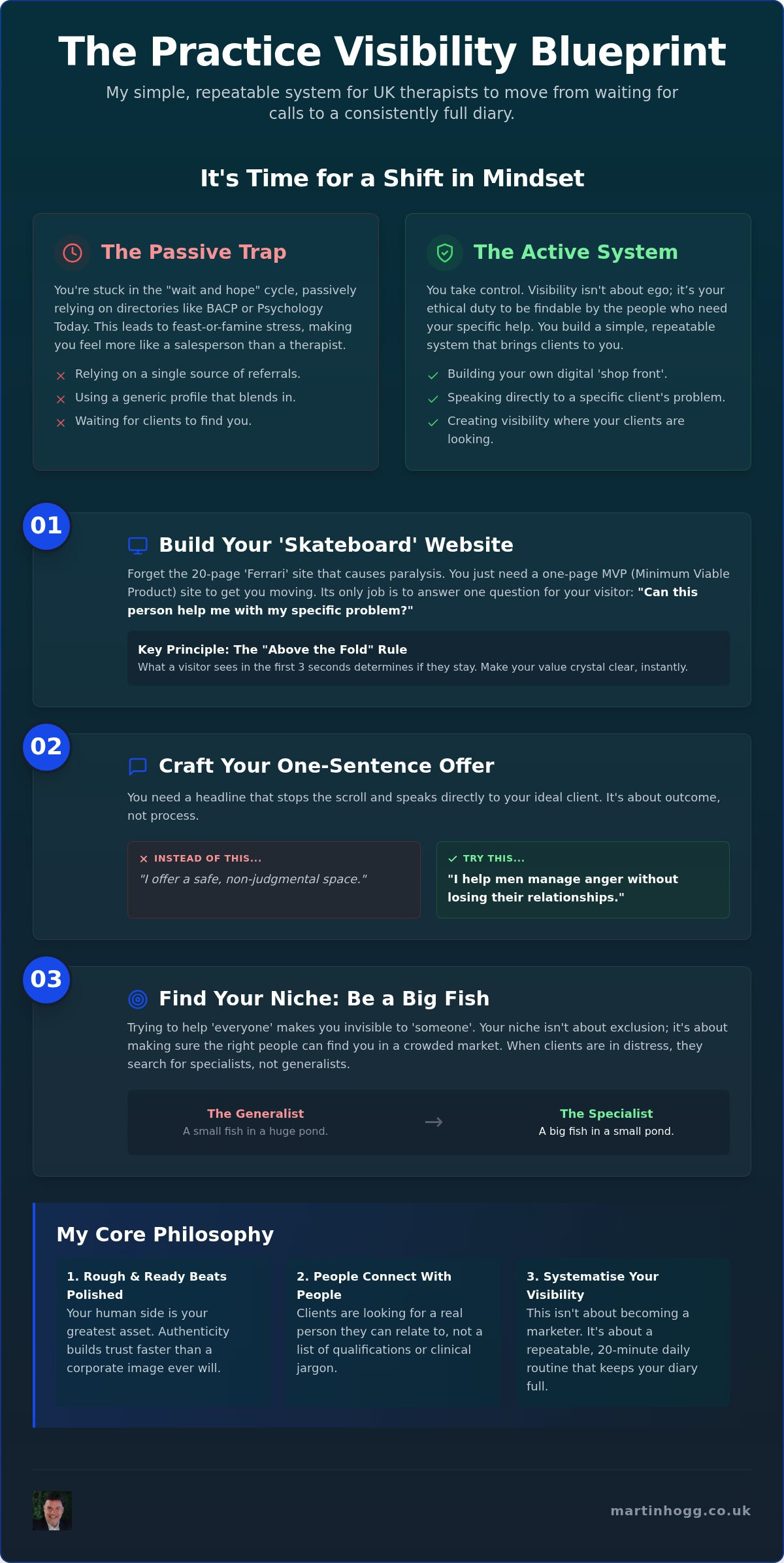
I see so many talented counsellors sitting by a silent phone, hoping the BACP directory or Psychology Today will do the heavy lifting for them. It’s a frustrating place to be. You’ve done the hard work of training, yet you're still wondering how to get counselling clients without begging for referrals. This is the difference between "responding to clients," which is passive, and "creating visibility," which is active.
Relying on a single directory is a recipe for financial stress and, eventually, burnout. If that one algorithm changes, your business is at risk. We need to reframe how we see marketing. If someone is in pain and can’t find you, you aren't helping them. Visibility isn't about ego; it’s an ethical duty to the people who need your support.
The Myth of the Generalist
Trying to help "everyone" actually makes you invisible to "someone." When you list every possible issue on your profile, you blend into the background of thousands of other generalists. I know the fear of narrowing your focus feels like you're turning people away, but it's actually why your diary is empty. People in distress look for specialists who understand their specific pain, not a jack-of-all-trades.
Active Marketing for Therapists
Active marketing is the process of putting your specific solution in front of a specific problem. It’s about being where your clients are, whether they are looking for local face-to-face sessions or online counselling options. You don't need a film crew or a marketing degree to do this well. In my experience, "rough and ready" content that shows your human side always beats polished, corporate messaging. People connect with people, and this is the most effective way to understand how to get counselling clients who actually value your expertise.
Building Your Digital Shop Front: The Skateboard Model and One-Sentence Offer
I recommend the "Skateboard Model" for your website. Too many counsellors get stuck trying to build a Ferrari with twenty pages and complex menus before they've even had their first enquiry. You just need a one-page MVP site that gets you moving. Your website’s job isn't to list your qualifications; it's to answer one question: "Can this person help me with my specific problem?"
Remember the "Above the Fold" rule. What your visitor sees within three seconds of landing on your page determines if they stay. Use Canva to create simple, human-centric graphics. Avoid those cold, clinical stock photos of pebbles or hands holding sand. Real people want to see a real person.
Crafting Your One-Sentence Offer
You need a headline that stops the scroll. Instead of therapist clichés like "I offer a safe, non-judgmental space," try something direct. "I help men manage anger without losing their relationships" is far more effective. It tells the reader exactly what the outcome will be. If you want to dive deeper into this, I've put together some Niche Building Secrets to help you sharpen that message.
Optimising Your UK Directory Listings
Your website is your hub, but your directory listings on Psychology Today and Counselling Directory are the signposts. Don't waste your title tags on just your name. Use those characters to state your niche. This is how to get counselling clients who are searching for specific help. It's a practical way to understand how to get counselling clients without the technical headache. If you're looking for a supportive community to help you implement these systems, you might find our Private Practice Success Membership a good fit.
Niche Building: The Fastest Way to Attract Private Pay Therapy Clients
I believe that your niche isn’t just what you do; it’s who you are best equipped to serve. When private pay clients are in distress, they rarely search for a generalist. They look for specific solutions like "anger management for dads" rather than a vague "counsellor near me." This level of specificity is exactly how to get counselling clients who are motivated and ready to pay for expert help. You can find more practical advice on setting up this way in my guide to Counselling Private Practice UK.
Your own life experience or previous CPD training is often the best place to find your niche. If you've spent years working in a specific industry or have navigated certain personal hurdles, you already speak the language of that demographic. This isn't about excluding people; it’s about making sure the right people can find you in a crowded market. It’s far easier to be a big fish in a small pond than to compete with every therapist in the country.
The Ethics of Specialisation
Being a specialist is actually more ethical than being a "jack of all trades." If you try to help everyone, you risk providing a diluted service that doesn't quite hit the mark for anyone. By focusing on niches like "Working with Men" or "Anger Management," you create instant authority and safety. Clients feel understood from the first sentence of your profile, which lowers their anxiety about reaching out because they know you understand their world.
Marketing Your Niche Without the Hype
You don't need to be a "content creator" to make this work. Use simple, "rough and ready" blog posts to show your expertise in your specific field. Talk about the common struggles your clients face and offer a few grounded, practical tips. This is how to get counselling clients by building a bridge of trust before the first phone call. If you want a step-by-step system to manage this, my Practice Visibility Blueprint shows you exactly how to do it.
Systematising Your Success: The Practice Visibility Blueprint
I developed the Practice Visibility Blueprint because I saw too many talented therapists drowning in a never-ending list of marketing chores. You don't need more tasks; you need a system that works while you're in the therapy room. Consistency beats intensity every single time. Spending just 20 minutes a day on your visibility is far more effective than a weekend of panic-driven social media posting when your diary is suddenly empty.
Private practice can be a lonely old world, and that isolation often leads to self-doubt. Having a community of peers who understand the specific nuances of the UK market helps you stay grounded and motivated. It’s also about working smarter by using technology to handle the admin. By using tools like Squarespace for your "skateboard" site and Calendly for automated bookings, you remove the friction for potential clients. This frees up your mental energy to focus on the work you’re actually trained for: the therapy.
The Five Pillars of the Blueprint
The system is built on five straightforward stages that move you from invisible to in-demand:
- Identify your niche: Stop being a generalist and speak to a specific pain.
- Build your skateboard: Launch a simple, effective one-page MVP site.
- Optimise your directories: Make your BACP or Psychology Today profiles work harder.
- Create human content: Share "rough and ready" insights that build trust.
- Automate your enquiries: Let your digital system handle the first contact.
Following a clear, repeatable system removes the emotional weight of marketing by turning a scary unknown into a series of manageable steps.
Next Steps for Your Practice
If you're still wondering how to get counselling clients, remember that "done is better than perfect" in every scenario. A rough and ready one-page site that is live today is infinitely better than a twenty-page masterpiece that stays in "draft" mode for six months. Stop waiting for the perfect time to be visible. For a deeper look at the broader strategy, you can read my guide on Marketing for Therapists in the UK. This is how to get counselling clients while keeping your professional sanity intact.
Take the Next Step Toward a Full Diary
You don't need to be a tech expert or a natural salesperson to run a thriving practice. By moving away from the "wait and hope" directory trap and focusing on a specific niche, you make it easy for the right people to find you. I know it feels daunting, but a simple site and 20 minutes of daily consistency are far more powerful than a month of overthinking. This grounded approach is the most sustainable way to understand how to get counselling clients without losing your professional identity.
I've spent over 20 years in UK private practice. As a BACP-endorsed CPD provider, I've seen how things move faster when you have a supportive community behind you. You have the clinical skills to change lives. Now it's just about making sure those in pain can find your door so you can help restore their personal trajectory.
I'm here to help you bridge that gap. You've got this.
Frequently Asked Questions
How do I get counselling clients on Psychology Today UK?
I would start by changing your profile title from your name to your specific niche. Most therapists waste that space, but it's the first thing a potential client sees. If you are wondering how to get counselling clients on this platform, focus on outcomes rather than modality. Since Psychology Today costs £19.95 per month, you want that listing to work hard for you. Use professional photos to stand out.
Is it ethical for a counsellor to use marketing strategies?
I believe marketing is an ethical duty because if someone is in distress and cannot find your support, you aren't helping them. Marketing isn't about being a "salesperson" or tricking people. It is simply about making your specific solution visible to the people who are already looking for it. Being honest and clear about who you can serve is the most ethical thing a private practitioner can do.
How much should a private practice therapist spend on advertising?
I wouldn't recommend spending hundreds on Google Ads until your organic visibility is sorted. Most therapists can build a full diary just by investing in a few key directories and a basic website. A typical budget might include £24.50 monthly for the Counselling Directory and about £17 per month for a Squarespace site. Focus on small, consistent investments in your own digital shop front before paying for expensive "clicks."
What is the best way to get private pay therapy clients without using directories?
The best way to understand how to get counselling clients without relying on directories is to create "rough and ready" content. Write simple blog posts or record short videos that address the specific pains of your niche. When you share these on platforms where your ideal clients hang out, you build trust before they even visit your site. This active approach creates a steady stream of enquiries that you actually own.
Do I need a complicated website to get counselling clients?
You definitely don't need a complicated website to be successful. I always suggest the "skateboard model," which is a simple, one-page site that answers the visitor's main questions immediately. A basic Squarespace plan is usually enough to get you moving. Your site just needs a clear one-sentence offer, a photo of you, and an easy way to book, like a Calendly link. Perfectionism only leads to empty diaries.
Disclaimer
The information provided on this blog is for general informational purposes only. It is also not intended to be a substitute for professional medical or mental health advice, diagnosis, or treatment. Reading this content does not create a therapist-client relationship.


