The Role of Local Marketing in Practice Growth: A Guide for UK Counsellors
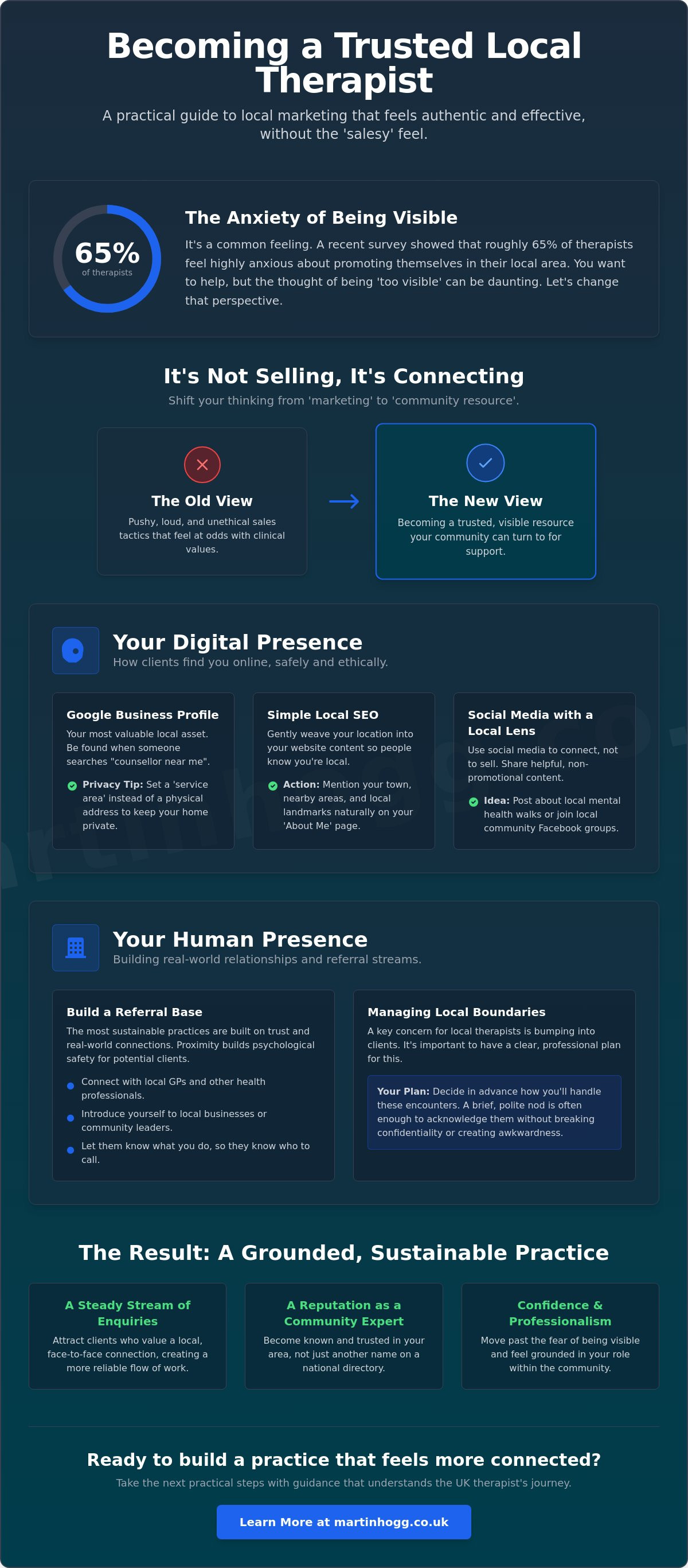
Did you know that roughly 65% of therapists feel highly anxious about promoting themselves in their own local area? (Source: vertexaisearch.cloud.google.com, April 2026). It's a common struggle, yet understanding the role of local marketing in practice growth is the key to moving from a place of isolation to one of steady, sustainable connection. You want to be found by those who need you most, but the thought of being too visible often feels daunting or even a bit exposed.
I know many of us feel that marketing is almost unethical or at odds with our clinical values. You likely entered this profession to offer a quiet space for healing, not to shout from the rooftops or get lost in technical jargon. It's completely natural to feel that tension. However, reaching out to your community doesn't have to be pushy, corporate, or loud.
In this guide, I will show you how to become a trusted, visible resource within your community without losing your professional integrity. We will look at how to secure a steady stream of local enquiries and build a reputation as a grounded community expert. You can create a practice that feels connected and sustainable, and I am here to help you take those first practical steps.
Key Takeaways
- Understand why building deep trust within your immediate community is more effective for your practice than trying to compete on a national level.
- Learn how to use local keywords and Google settings to stay visible to those nearby without compromising your personal home privacy.
- Discover the ethical way to build referral bases with GPs and local businesses, ensuring you have a steady stream of enquiries.
- See how understanding the role of local marketing in practice growth can help you move past the fear of being 'too visible' in your own town.
- Gain a clear plan for managing boundaries so you feel confident and professional when you happen to bump into clients in your daily life.
What is Local Marketing for Therapists and Why Does it Matter?
When we talk about marketing, it often conjures up images of pushy sales tactics or cold, digital algorithms. For a counsellor, this can feel quite jarring. However, local marketing is something much more grounded. At its core, What is Local Marketing? is simply the process of positioning your practice as a primary mental health resource for your immediate neighbours. It is about being the person the community naturally turns to when they are struggling.
Understanding the role of local marketing in practice growth helps you shift from being a hidden secret to a visible, reliable presence. It isn't about shouting for attention. Instead, it is about creating a sense of "place." People seeking therapy often look for a shared community context. They want to know that you understand the local area, the local schools, and the general pace of life where they live. This shared background builds a foundation of trust before they even step into your room.
This approach requires a mindset shift. You aren't "selling services" in the traditional sense. You are providing a community resource. When you view your visibility as a way to help people find the support they need, the ethical weight of marketing begins to lift. Local visibility also acts as a natural filter. It attracts clients who specifically value face-to-face work or a therapist who is rooted in their own geography.
The Trust Factor in Local Practice Growth
Proximity breeds a unique kind of psychological safety. When a potential client knows you are just down the road, the "barrier to entry" feels much lower. There is a quiet comfort in knowing a therapist is part of the community fabric. It makes the prospect of starting therapy feel less like an intimidating medical appointment and more like a local connection. This familiarity is a powerful tool for practice growth because it reduces the hesitation many people feel when reaching out for the first time.
Marketing for Therapists UK: Beyond the Directory
Many of us start by listing our name on a national directory. While these sites have their place, relying on them alone can feel like being a small fish in a very large, anonymous pond. To create a sustainable practice, you need a strategy that goes deeper than a simple profile page. A holistic approach to marketing for therapists uk involves connecting with your town both online and offline. This ensures you aren't just a name on a list, but a known and trusted professional in your own right.
Establishing Your Digital Presence in the Local Community
Your digital presence is often the first point of contact for a person in distress. It acts as a digital shop window. When you are looking to attract new customers locally, your Google Business Profile is your most valuable asset. Many counsellors worry about privacy, especially if they work from home. You don't have to display your full home address. By setting a "service area" instead of a specific pin, you can remain visible in local searches while keeping your front door private.
The role of local marketing in practice growth is about being found at the exact moment someone types "counsellor near me" into their phone. Using Google Maps helps clients find your physical location easily, reducing the anxiety of their first visit. It's about making the journey to your chair as smooth as possible. We must also consider the ethics of "star ratings." The BACP and other UK bodies generally advise against soliciting testimonials from clients. Instead, focus on providing clear, factual information about your location and services to build professional credibility.
Local SEO for Therapists: Simple Steps
Integrating local keywords doesn't mean stuffing your website with town names. It's about naturally mentioning your area and surrounding neighbourhoods. Try writing a location-specific "About Me" page. Mentioning local landmarks or community values shows that you aren't just a distant voice on a screen. If you feel overwhelmed by the technical side, I've put together a guide on SEO for therapists to help you get the basics right.
Social Media with a Local Lens
Social media can often feel like a shouting match. To avoid the "salesy" trap, use local hashtags or join community groups to share helpful, non-promotional content. Sharing a post about local mental health awareness or a local walk can position you as a human being who cares about the area. This builds a bridge of trust before a client even picks up the phone. If you'd like to explore how to do this alongside other practitioners, you might find our Private Practice Success membership a helpful place to start.
The Human Side: Networking and Local Referral Bases
While digital visibility is vital, the most enduring practices are often built on real-world relationships. In my experience, the role of local marketing in practice growth is most effective when it happens away from a computer screen. Think about your local GP surgery or health centre. These professionals are frequently overwhelmed and looking for trusted, local places to signpost people. An ethical introduction, perhaps a simple letter or a brief meeting to explain your specific niche, positions you as a helpful solution rather than someone just looking for business.
You can also look toward complementary professionals in your area. Yoga studio owners, HR managers in local firms, or solicitors handling family law are often on the front lines of people's major life transitions. They aren't your competitors; they are your allies. Unlike some business models that suggest "neighbourhood discounts," which can feel quite unethical in a therapeutic context, a professional partnership is built on mutual respect. This human connection is a core part of building a counselling private practice uk that feels both grounded and sustainable.
When you understand the role of local marketing in practice growth, you see that it's actually about service. By offering a short, helpful talk at a local charity or a community hub, you aren't "selling." You are sharing your expertise to help people who might be struggling. This "Local Expert" strategy builds your authority and ensures that when someone in your town thinks of mental health support, your name is the one that naturally comes to mind.
Creating a Local Referral Loop
Once a referral comes in, the professional relationship needs nurturing. While you must never break client confidentiality, a professional "thank you" to the referrer (with the client's permission where appropriate) keeps the communication loop open. Being a "known entity" in your local professional network means people think of you first because they trust your reliability. It's about being a steady presence in a busy world.
Community Engagement Without Burnout
You don't need to be everywhere at once. That's a quick route to exhaustion. Instead, choose one or two local hubs to focus on. Perhaps there is a specific community centre or a local business group where you feel comfortable. Balancing your clinical work with this kind of visibility is much easier when you aren't spreading yourself too thin. If you'd like to learn how to build these connections without feeling overwhelmed, I invite you to join our Private Practice Success membership where we support each other in growing our practices ethically.
Overcoming the Fear of Being 'Seen' Locally
It is perfectly normal to feel a prickle of anxiety when you start putting yourself out there. Many of us grapple with imposter syndrome, questioning whether we are truly the "experts" our town needs. I want to reassure you that your community isn't looking for a perfect academic. They are looking for a real person who understands their local context and can offer a safe space. When you embrace the role of local marketing in practice growth, you are simply helping those in need find the right door to knock on.
The secret to reducing the fear of being "too pushy" is to reframe marketing as an act of service. If you have a skill that can ease someone's suffering, staying hidden isn't actually helping anyone. By moving your focus away from yourself and onto the person who is struggling in the next street over, the process becomes much more comfortable. It stops being about "selling" and starts being about providing a vital community resource.
Maintaining Professional Boundaries
A common worry is the "supermarket encounter." What happens if you see a client at the school gate or the local Co-op? It's a valid concern. Setting clear boundaries from the start is essential. Most clients are just as keen to maintain their privacy as you are. A simple, pre-agreed acknowledgement or even a polite, neutral nod is often all that is required. You can remain a visible part of your community while keeping your clinical space entirely separate and sacred.
Your Next Steps for Growth
If you feel ready to move forward but aren't sure where to start, I recommend looking at a structured approach. The Practice Visibility Blueprint is designed to break this process down into small, manageable steps that won't feel overwhelming. It's about building your practice at a pace that feels right for you. You can also view my upcoming training calendar to see when I am running live sessions. These workshops offer a safe place to discuss visibility and get practical support from peers who are on the same journey.
Creating a Practice That Truly Connects
Growing a practice doesn't have to feel like a lonely or overwhelming task. We have looked at how a well-managed digital presence and genuine, human networking can transform your reach. By reframing your visibility as a way to serve those in your immediate area, you can move past the fear of being "too seen" and focus on the help you provide. Your local community is waiting for exactly the kind of support you offer.
Understanding the role of local marketing in practice growth is about more than just numbers; it's about becoming a reliable pillar of support in your town. I've spent over 20 years in the UK counselling sector helping therapists just like you find their feet. My goal is always to provide practical, jargon-free business coaching that respects your clinical ethics and your personal boundaries. You don't need to be a marketing expert to have a full and thriving practice.
If you're ready to stop feeling isolated and start building a sustainable practice, I'd love to support you. Through our community, you can access BACP-endorsed workshops and accredited CPD designed specifically for our profession. Join the Private Practice Success community to grow your local visibility today. You have the skills to change lives; let's make sure your neighbours know where to find you.
Frequently Asked Questions
Is local marketing ethical for UK counsellors under BACP guidelines?
Yes, local marketing is entirely ethical provided you follow the BACP Ethical Framework regarding honesty and accuracy. You should avoid making exaggerated claims or using pressure tactics that might exploit a person's vulnerability. Instead, focus on providing clear, factual information that helps people make an informed choice. When you understand the role of local marketing in practice growth, you see it as a way to signpost your community to professional support rather than a cold sales exercise.
How do I use Google Business Profile if I work from a home office?
You can use a Google Business Profile without revealing your exact home address by setting yourself as a "Service Area Business." During the setup, simply choose the specific towns or boroughs you cover and leave the physical street address hidden from the public view. This allows you to appear in local search results and on maps while maintaining your personal privacy and safety. It's a practical way to balance visibility with professional boundaries.
Can I ask local clients for reviews to help my practice grow?
You should avoid asking current or former clients for reviews, as most UK professional bodies consider this an ethical boundary violation. Soliciting testimonials can put undue pressure on the therapeutic relationship and potentially compromise client confidentiality. Instead of reviews, focus on building your reputation through professional networking and providing high-quality, helpful content. This builds trust naturally without compromising the integrity of your clinical work or the safety of your clients.
How do I approach a local GP surgery about my private practice?
The best way to approach a GP surgery is to offer yourself as a helpful solution to their high patient demand. Send a professional, concise letter or an email addressed to the Practice Manager or the Mental Health Lead. Explain your specific niche and how you can help patients who might be facing long NHS waiting lists. This grounded approach highlights the role of local marketing in practice growth as a collaborative effort within the local healthcare ecosystem.
What are the best local directories for UK therapists beyond the obvious ones?
Look beyond the national directories and consider listing your practice on local community hub websites or council-run service directories. Many towns have specific wellbeing or support lists managed by local charities or volunteer groups. You might also look for niche-specific directories that focus on your particular area of expertise, such as a local business association. These smaller, hyper-local platforms often carry significant trust with residents and can be more effective than broad, national sites.

Article by
Martin Hogg
I help Private Practice counsellors in the UK set up and grow an ethical Private Practice they love, work with their ideal clients, and earn the income they deserve. All without guesswork and burnout. I have been a private practice counsellor myself for over 20 years, specialising in anger management. I set up a not-for-profit social enterprise, Citizen Coaching and Counselling, which delivers thousands of counselling sessions a year to adults and young people in Birmingham. I am a registered BACP Counsellor and the author of three books, My Anger Coach, My Anxiety Coach and My Relationship Coach. These are available on Amazon.
Disclaimer
The information provided on this blog is for general informational purposes only and is not intended to be a substitute for professional medical or mental health advice, diagnosis, or treatment. Reading this content does not create a therapist-client relationship.


