
The Ultimate Private Practice Checklist for Therapists UK: From Setup to Success

Article by
Martin Hogg
I help Private Practice counsellors in the UK set up and grow an ethical Private Practice they love, work with their ideal clients, and earn the income they deserve. All without guesswork and burnout. I have been a private practice counsellor myself for over 20 years, specialising in anger management. I set up a not-for-profit social enterprise, Citizen Coaching and Counselling, which delivers thousands of counselling sessions a year to adults and young people in Birmingham. I am a registered BACP Counsellor and the author of three books, My Anger Coach, My Anxiety Coach and My Relationship Coach. These are available on Amazon.
What if the biggest hurdle to your new career isn't your clinical ability, but a legal requirement you didn't know existed? I've spoken to so many talented counsellors who are held back by the fear of getting "found out" because they haven't ticked the right box. It's a heavy weight to carry when you just want to get on with the work of helping people. You shouldn't have to feel like an imposter in your own business just because of some admin.
I understand that anxiety. This private practice checklist for therapists uk is my way of handing you the map I wish I'd had. I will walk you through the essential clinical, legal, and marketing steps to launch a sustainable practice without the typical overwhelm. We'll cover everything from BACP requirements and ICO fees to building a simple "skateboard" website that actually works. By the end, you'll have a clear roadmap to follow and the quiet confidence that your practice is both legit and ready for a steady stream of clients.
Key Takeaways
- Follow this private practice checklist for therapists uk to tick off the essential legal and clinical boxes, ensuring your practice is professional and fully protected from day one.
- Stop trying to be everything to everyone; instead, define your niche and use a "One-Sentence Offer" to clearly explain exactly how you help your ideal clients.
- Set up simple, efficient systems for banking and payments, using tools like Starling and Stripe, to spend less time on paperwork and more time in the chair.
- Build a sustainable future for your practice by creating a strategic referral network and a CPD calendar that actually supports your specific clinical goals.
Clinical and Legal Foundations: The Non-Negotiables
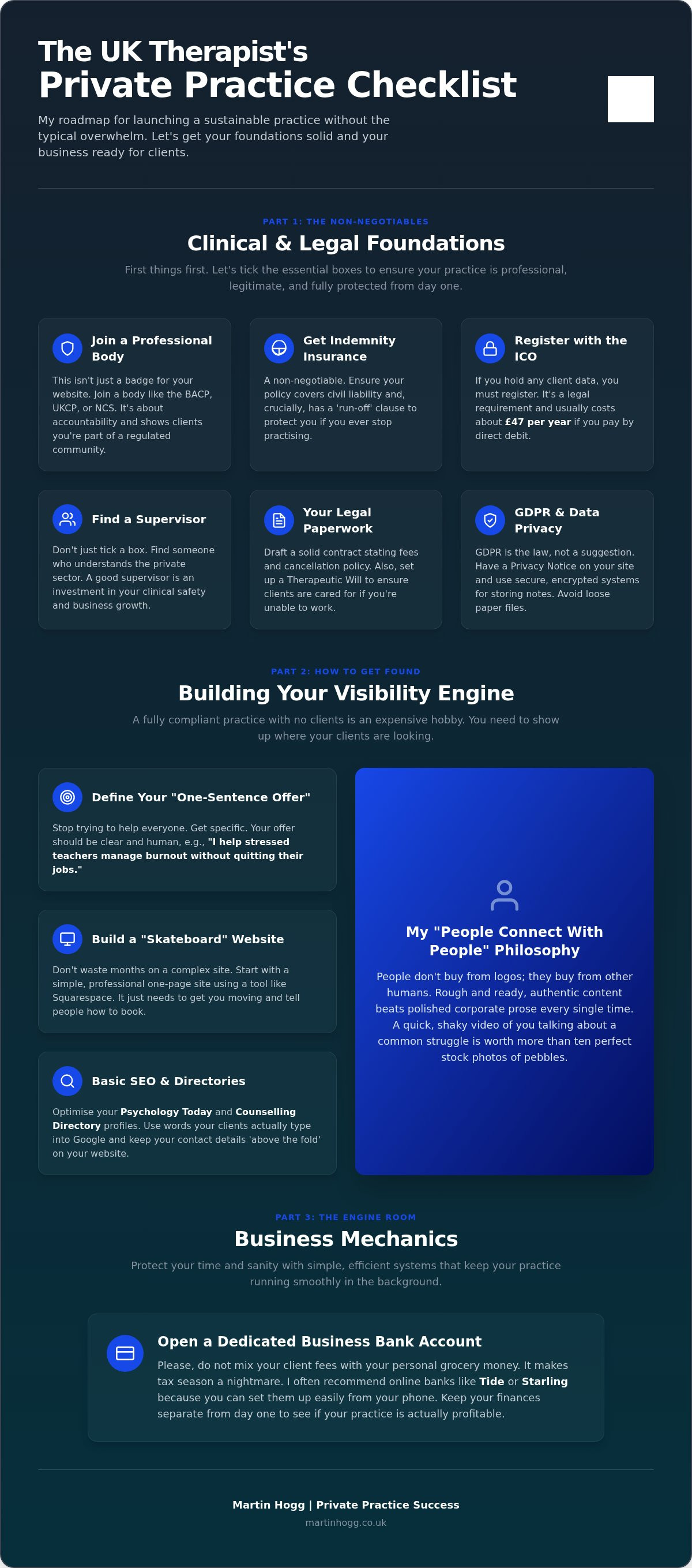
Setting up shop starts with credibility. You need to be part of a professional body like the BACP, UKCP, or NCS. This isn't just about a badge on your website; it's about joining the regulated community of Psychotherapy in the United Kingdom. It tells clients you're accountable. Next, get your Professional Indemnity Insurance sorted. For 2026, ensure your policy specifically covers civil liability and has a "run-off" clause to protect you if you ever stop practising.
Don't forget the ICO. If you're holding client data, you must register with the Information Commissioner's Office. It usually costs about £47 a year if you pay by direct debit, and it's a non-negotiable part of your private practice checklist for therapists uk. Also, find a supervisor who understands the private sector. You want someone who supports your clinical safety while encouraging your business growth. A good supervisor is an investment, not just a box to tick.
The Legal Paperwork You Need
You need a solid contract. It should clearly state your fees, cancellation policy, and boundaries. This protects your income and sets the tone for the therapeutic relationship from the very first session. I also strongly suggest setting up a "Therapeutic Will." It’s a bit grim to think about, but it ensures your clients are cared for and your family isn't left with a mess if you're suddenly unable to work.
GDPR and Data Privacy
GDPR is the law, not a suggestion. You need a Privacy Notice on your website before you take your first enquiry. For storing notes, avoid loose paper or unencrypted files. I often point people toward the Counsellor Efficiency Bundle to get these systems right from the start. It keeps you compliant and stops the admin from piling up.
Building Your Visibility Engine: How to Get Found
Most guides stop at the legal paperwork. That’s a mistake. A fully compliant practice with no clients is just an expensive hobby. You need a visibility engine. This is a vital part of your private practice checklist for therapists uk. You can't just build it and hope they come; you have to actively show up where your clients are looking.
Start by narrowing your focus. If you try to help everyone, you'll reach no one. You need a "One-Sentence Offer" that tells people exactly what you do. For example: "I help stressed teachers manage burnout without quitting their jobs." It's clear and human. If you're struggling to narrow it down, have a look at Niche building for counsellors.
Don't waste months on a complex website. Use the "skateboard model", a simple, one-page Squarespace site that gets you moving. It just needs to look professional and tell people how to book. Optimise your profiles on Psychology Today and the Counselling Directory too. Clicks happen when you stop sounding like a textbook and start sounding like a person.
The "People Connect with People" Philosophy
People don't buy from logos; they buy from humans. Rough and ready content beats polished corporate prose every time. A quick, shaky video of you talking about a common struggle is worth ten stock photos of pebbles. Use Canva to keep your human centred social media posts consistent, but keep them authentic. People want to see the person they'll be sitting across from.
Basic SEO for Therapists
You don't need to be a tech wizard. Just get your title and description tags right. Use words your clients actually type into Google. This is a crucial step in your private practice checklist for therapists uk. Keep your most important info "above the fold", which is the part of the screen people see without scrolling. If they have to hunt for your contact details, they'll leave.
If you're feeling stuck on how to put this together, you might find my Private Practice Success Membership helpful for getting those first few clients through the door.
Business Mechanics: Taking Payments and Managing Time
Running a business is a different skill set from being in the therapy room. You need an engine room that keeps things ticking over without you having to poke it every five minutes. This part of your private practice checklist for therapists uk is about protecting your time and your sanity. If your systems are clunky, you'll end up resentful of the admin before you've even seen your third client of the day.
Start by opening a dedicated business bank account. I often recommend Tide or Starling because they are incredibly easy to set up from your phone. Please don't mix your client fees with your personal grocery money. It makes tax season a nightmare and makes it much harder to see if your practice is actually profitable. Keep it separate from day one.
When it comes to getting paid, I prefer Stripe or GoCardless over old-fashioned bank transfers. It removes that awkward "did you send the money?" conversation at the start of a session. Automate your diary with a tool like Calendly too. It stops the endless back and forth emails trying to find a time that works for both of you. Finally, be a friend to your future self and set aside 20 to 30 percent of every fee for HMRC. They won't forget you, so don't forget them.
Managing Your Practice Efficiently
You have a choice between complex practice management software or a simpler bespoke system. Many therapists find the big platforms too clunky or expensive for a solo practice. I created the Counsellor Efficiency Bundle to provide a middle ground that saves you hours of admin without the steep learning curve or monthly subscription fees.
Setting Your Fees
Your fee needs to cover more than just the hour in the chair. You have to account for room rent, insurance, and your own professional development. Many therapists struggle with "money shame" when setting rates, but undercharging is the fastest way to burnout. Charge what you're worth so you can stay in this profession for the long haul.
Sustainable Growth: Beyond the Initial Launch
Once you've ticked off the essentials on your private practice checklist for therapists uk, the real work shifts toward longevity. It’s about keeping the momentum going without losing your clinical spark. Don't just pick CPD because it looks interesting; pick it because it deepens your specific area of expertise. When you're known for something specific, like niche building for counsellors, your marketing becomes much more effective. Local practitioners and GPs often need trusted colleagues for their own overspill, so start building that referral network early.
You need to monitor your "Practice Visibility" regularly. If you aren't getting enough enquiries, something in your engine needs a tweak. Don't try to do this alone. Solo work can be incredibly isolating, which is why joining a community like the Private Practice Success Membership is a smart move. It keeps you grounded and provides a safe space to share the wins and the inevitable wobbles of being your own boss.
Avoiding Burnout
Setting healthy boundaries is the only way to stay in this game for the long haul. Decide your working hours and stick to them. Don't reply to emails at 11 pm just because you feel you should. It's better to have a slightly slower response time than to be a therapist who is too exhausted to actually listen. Focus on the quality of your work rather than the quantity of hours you're available.
Your Next Steps
The first 10 clients are always the hardest to find. Once you have them, your practice starts to feel real. This is when you move from a "Solo" mindset to a "CEO" mindset. You're no longer just a therapist; you're a business owner. Keep referring back to your private practice checklist for therapists uk to ensure your foundations stay strong as you grow. It's a journey of constant refinement, but with the right community behind you, it's one you can handle with confidence.
Ready to Build Your Future?
You now have the map. From legal must-haves like ICO registration to the "skateboard" website that actually gets you found, you have the tools to start. Building a practice is about more than just clinical skill; it's about creating a sustainable business that lets you do the work you love. This private practice checklist for therapists uk is your foundation, but the real magic happens when you stop planning and start doing.
I've spent over 20 years in the UK therapy sector, moving from my social enterprise roots to being a BACP-endorsed workshop leader. I know exactly how isolating this journey can feel when you're on your own. You don't have to figure this out in a vacuum. The path is there, and the clients are waiting.
It's time to take that first step with confidence. Your future practice is waiting for you to begin.
Frequently Asked Questions
Do I need to register as a limited company to start a private practice in the UK?
No, you don't need to be a limited company. Most therapists start as sole traders because the admin is far lighter. You just register for Self-Assessment with HMRC. For the 2026-2027 tax year, your deadline to file and pay is 31 January 2028. You can always switch to a limited company later if your turnover grows, but keeping it simple at the start is usually the best move.
How much does it typically cost to set up a private therapy practice?
You can get started for less than you might think. Essential costs on your private practice checklist for therapists uk include the ICO fee at £47 and BACP membership at £196. Professional indemnity insurance starts from about £69 per year. When you add in directory listings like Psychology Today at £19.95 a month, your initial investment is often under £500. It's a small price for a professional launch.
Is it better to rent a therapy room or work from home?
It depends on your boundaries and budget. Working from home saves you a fortune in rent, but you need a dedicated, private space that doesn't feel like your lounge. Renting a room adds overhead but provides a clear work environment and a professional address. Many therapists start with a skateboard approach by working from home or renting by the hour before committing to a full-time lease.
What insurance do I need for online therapy with UK clients?
You need Professional Indemnity Insurance that explicitly covers remote work. Most standard UK policies for 2026 include online therapy as long as you're working with clients in the UK. If you plan to see people overseas, especially in the US or Canada, you must check your policy carefully. Always verify that your cover meets the current BACP or UKCP requirements for digital practice to stay fully protected.
How many clients do I need to make a full-time living in private practice?
To make a full-time living, most therapists aim for 15 to 20 client hours a week. With average UK session rates between £50 and £90 in 2026, this allows for a decent income while leaving room for admin and CPD. If you follow a solid private practice checklist for therapists uk, you'll account for the 20 to 30 percent you need to save for tax and your business overheads first.
Disclaimer
The information provided on this blog is for general informational purposes only. It is also not intended to be a substitute for professional medical or mental health advice, diagnosis, or treatment. Reading this content does not create a therapist-client relationship.


