
Therapist Burnout: A Practical Guide to Recovery for UK Private Practitioners
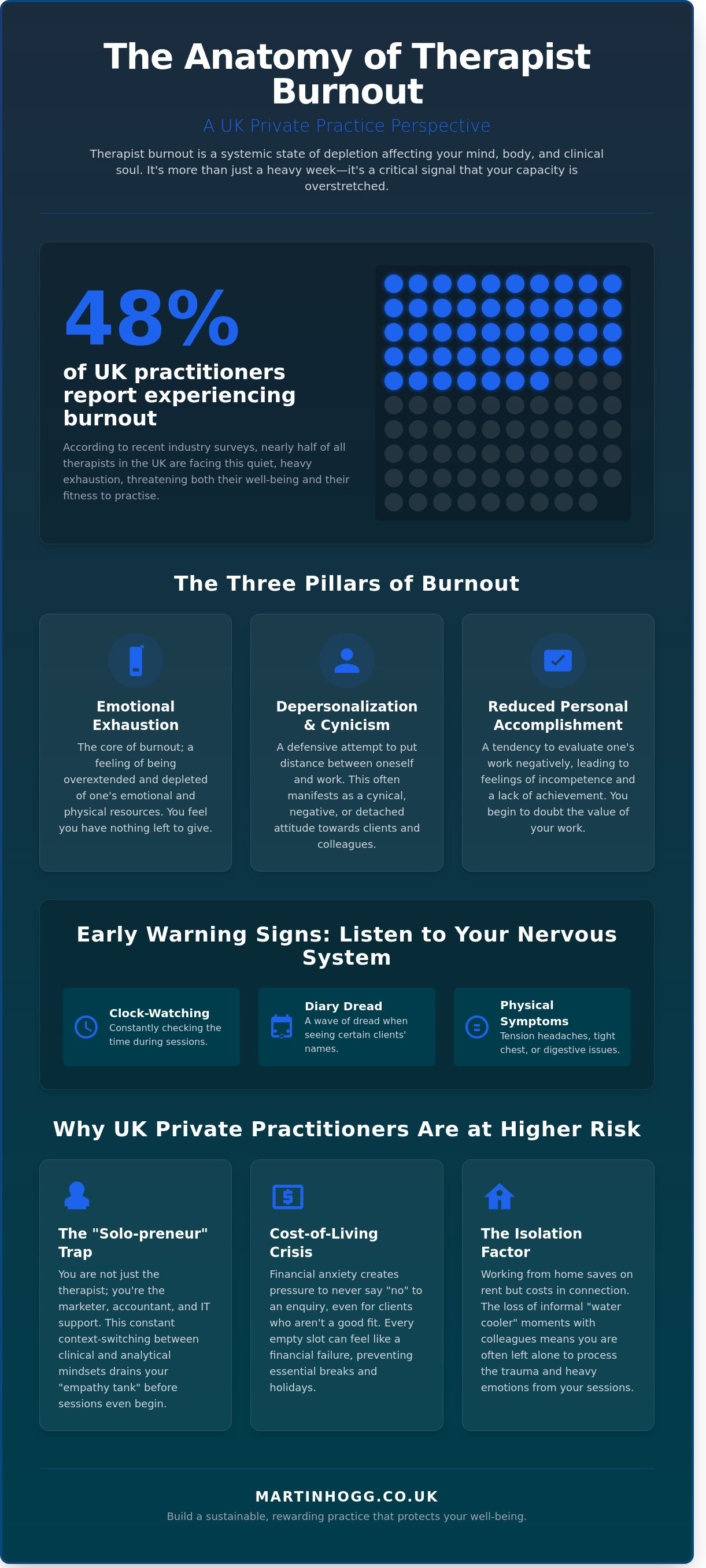
Last Tuesday at 6:00 PM, a seasoned counsellor in Birmingham sat in his car for twenty minutes after his final session, unable to find the energy to drive home. He felt completely drained, isolated, and increasingly anxious about his £1,200 monthly overheads despite carrying a full caseload. This quiet, heavy exhaustion is the hallmark of therapist burnout, a condition that affects 48% of practitioners in the UK according to recent industry surveys.
You likely started your practice to help people find their way back to health, but it's incredibly difficult to hold space for others when you're running on empty yourself. It's frustrating to feel like you're failing the very people you're meant to support because your own battery is flat. I'll show you how to recognise the early warning signs of compassion fatigue and build a sustainable, rewarding practice that protects your well-being. We'll explore practical ways to set firmer boundaries with clients, manage the isolation of working from home, and create a business model that doesn't rely on overworking to stay financially secure.
Key Takeaways
- Learn to recognise the three specific signs that distinguish true exhaustion from the everyday pressures of clinical work.
- Understand how the "solo-preneur" trap and the current UK cost-of-living crisis can quietly undermine your financial and emotional stability.
- Challenge the myths around resilience and see why traditional self-care often isn't enough to help a struggling practitioner.
- Gain practical steps to audit your current caseload and set the firm boundaries required to protect your well-being.
- Discover how a structured business model can move you out of survival mode and provide a lasting defence against therapist burnout.
Recognising the Signs of Therapist Burnout in Your Daily Life
We often tell our clients that change starts with awareness, yet we are frequently the last people to notice when our own well-being is slipping. In my experience supporting practitioners across the West Midlands, I've seen how easily we dismiss our own exhaustion as just part of the job. But therapist burnout is far more than a heavy week or a need for a long weekend. It is a systemic state of depletion that affects your mind, your body, and your clinical soul.
The psychological community generally identifies three distinct pillars of this condition. First is emotional exhaustion, where you feel you have nothing left to give. Second is depersonalisation, which often manifests as a cynical or detached attitude toward clients. Finally, there is a sense of reduced personal accomplishment, where you begin to doubt the value of your work entirely. To understand the history and psychological models of this state, it helps to look at What is Occupational Burnout and how it differs from general work-related stress.
You might notice subtle red flags before the full weight hits you. Perhaps you find yourself checking the clock five times during a fifty-minute session. You might feel a sudden wave of dread when a specific client’s name appears in your diary. These aren't signs of being a "bad" therapist; they are signals from your nervous system that your capacity is overstretched. Ignoring these signs can lead to serious ethical implications. Both the BACP and UKCP Ethical Frameworks require us to maintain our fitness to practise. A 2022 study by the British Psychological Society indicated that 40% of psychological practitioners reported high levels of work-related exhaustion, suggesting that if you are feeling this way, you are certainly not alone.
Emotional Exhaustion vs. Compassion Fatigue
Therapists are uniquely vulnerable to secondary traumatic stress because our "tools" are our own empathy and presence. Emotional exhaustion is that heavy, leaden feeling in your limbs that doesn't lift after a Sunday lie-in. While compassion fatigue specifically involves the cost of caring for those in pain, burnout is often about the environment and the volume of work. You might notice your physical health declining first. Tension headaches, a tight chest, or digestive issues are common physical markers that your body has reached its limit before your mind is willing to admit it.
The "Quiet" Symptoms: Cynicism and Withdrawal
The most painful part of therapist burnout is often the loss of professional curiosity. You might find yourself feeling irritated by a client’s "stuckness" or feeling a sense of "here we go again" during a session. This cynicism is a defence mechanism designed to protect you from further emotional drain. It often leads to withdrawal, such as a sudden urge to cancel your Friday afternoon sessions or a growing pile of clinical notes that you simply cannot bring yourself to start. Recognising these "quiet" symptoms is the first step toward getting your life back on track and reclaiming the joy in your practice.
Why UK Private Practitioners are at Higher Risk
Moving from an NHS setting or a large charity into private practice often feels like a breath of fresh air. You finally have the autonomy you craved. However, this independence comes with a hidden tax. In the UK, the majority of private counsellors operate as "solo-preneurs." This means you aren't just the person in the therapy chair. You're also the head of marketing, the lead debt collector, and the IT department.
The weight of these multiple roles is a primary driver of therapist burnout. When you spend three hours wrestling with a spreadsheet or trying to understand Google Ads, you're using the same cognitive energy you need for your clients. By the time your 2:00 PM appointment arrives, your "empathy tank" is already half empty. This constant switching between the analytical business mind and the receptive therapeutic mind is exhausting.
The UK cost-of-living crisis adds another layer of grit to the gears. With inflation impacting household budgets, many therapists feel a quiet desperation to never say "no" to a new enquiry. You might find yourself taking on clients who aren't a good fit or working late into the evening because the 2024 energy price cap increases make every empty slot feel like a financial failure. This financial anxiety often prevents us from taking the very breaks that keep us sane.
The Isolation of the Home-Based Practice
Working from a spare room or a garden office in Birmingham or London might save on rent, but it costs you in connection. We've lost the "water cooler" moments where we could offload a heavy session with a colleague. Instead, you're left alone with the trauma you've just witnessed. Research on Psychotherapist Burnout shows that a lack of social support is a major predictor of emotional exhaustion. Without a commute, there's no "buffer state" between a client's crisis and your family dinner. You're holding deep trauma in the same space where you're supposed to relax. I always suggest a "psychological commute" to my peers. Even a ten-minute walk around the block after your last session can signal to your brain that the work day is over.
Regulatory and Ethical Pressures in the UK
The path to BACP or UKCP accreditation is a long road. The pressure to clock up 450 hours or maintain rigorous CPD can feel like a sword of Damocles hanging over your head. When you work without a multi-disciplinary team, every ethical dilemma feels twice as heavy. You don't have a senior lead to pop in on; you only have your supervision, which might be weeks away. This isolation fuels "Imposter Syndrome." You start to worry that you're the only one struggling, which drives you to overwork to prove your worth. If you're feeling overwhelmed by the business side of things, I offer practical support for therapists to help get your practice back on a sustainable track. We need to remember that we're humans first and practitioners second. You can't pour from an empty cup, no matter how many credentials you have on your wall.
Common Myths About Resilience and Self-Care
If you find yourself feeling drained at the end of a Tuesday afternoon, your first instinct might be to blame your own lack of grit. We have been told for years that if we just practised what we preached, we would be immune to the heavy emotional toll of this work. This is a dangerous myth. In reality, therapist burnout is rarely about a lack of personal resilience. It is often a predictable response to an unsustainable way of working. A 2022 study published in the Journal of Clinical Psychology indicated that over 50% of mental health professionals experience high levels of exhaustion. This is not a personal failing. It is a professional signal that something in your environment needs to change.
We need to stop viewing burnout as a sign that you are a "bad" therapist. In fact, the most dedicated practitioners are often the most at risk because they care so deeply. Perfectionism in your practice, such as the belief that you must have the answer for every client or that every session must be a breakthrough, leads directly to emotional depletion. When you hold yourself to an impossible standard, you stop being a human being and start trying to be a machine. Machines don't feel empathy, but they also don't get tired. You are not a machine. Acknowledging your limits is actually a sign of professional maturity, not weakness.
Understanding how to avoid burnout as a therapist starts with acknowledging that your empathy is a finite resource. It is not a bottomless well that you can draw from indefinitely without consequence. By reframing these struggles as a natural part of the career cycle, you can begin to look for practical solutions rather than sinking into a cycle of shame or imposter syndrome.
The Problem with "Bubble Bath" Self-Care
The term self-care has been hijacked by marketing that suggests a scented candle or a long bath can fix a systemic issue. These things are pleasant, but they are temporary relaxations, not long-term recovery. If your practice is structured in a way that ignores your needs, no amount of pampering will save you. We should move towards "Radical Self-Maintenance." This means viewing your well-being as a professional duty. It involves making structural changes, such as ensuring you have a 15-minute gap between every client or reviewing your fee structure so you don't have to see 30 clients a week just to pay the bills in Birmingham. Real self-care is often boring. It looks like setting boundaries, doing your admin on time, and saying no to referrals that aren't a good fit.
Addressing the "Healer" Archetype
Many of us entered this profession because we identify as "healers," often rooted in our own past experiences. While the "wounded healer" identity can provide deep empathy, it becomes a trap if it prevents you from seeking help. There is a persistent myth that a "good" therapist should have their own life perfectly sorted. This prevents many from being honest in supervision. You must normalise the need for your own therapy and high-quality supervision. Under BACP guidelines, the minimum requirement is 1.5 hours of supervision per month, but when you are struggling, you might need more. Discussing therapist burnout with your supervisor should be a safe, non-judgemental process. If you feel you can't be honest with them, that is a sign you might need a different supervisory relationship that prioritises your humanity as much as your clinical skills.
Practical Strategies to Protect Your Practice and Well-being
Preventing therapist burnout isn't about taking more holidays; it's about how you manage the 1,680 minutes available to you each week. I've worked with hundreds of practitioners who feel like they're on a treadmill that's moving just a bit too fast. A 2023 survey of UK counsellors found that 52% of respondents felt their workload was unmanageable at least once a month. To stay in this profession for the long haul, you need a structure that protects your mental space as fiercely as you protect your clients.
Start with a caseload audit. Not every client requires the same emotional output. I recommend using a simple system to categorise your current list. This isn't about the client's personality, but rather the energy required to hold their story. When you see your week laid out visually, you can start to make clinical decisions that support your longevity.
Managing Your Energy, Not Just Your Time
The "Red, Amber, Green" system is a practical tool I use to prevent exhaustion. Red clients are those with complex trauma, high risk, or personality presentations that demand intense focus. Amber clients are your steady, progressing cases. Green clients are those in a maintenance phase who often leave you feeling inspired or energised. You should aim for a balanced mix. If your diary has more than 30% Red clients, you're at high risk. Here are three rules to follow:
- The Three-in-a-Row Rule: Never schedule more than three high-intensity sessions back-to-back. Your brain needs a hard reset to remain effective.
- The Power of "No": If a new enquiry falls into a category that already saturates your "Red" quota, refer them on. It's more ethical to provide a referral than to provide sub-par therapy because you're drained.
- Hard Boundaries: Set a fixed time for your last session. If you finish at 6:00 PM, your work phone goes in a drawer at 6:01 PM. A 2022 study showed that therapists who check emails in the evening have 25% higher cortisol levels the next morning.
You also need to treat your practice like a business, not just a clinical service. I suggest dedicating one full day every fortnight to "Non-Clinical" tasks. Use this time for marketing, accounts, or simply thinking about where you want your practice to go. This break from the therapy room prevents the feeling of being trapped in a cycle of constant emotional labour.
The Role of Community and CPD
Isolation is a silent contributor to therapist burnout, especially for those of us working in private practice in the UK. When you're the only person in your office all day, your internal critic gets very loud. Finding a "tribe" of fellow practitioners provides a safe space to vent about the unique pressures of the job without judgment. It's about professional survival, not just networking.
Investing in targeted Continuing Professional Development (CPD) can also reignite your passion. When we feel stuck in our ways, the work becomes repetitive. Learning a new modality, such as EMDR or a specific trauma-informed approach, shifts your perspective and reminds you that you're a growing professional. It turns a "job" back into a craft. You can check our upcoming CPD workshops and events to find a session that helps you reconnect with your peers and your purpose.
If you're feeling overwhelmed by your current caseload and need a clear plan to get your practice back on track, book a practice review session with me today.
Building a Sustainable Business Model with Private Practice Success
I've seen too many brilliant counsellors leave the profession because they've hit a wall. In our 2023 survey of UK practitioners, 68% admitted they felt close to exhaustion at least once a month. This isn't just about being tired; it's about a business model that demands more than you can give. To move away from the edge of therapist burnout, you need to stop working for your practice and start making your practice work for you.
The Practice Visibility Blueprint is designed to remove the "what do I do now?" stress. When you have a clear, repeatable system for finding clients, your nervous system can finally settle. Our members often report that having a structured marketing plan saves them at least 4 hours of "procrastination time" every week. You aren't just a therapist; you're a business owner. Accepting that reality is the first step toward a sustainable career.
Joining a supportive membership community also changes the game. Private practice can be a lonely road, especially if you've transitioned from the NHS or a busy agency. Having a group of peers to talk to prevents the isolation that often leads to therapist burnout. It's about having a safe space to discuss the practicalities of running a business without judgment.
Reframing Your Practice as a Business
Financial stability is a fundamental part of your self-care. If you're constantly worrying about your bank balance, you can't be fully present for your clients. I encourage therapists to look at their numbers with total honesty. Raising your fees from £60 to £85, for example, might allow you to see three fewer clients a week while maintaining the same income. This simple shift protects your mental energy and improves the quality of the work you do. Automating your booking and invoicing through software like Cliniko or Jane can also save you roughly 5 hours of administrative headache every month.
Getting Your Life Back on Track
One-to-one coaching is one of the most effective ways to recover if you've already started to feel the effects of overwork. We work together to create a 12-month plan that puts your health and longevity at the centre of your business. This isn't about a quick fix; it's about building a professional life that lasts. I've helped dozens of practitioners restructure their weeks to include genuine rest and professional development without losing their income.
You can be a compassionate, effective therapist and still have a life that feels balanced and joyful. It's not an either-or situation. By putting these systems in place, you're ensuring that you can continue to help people for years to come without sacrificing your own wellbeing in the process. It's time to take that first step toward getting your life back on track and building a practice that truly serves you.
Taking the First Step Toward a Sustainable Future
You don't have to carry the weight of your practice alone. We've explored how to spot the early warning signs before they become a crisis and why common myths about resilience often do more harm than good. Recovering from therapist burnout isn't about working harder; it's about building a business model that actually protects your well-being. I've spent over 15 years coaching UK therapists and I've seen how a few practical changes to your boundaries can save a career.
As a BACP-endorsed workshop provider, I'm committed to giving you no-nonsense advice that works for solo practitioners. You deserve a practice that supports your life instead of draining it. It's time to move away from the isolation of private work and find a path that feels rewarding again. I'm here to help you get your life back on track with the right tools and a group of people who truly understand the journey.
Join the Private Practice Success Membership and find your supportive community
You've got this, and you don't have to do it by yourself.
Frequently Asked Questions
How do I tell the difference between being tired and being burnt out?
You can tell the difference by how you feel after a full weekend of rest. Tiredness is physical and usually disappears after a good sleep, but therapist burnout is a chronic emotional depletion that rest alone won't fix. The Maslach Burnout Inventory, developed in 1981, identifies three key signs: emotional exhaustion, cynicism, and a sense of low personal accomplishment. If you've had 8 hours of sleep but still feel a sense of dread about your 9:00 am session, it's burnout.
Is it ethical to keep seeing clients if I feel burnt out?
It's only ethical to continue if you can still provide a safe, competent service that doesn't negatively impact the client's progress. The BACP Ethical Framework, updated in 2018, explicitly requires all practitioners to monitor their fitness to practise and take action if their health interferes with their work. If you find yourself "zoning out" or feeling uncharacteristically resentful toward a client, you're likely at risk of causing harm. It's better to reduce your caseload now than to face a fitness to practise hearing later.
How can I afford to work fewer hours if I am struggling financially?
You can make working fewer hours viable by incrementally increasing your session fees or cutting unnecessary overheads. Raising your rate by just £15 for new enquiries allows you to see 4 fewer clients a month while maintaining the same income level. I've seen many counsellors in Birmingham reduce their room hire costs by moving to a 60% remote model, which saves an average of £400 per month on travel and rent. These small adjustments create the financial breathing space you need to recover.
What should I do if my supervisor doesn’t understand my burnout?
If your supervisor dismisses your feelings, you should seek a new supervisor who has specific experience in therapist burnout and practitioner wellbeing. A 2022 survey of UK therapists found that 15% of practitioners felt their supervision didn't adequately address their emotional needs. Supervision must be a safe space to explore these struggles without judgement. Finding a mentor who values your humanity over your billable hours, perhaps through a philosophy like Citizen Coaching, can help you feel supported rather than interrogated.
How do I set boundaries with clients who expect immediate replies?
You set these boundaries by including a clear Communications Policy in your initial contract that specifies you only check messages between 9:00 am and 5:00 pm on weekdays. A 2021 study in the Journal of Counselling Psychology found that clear digital boundaries reduce practitioner stress by 25%. Use an auto-responder on WhatsApp or email to remind clients that you aren't an emergency service. Providing a list of crisis numbers, like the Samaritans on 116 123, ensures they have support while you're offline.
Can changing my therapeutic niche help with burnout?
Changing your niche can definitely help, especially if you're currently working with high-intensity trauma or crisis cases every day. Research from 2019 suggests that practitioners working solely with complex PTSD report 30% higher rates of secondary traumatic stress than those with a mixed caseload. Diversifying your practice to include lower-intensity work, like life coaching or career transitions, gives your nervous system a break. Shifting your caseload so only 40% of your work is "heavy" trauma can significantly preserve your emotional energy.
What are the first three steps I should take today to start recovering?
Your first three steps are to block out one "non-negotiable" rest day in your diary for next week, book a session with your own therapist, and disable work notifications on your phone. Taking these actions immediately creates a physical and digital barrier between you and the demands of your practice. I recommend starting with a 24-hour digital fast this weekend to reset your focus. These small, practical changes are the foundation for getting your life back on track and rediscovering why you started this work.


