
Therapist Peer Support Groups: Why You Shouldn’t Go Solo in Private Practice

Article by
Martin Hogg
I help Private Practice counsellors in the UK set up and grow an ethical Private Practice they love, work with their ideal clients, and earn the income they deserve. All without guesswork and burnout. I have been a private practice counsellor myself for over 20 years, specialising in anger management. I set up a not-for-profit social enterprise, Citizen Coaching and Counselling, which delivers thousands of counselling sessions a year to adults and young people in Birmingham. I am a registered BACP Counsellor and the author of three books, My Anger Coach, My Anxiety Coach and My Relationship Coach. These are available on Amazon.
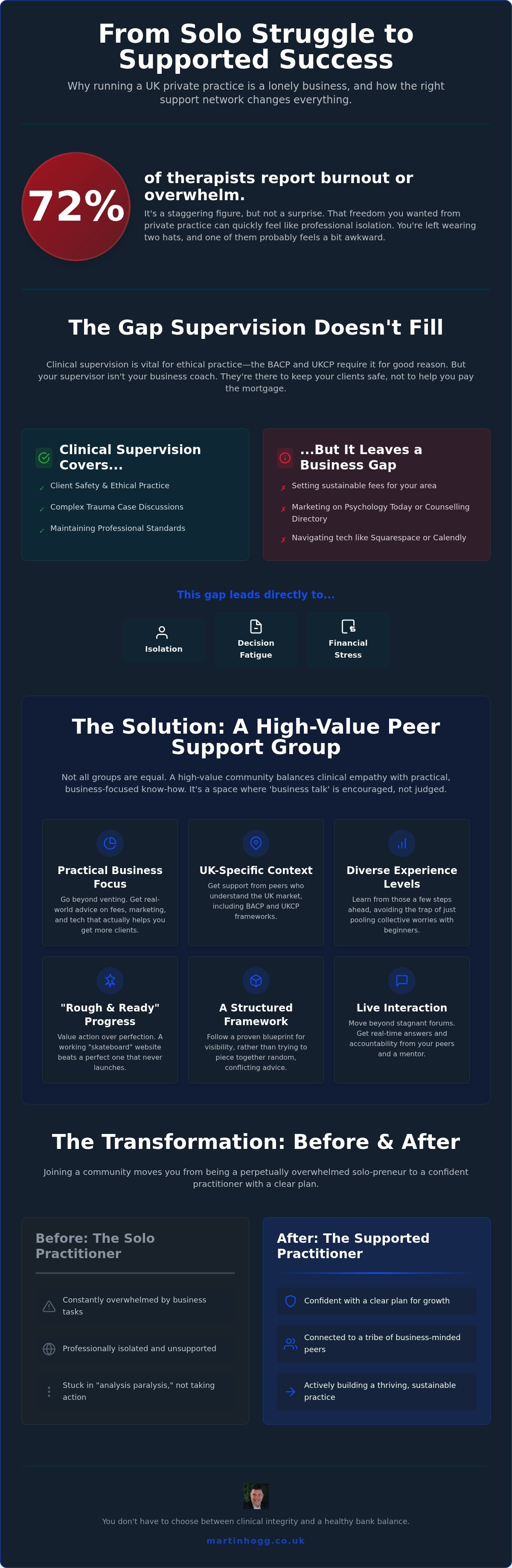
Did you know that 72% of therapists report experiencing burnout or overwhelm? It's a staggering figure, but if you're sat in your home office wondering why you feel so drained, it probably doesn't surprise you one bit. Running a private practice in the UK is a lonely business. You've got the clinical side down, but nobody warned you about the decision fatigue that comes with choosing between Canva and Psychology Today, or the sheer awkwardness of setting your fees.
I've been there, and at Martin Hogg Private Practice Success, I know that clinical supervision often stops exactly where your business struggles begin. Joining a therapist peer support group isn't just about having a moan over a brew. It's about building a sustainable, successful business where you actually feel like you belong. I'll show you how the right network can end your professional isolation and provide the practical marketing advice you need to thrive without the constant solopreneur fatigue. We'll look at why going solo is a recipe for exhaustion and how a community can help you grow.
Key Takeaways
- Learn why clinical supervision isn't designed to support your business growth and how to bridge that gap with a different kind of professional network.
- Discover what makes a high-value therapist peer support group, from practical marketing advice to shared UK-specific professional standards like the BACP.
- Identify your current practice bottlenecks so you can choose a network that helps you tackle marketing, fees, or professional boundaries effectively.
- Understand the power of following a visibility blueprint alongside peers to move from "rough and ready" ideas to a thriving, sustainable practice.
The Hidden Cost of Solo Practice: Why Supervision Isn’t Enough
Most of us stepped into private practice for the freedom. But after a few months of staring at the same four walls between sessions, that freedom often starts to feel like isolation. Clinical supervision is vital; the BACP and UKCP require it for very good reasons. It keeps your clients safe and your practice ethical. However, your supervisor isn't there to help you navigate the back-end of the Counselling Directory or tell you if your fee of £60 is sustainable for your local area. That is why finding a reliable therapist peer support group is so important for your sanity.
There is a massive difference between discussing a complex trauma case and admitting you're terrified of being seen on camera. This is where Peer Support becomes your professional lifeline. Without a dedicated therapist peer support group, you're left carrying the heavy "business owner" hat entirely on your own. That isolation is a fast track to burnout. It feeds the imposter syndrome that whispers you aren't a "real" business person just because you haven't mastered SEO or Squarespace yet.
The Gap Between Clinical Excellence and Business Success
Being a brilliant counsellor doesn't mean you naturally know how to craft a "one-sentence offer" or manage a complex Calendly schedule. In many traditional training circles, talking about profit or marketing feels almost taboo. You need a safe space where "business talk" is encouraged, not judged. Joining a community allows you to bridge this gap. It's about moving from being a "solo-preneur" who is perpetually overwhelmed to a confident practitioner with a clear niche. You don't have to choose between clinical integrity and a healthy bank balance. You just need the right people around you to show you how to manage both.
What to Look for in a High-Value Therapist Peer Support Group
Not all groups are created equal. Some are just places to vent about difficult clients, which has its place, but it won't pay your mortgage. A high-value therapist peer support group must balance clinical empathy with practical business know-how. You need peers who understand the emotional weight of a heavy session but can also help you troubleshoot a booking error on your Squarespace site or critique your Canva graphics. The APA has long warned about the risks of going it alone, noting that isolation can lead to professional stagnation and poor decision-making. Having a group of "business-minded" therapists around you prevents that drift.
I always look for a group with a diverse mix of experience levels. If everyone in the room is at the exact same stage, you're often just pooling your collective worries. You want to be in a space where someone is three steps ahead of you, perhaps already scaling an associate practice or mastering their niche. This environment fosters a culture of "rough and ready" progress. In my world, a working "skateboard model" website beats a perfect one that never sees the light of day. We value action over perfectionist paralysis every single time.
Key Features of a Growth-Oriented Community
Stagnant Facebook groups or forum posts aren't enough to move the needle. You need regular live interaction where you can ask questions in real-time. A truly effective community follows a structured framework, like the Practice Visibility Blueprint, rather than just throwing random advice at you. This structure helps you master the Counselling Directory, optimize your Psychology Today profile, and build a brand that attracts private pay clients. If you want a space that combines this practical mentorship with a supportive tribe, you should explore the Private Practice Success Membership.
How to Choose (or Build) Your Own Support Network
Finding the right therapist peer support group starts with a bit of honest self-reflection. Start by identifying where you're actually stuck. Is it your clinical confidence, or is it simply that the phone isn't ringing? If you're struggling with the business side, a group that only focuses on case studies won't help you pay the mortgage. Joining a high-quality therapist peer support group is the fastest way to stop overthinking and start doing. You also need a network that understands the UK market. Local standards from the BACP or UKCP matter, so look for a group that respects these frameworks while pushing you to grow.
The vibe is everything. You want to feel like you're talking to a supportive mentor, not sitting in a cold, academic classroom. I often use the skateboard model for networking. Don't commit to a massive, expensive mastermind until you've tested the waters with a low-friction entry point. Reading about Understanding Group Therapy and Support Groups helps clarify the value of shared experience over formal instruction. You want a safe space to discuss fees and boundaries without feeling like you're being graded by a tutor.
Avoiding the "Gripe Session" Trap
Be careful of groups that turn into a gripe session. You've probably seen them on social media; people spend two hours moaning about the Counselling Directory or how hard life is. I prefer groups led by a facilitator who has actually built a successful practice themselves. They should offer practical solutions, not just a shoulder to cry on. A good group will help you uncover niche building secrets that actually work in the UK market. If the group feels like a drain on your energy, it's time to move on. You need a space that values action, tangible results, and maybe a bit of a laugh over a brew.
Beyond the Basics: Joining a Community That Grows Your Practice
I created the Private Practice Success Membership because I was tired of seeing brilliant UK counsellors give up on their dreams. They weren't failing because they were bad therapists. They were failing because they were trying to be their own marketing agency, IT department, and accountant all at once. When you join a high-quality therapist peer support group, you stop being just a solo practitioner. You start becoming the CEO of your own practice. This shift in mindset is what allows you to build something sustainable that actually serves your life rather than draining it.
Having a visibility blueprint to follow alongside your peers takes the guesswork out of the equation. You don't have to spend your weekends trying to figure out SEO or how to sync your Calendly with your website. Instead, you follow a proven path. We focus on what works right now in the UK market. It's about getting things done, even if they aren't perfect yet, because you have a tribe of people who have your back. You don't have to figure out everything on your own.
The Private Practice Success Membership
Our community lives on Skool, where we have regular live training sessions and a very active therapist peer support group. One of the most valuable things we do is peer feedback on "above the fold" content. Getting a fresh set of eyes on the first thing people see on your website can transform your conversion rate almost overnight. If you're looking for more ways to streamline your day-to-day work, you should Check out our Counsellor Efficiency Bundle. It's designed to save you time so you can focus on your clients.
Remember, you don't have to do this on your own. Private practice can be lonely, but it doesn't have to be. With the right backing and a clear plan, you can grow a practice that you are truly proud of.
Time to Step Out of the Four Walls
You didn't train for years just to spend your days wrestling with tech or feeling isolated. While clinical supervision is non-negotiable for ethics, a dedicated therapist peer support group is what keeps your business healthy. It's the difference between guessing your way through marketing and following a proven system like the Practice Visibility Blueprint alongside people who truly understand the UK landscape.
You deserve a practice that feels like a fulfilling career, not a constant source of stress. Whether it's setting sustainable fees or finally getting your head around Squarespace, having a mentor-led community around you changes everything. I've seen this transformation happen for countless colleagues through my BACP-endorsed CPD training, and it's your turn next.
Stop the solo grind and start building a practice that lasts. You're already a brilliant therapist; now let's make sure the right clients can actually find you.
Frequently Asked Questions
What is the difference between peer supervision and a peer support group?
Peer supervision is primarily for clinical cases and ethical dilemmas. A therapist peer support group is for the person behind the practice. One protects your clients, while the other protects your livelihood. It’s about the tech, the marketing, and the isolation that clinical supervision doesn't touch. You need clinical oversight for safety, but you need peer support for business sustainability and personal growth.
Is it ethical for therapists to discuss marketing and business growth in a group?
It’s perfectly ethical to talk about business. If you don't have a visible, sustainable practice, you can't help anyone. We discuss fees and marketing within the ethical guidelines of the BACP and UKCP. It isn't about being pushy; it's about being accessible. A healthy business allows you to be a better, more present therapist for your clients without the stress of unpaid bills.
How much time should I realistically spend in a peer support group?
You only need an hour or two a week to see real benefits. This isn't another chore; it's a time-saver. Instead of spending three hours fighting with a Squarespace template or your Calendly settings, you can ask the group and get an answer in minutes. Consistent, short bursts of interaction keep you moving forward without adding to your already heavy clinical load.
Can a peer support group help me get more clients in the UK?
Yes, specifically by refining your visibility. We help you polish your profiles on the Counselling Directory and Psychology Today so they actually work. By getting peer feedback on your "one-sentence offer" in our therapist peer support group, you ensure you're speaking directly to your niche. This practical approach helps you stop wasting money on broad marketing and starts bringing in the right enquiries.
Do I need to be a BACP member to join a therapist support network?
You don't need to be a BACP member, although we follow their professional standards closely. Our community includes therapists from the UKCP, NCPS, and other bodies. The struggle of being a solo-preneur is universal across the profession. As long as you're a qualified therapist looking to grow a sustainable practice, you're welcome. We focus on the practical business side that training courses usually skip over.
Disclaimer
The information provided on this blog is for general informational purposes only. It is also not intended to be a substitute for professional medical or mental health advice, diagnosis, or treatment. Reading this content does not create a therapist-client relationship.


