
Therapy niches in demand UK: find a focus that fits your practice

Article by
Martin Hogg
I help Private Practice counsellors in the UK set up and grow an ethical Private Practice they love, work with their ideal clients, and earn the income they deserve. All without guesswork and burnout. I have been a private practice counsellor myself for over 20 years, specialising in anger management. I set up a not-for-profit social enterprise, Citizen Coaching and Counselling, which delivers thousands of counselling sessions a year to adults and young people in Birmingham. I am a registered BACP Counsellor and the author of three books, My Anger Coach, My Anxiety Coach and My Relationship Coach. These are available on Amazon.
There isn’t one best niche for every therapist. When exploring therapy niches in demand in the UK, start by identifying three areas that fit your experience and the clients you work well with. You can market up to five if they have a clear connection. A niche can make your message easier to understand, but you don’t have to commit to one for your whole career.
It’s easy to feel you need to choose the most popular specialism and build your practice around it. Consider demand, of course, but also look at where your skills, interests and clients’ needs meet. That’s a more useful starting point than choosing a label just because it sounds fashionable.
In this guide, you’ll learn how to assess your fit and explore niche ideas across clinical specialisms, client groups, life stages, problems and therapy approaches. You’ll also see how to start with a broad focus and refine it as your practice develops. A clear focus doesn’t have to box you in; it can help the right people recognise that your work may be relevant to them.
Key Takeaways
- Look for patterns in the clients you work well with, the challenges they bring and the strengths you use. Feedback from colleagues can help you spot a promising focus.
- Explore specialisms and client groups that connect with your experience, training and interests, then consider how you might assess whether people are looking for that support.
- Think about how needs can differ across childhood, adolescence, adulthood and later life before deciding which stage best fits your practice.
- Shape a focus around a problem, a population or a therapy approach, and use a clear message to help prospective clients understand who you work with.
1. How Can I Identify a Good Fit for My Therapy Niche?
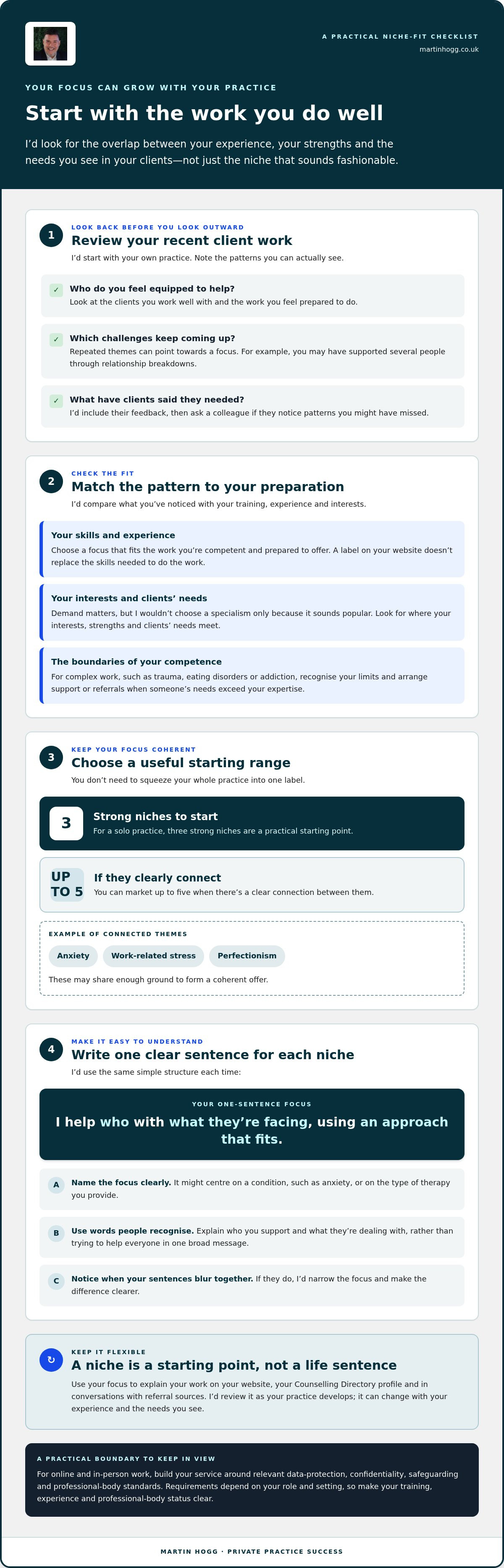
Start with yourself, not Google. Review your recent client work and note who you felt equipped to help, which problems came up repeatedly, and what clients said they needed. Then compare those patterns with your training and experience. For example, supporting several people through relationship breakdowns and feeling confident in that work may point towards a useful focus.
A niche can make your private practice easier to explain. Rather than saying you help everyone, describe who you support and what they’re dealing with. That clarity can help the right people connect with your message and give you a focused starting point for your website, Counselling Directory profile or conversations with referral sources. It’s also easier to plan relevant content when you know who you’re trying to reach.
You can define a niche by the condition you work with, such as anxiety, depression, addiction or PTSD. Or you can focus on the type of therapy you provide. Cognitive behavioural therapy, or CBT, is described as the most well-researched type of psychotherapy and a highly sought-after approach for various mental health conditions. Whichever route you choose, align your focus with your competence and training. A label on your website doesn’t replace the skills needed to do the work.
For a solo practice, three strong niches are a practical starting point. You can market up to five when they have a clear connection. For instance, anxiety, work-related stress and perfectionism may share enough ground to form a coherent offer. Try writing one sentence for each: who you help, what they’re facing, and how your approach fits. If the sentences blur together, narrow the focus. A niche can change as your practice develops; it isn’t a life sentence.
For online and in-person work in the UK, build your service around relevant data-protection, confidentiality, safeguarding and professional-body standards. Practical arrangements can differ by format, and the requirements that apply depend on your role and setting.
2. Therapy niche ideas across clinical specialties and client groups
Start with the people and problems you understand through your clinical experience. Possible focuses include trauma after abuse, addiction support, eating difficulties, PTSD, depression or anxiety. You might also work with LGBTQIA+ clients, veterans, people recovering from serious illness, or those leaving prison. Treat these as starting points, not labels to adopt without relevant preparation.
Telehealth can extend the reach of your speciality. For example, a therapist working with trauma could offer online sessions to people in rural communities with limited local mental-health resources. Consider whether your approach suits remote work, then explain the format clearly in your marketing. Your local area may still matter for referrals, but it needn’t define everyone you can reach.
There isn’t one qualification or registration route for every UK therapy niche. Requirements depend on your role and setting, so make your relevant training, experience and professional-body status clear. If you belong to the BACP, describe that accurately; don’t imply a specialist credential you haven’t earned.
Demand varies by community, access to services and the issues people seek help with. Rather than naming a single busiest area, look for local referral patterns and unmet needs. Rural communities may have fewer mental-health resources, while online appointments can help a focused service reach beyond one town.
Specialising in trauma, eating disorders or addiction can involve complex clinical work. Recognise the limits of your competence, prepare for difficult presentations, and arrange appropriate support or referrals when someone’s needs exceed your expertise. Specialist training and ongoing professional development can help you build sound practice; experience alone isn’t a substitute.
For your marketing, balance specificity with language people actually use. A page for “trauma therapy after domestic abuse” speaks to a clearer need than “support for difficult experiences”, but an overly narrow phrase may reach fewer prospective clients. Explore search wording, speak with referral sources, then test a focused page before reshaping your whole site. A private practice growth community can give you a place to develop those ideas with peers.
3. Counselling for different life stages
Children, adolescents, adults and older people can each form a distinct counselling focus. Consider which age group you’re equipped to work with and whose concerns fit your approach. For example, you might focus on young people adjusting to school changes, adults facing a major relationship transition, or older people considering changes in independence. Each focus gives you a clearer starting point for explaining who you support.
Working with children means thinking carefully about how they communicate and what feels manageable for them. A counsellor might focus on children experiencing family change, then describe the work in language parents can understand. With adolescents, possible themes include friendship pressures, identity and decisions about further education. Your website should speak plainly to young people and the adults who may help them find support.
For adults, life-stage niches can centre on starting a family, changing careers, separation or adjusting to retirement. These moments can affect relationships, confidence and day-to-day choices. Rather than listing every possible difficulty, choose a clear audience and example, such as adults rebuilding routines after a major life change. That makes it easier for someone to recognise your focus without suggesting everyone has the same experience.
Older clients may seek counselling around bereavement, changing roles or shifts in family relationships. These can be useful themes for a specialist practice if they match your experience and the support you can offer. Also consider how people in your chosen age group might find you. A page aimed at adults approaching retirement needs different wording from one for parents seeking support for an adolescent.
Test a life-stage focus with a simple one-sentence offer: “I work with [group] experiencing [situation].” Then check whether it reads clearly on your Squarespace homepage and in a Counselling Directory profile. If it feels too broad, add a relevant situation; if it feels cramped, widen the group. Finding the right fit is a practical process, not a permanent label.
4. Problem-, population- and modality-based therapy niches
A useful speciality can combine a problem, a population and a therapy type. For example, you might offer psychodynamic therapy for adults experiencing relationship difficulties, or couples counselling for partners rebuilding trust after a major change. This gives your marketing a sharper focus than simply saying you support mental health. It also helps prospective clients recognise why your approach may suit their situation.
Modality can also be a starting point. Trauma therapy, psychodynamic therapy and online therapy each describe a different part of the service. Make the practical offer clear: explain who you work with, what brings them to counselling, and how your approach informs the work. “Online support for adults managing anxiety” is easier to picture than a list of therapy terms.
A population-based focus adds another layer. You could work with couples facing repeated communication difficulties, or support people whose career pressures affect their wellbeing. The point isn’t to squeeze every client into a neat box. Name a recognisable concern and describe your work honestly, without implying that one method suits everyone.
Try this simple exercise: write one sentence for each possible niche, naming the client, the concern and the modality. Then compare those sentences with your actual experience and training. If “trauma-focused work with adults” reflects your preparation, make that clear. If the wording promises more than your practice can deliver, bring it back to what you can responsibly offer.
On your Squarespace site, give your main speciality a clear place. Put the audience and concern above the fold, then use a useful title tag such as “Couples counselling for communication difficulties”. Keep related themes together rather than creating separate pages for every possible combination. Your site should help people understand your focus, not leave them decoding a menu of clinical language.
Martin Hogg Private Practice Success: Practice Visibility Blueprint
Martin Hogg’s Practice Visibility Blueprint helps counsellors make a chosen focus clear to prospective clients. Your niche might be couples counselling, support for men, or work around anger. The next step is to turn that focus into a straightforward message and make it easier for people to find your practice.
Start by writing a one-sentence offer: who you help, what they’re facing, and how you work. Use it to check whether your website and directory profiles communicate the same focus. If you’re still shaping your specialism, the Working with Men CPD Course or Anger Management CPD for Professionals may support your professional development.
If you want help making your niche more visible, explore the Practice Visibility Blueprint. Visit martinhogg.co.uk to take the next step.
Put your chosen focus into practice
Start with one useful change, not a full website overhaul or grand announcement. Choose one audience and one concern, then make your homepage or directory profile clearer for those people. Read the wording as if you were a prospective client: can you tell who the service is for and what you can help with? Even a small edit is progress.
Therapy niches in demand in the UK can give you ideas, but your practice needs a focus that fits your skills and the work you want to do. Notice which enquiries feel aligned, which referral conversations lead somewhere useful, and where your current message feels vague. Those signals can help you refine your direction without treating your first choice as permanent.
If you’d value support turning your niche into a clearer practice focus, Martin Hogg’s Private Practice Success Membership can help. Take the next step at a pace that works for you. A clearer message can begin with one honest sentence.
You don’t need every detail sorted. Start with the next useful change, then build from there.
Frequently Asked Questions
How Can I Identify a Good Fit for My Therapy Niche?
Look for a match between your experience, the work you find engaging and a client need you can describe plainly. Try drafting a profile for one prospective client, such as a parent worried about family changes affecting their teenager. Note the questions that person might ask before booking. This can reveal gaps in your offer and give you practical wording for your website or directory profile.
Should I Niche My Private Practice?
You don’t have to choose a niche, but a clear focus can help prospective clients understand whether your practice suits them. If you’re uneasy about narrowing down, keep your clinical work broad while giving your marketing a clearer emphasis. For example, you might highlight support for work-related stress without turning away clients with other concerns. Review that emphasis as your experience and practice develop.
What type of therapy is most in demand?
There isn’t one approach that suits every client or practice. CBT is described as highly sought-after, while psychodynamic therapy, trauma therapy, couples counselling and online therapy are also identified as in-demand areas. Treat these as useful signals, not a league table of clinical value. Consider which approach you’re trained to provide and whether people seeking it are finding your service.
How Do I Research Market Demand for My Niche?
Use three practical sources: conversations with referral contacts, relevant mental-health research and search trends. Notice the phrases people use, not just professional terminology. You could publish a focused page or a short run of related posts, then review responses over 90 days before changing your wider marketing. Look at meaningful signs, such as relevant enquiries and referral conversations, rather than likes alone.
What If My Niche Isn’t Working?
First, distinguish a weak niche from unclear marketing. Ask a colleague to read your website and explain who they think you help. If the message is clear but isn’t connecting, consider a related client group or problem that better fits your skills. You can also widen the focus temporarily, then use the questions people bring to sessions to guide your next adjustment.
Which therapy niches are most in demand in the UK in 2026?
Therapy niches in demand in the UK include CBT, psychodynamic therapy, trauma therapy, couples counselling and online therapy. Condition-focused work may address anxiety, depression, PTSD, addiction or disordered eating. These are broad areas, not a ranked list, and demand can differ between communities. Use them to generate ideas, then weigh local referral patterns, your training and the clients you’re equipped to support.
Disclaimer
The information provided on this blog is for general informational purposes only. It is also not intended to be a substitute for professional medical or mental health advice, diagnosis, or treatment. Reading this content does not create a therapist-client relationship.


