
Time Management for Therapists: Make Room for Admin and Personal Commitments

Article by
Martin Hogg
I help Private Practice counsellors in the UK set up and grow an ethical Private Practice they love, work with their ideal clients, and earn the income they deserve. All without guesswork and burnout. I have been a private practice counsellor myself for over 20 years, specialising in anger management. I set up a not-for-profit social enterprise, Citizen Coaching and Counselling, which delivers thousands of counselling sessions a year to adults and young people in Birmingham. I am a registered BACP Counsellor and the author of three books, My Anger Coach, My Anxiety Coach and My Relationship Coach. These are available on Amazon.
A full diary can still leave important work squeezed into the margins. Time blocking gives each kind of work a place in your calendar, so client sessions, administration and personal commitments aren’t competing for the same gaps. Good time management for therapists means planning around your energy and priorities, while leaving room for the day to change.
If you’re keeping session notes in your head while trying to remember a personal appointment, you’re not short of commitment. You may simply need a clearer view of what fits. A calendar that includes the work behind each session, not just the sessions themselves, can make the week more manageable.
This guide explains why planning matters, how to use time blocking in private practice, and how to make space for notes, administration and life outside work. You’ll find practical ways to set priorities, protect breaks and build a schedule that’s realistic rather than perfect.
Key Takeaways
- Use a quick brain dump, then sort tasks by urgency and importance to see what deserves your attention first.
- Choose three or four priorities for the day and give focused work a clear place in your calendar.
- Build in time for notes, admin and breaks instead of expecting every gap between sessions to be productive.
- Review your week, make room for personal commitments and adjust the plan when real life gets in the way.
1. Why is time management important?
Time management for therapists is about choosing what gets your attention, not squeezing every task into the day. A full diary can still leave responsibilities unfinished if you haven’t made time for notes, email and practice administration. Start by listing your tasks, then sort them into urgent and important, urgent but less important, important but not urgent, and neither. The Eisenhower Matrix makes these categories easy to see.
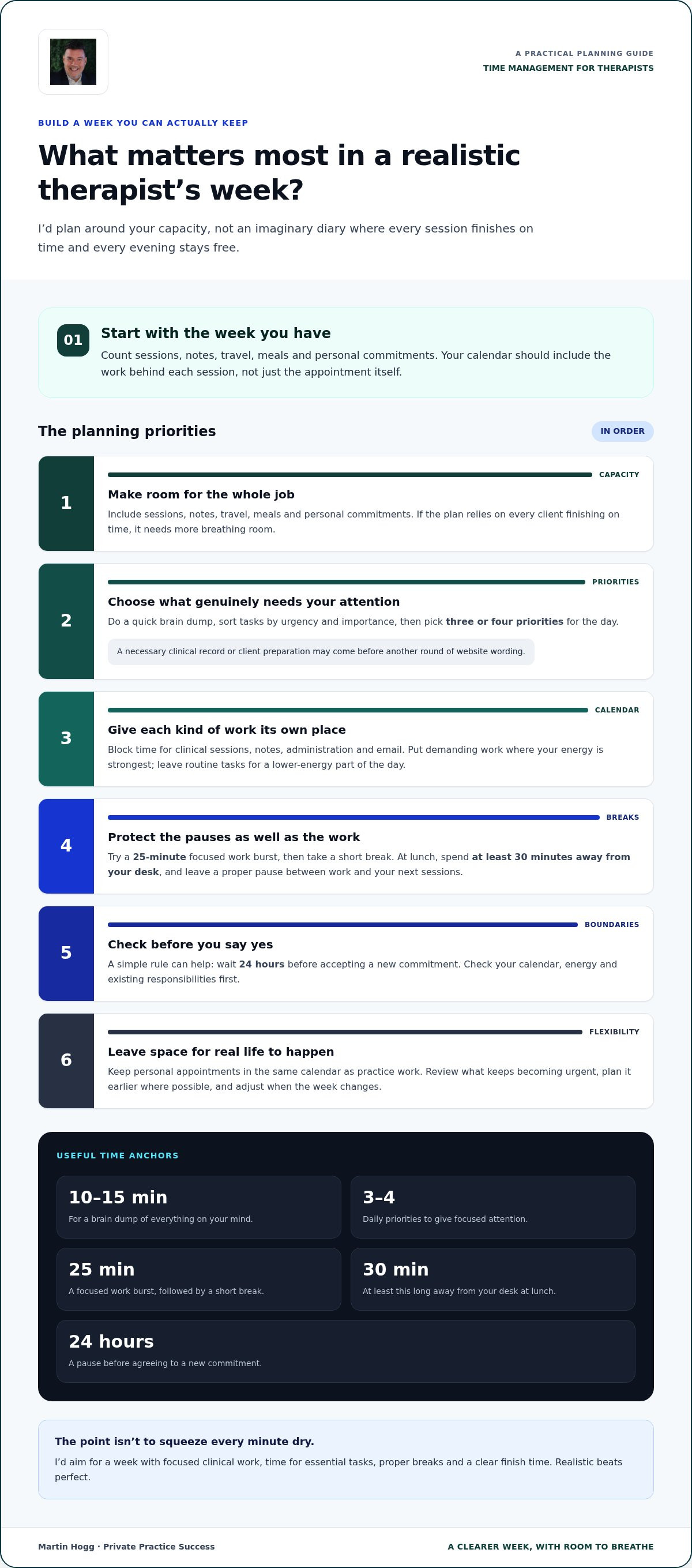
For a useful brain dump, set a timer for 10-15 minutes and write down every task on your mind. Review the list afterwards. Ask which tasks support your longer-term goals, such as building a sustainable practice or improving your clinical work. Choose three or four priorities for the day. For example, completing a necessary record and preparing for a client may take precedence over adjusting your website wording again.
Time blocking turns priorities into calendar appointments. Reserve separate periods for clinical sessions, administration and email instead of assuming everything will fit around client work. Schedule demanding tasks when your energy is strongest and routine jobs for a lower-energy part of the day. Notice what keeps becoming urgent, then plan it earlier where possible.
Your role shapes your schedule. In an NHS or employed post, you’ll need to account for team commitments and allocated duties. Private practice gives you more control over when you place sessions and business tasks, but both still need protected time.
UK therapists should keep accurate, confidential clinical records in line with relevant professional standards and employer policies. Calendly can support appointment booking, while practice-management tools may bring diary and administrative tasks together. Costs vary by provider, plan and features, so choose a tool that solves a real problem rather than adding extra upkeep.
These practical management skills can help you focus on essential work and make your schedule more realistic. If a task doesn’t support your priorities, consider whether you can delegate, simplify or remove it.
2. Reducing stress and improving productivity
A cluttered desk can make a full working day feel busier. Before your first client, clear away old paperwork and leave out only the session materials you need. Put confidential notes away after use and keep everyday items in consistent places. This simple reset makes things easier to find and helps prevent transitions from becoming another task.
Phone notifications are another easy distraction to underestimate. During a notes or email task, put your phone in another room or switch off non-essential alerts. Try a 25-minute focused work burst, then take a short break before starting again. If a task keeps getting interrupted, note what pulled your attention away. That record helps you spot patterns rather than blaming yourself for a vague feeling of being unproductive.
Look for time wasters in the small, repeated actions around your practice. Rewriting appointment messages, searching through scattered documents or checking email between every session all add friction. Keep reusable message templates and organise common files in clearly named folders. Batch routine replies into a defined email period, while leaving room for genuinely time-sensitive matters.
Reducing administration doesn’t mean cutting corners on clinical records. It means making routine steps easier: use a consistent note structure, keep your diary current and create repeatable processes for bookings and reminders. Choose a management tool that solves a real problem instead of collecting apps that need more upkeep. Review your process after a working week and change what still causes delays.
Productivity isn’t about squeezing every minute dry. It’s about making room for focused clinical work and finishing the necessary tasks without carrying them into the evening. If you want practical learning and ideas for running a more successful practice, the Martin Hogg Private Practice Success community can help you build those essential time management for therapists skills through shared discussion.
3. Setting realistic work-life balance expectations
A workable balance starts with an honest view of your capacity, not an ideal diary. Look at a typical week and include sessions, notes, travel, meals and personal commitments. If your plan assumes every client finishes on time and every evening stays free, it isn’t a plan. It’s a rather optimistic work of fiction.
Set reminders for appointments and deadlines as soon as they enter your calendar. One can prompt preparation; another can leave time for travel or finishing a task. Keep personal commitments alongside practice appointments, so a school event or medical appointment doesn’t become an afterthought. A single calendar makes clashes easier to spot before you agree to extra work.
Give paperwork a defined container. Set a 30-minute limit, then decide whether to continue or move to another task. If a note needs longer, make a clear plan for finishing it rather than letting paperwork quietly swallow your evening. Taking a break matters too: spend at least 30 minutes away from your desk at lunch, then return with a proper pause between work and your next sessions.
Boundaries need a simple rule you can use when you feel overwhelmed. For example, wait 24 hours before accepting a new commitment. That pause gives you time to check your calendar, energy and existing responsibilities before saying yes. It’s especially useful when an extra meeting or piece of admin sounds small on its own, but would push your working day past its limit.
For effective time management, treat your mental energy as part of the schedule. Place demanding treatment-related work where you can give it proper attention, and avoid stacking emotionally intensive sessions if your diary allows. A realistic week includes breaks, a finish time and flexibility. You’re more likely to maintain that balance than a timetable built around constant availability.
4. Scheduling administrative and personal commitments
Put more than client appointments in your calendar. Block time for notes, emails, invoicing, meetings, professional development and personal commitments. Use one master calendar, with colour coding to distinguish work and home. Add commitments as soon as they arise, so a family event is visible before you offer that slot to a client.
Leave breathing room between sessions. A traditional therapy session lasts 50 minutes, and a 10-minute buffer can support a brief transition. In practice, scheduling 15-20 minutes between sessions gives you more room for documentation, overruns and a mental reset. Those minutes aren’t wasted time. They’re part of delivering thoughtful work without rushing straight into the next conversation.
Schedule breaks as deliberately as sessions. Protect time away from your desk at lunch, and make room for your mental health and personal life. To prevent burnout, block out breaks, supervision and continuing professional development before filling the diary with client work. Treat them as real calendar events, not optional extras to squeeze in later.
Seasonal changes can shift demand and your energy. Review your diary weekly and make small adjustments around school holidays, planned leave or changes in client availability. Set aside 30 minutes each week to review and plan your schedule and priorities. If winter makes early starts harder, for example, move admin to a later block rather than pretending you’ll become a different person by Tuesday.
Have a backup plan for disruptions, such as a cancelled session or an urgent personal appointment. Keep a short list of admin tasks that could fill a gap, but don’t automatically turn every cancellation into work. A realistic schedule leaves some room for yourself. That’s what makes it productive over time, rather than merely full.
Martin Hogg Private Practice Success: Practice Visibility Blueprint
If practice growth keeps slipping behind client work and administration, Martin Hogg’s Practice Visibility Blueprint offers a structured way to give it attention. Start by deciding what you want your practice to be known for, then identify a clear, manageable visibility task. A focused plan can help you give growth a proper place in your working week, rather than leaving it for a mythical quiet day.
You don’t need to polish every detail before taking action. A clear, one-sentence offer and straightforward content can help you explain your work without turning marketing into a sprawling project. Set aside a dedicated block for one useful task, then return to your clinical responsibilities.
If you’d like support making space for practice growth, visit martinhogg.co.uk.
Give your next week a more deliberate shape
The best time management for therapists doesn’t mean having a perfect calendar. It means creating a working arrangement that reflects how you practise and what matters outside work. Choose one change to try next week, such as protecting a proper finish time or setting aside a block for practice development. Notice what becomes easier and what still creates friction.
Treat that review as useful information, not a test you’ve passed or failed. Your schedule should serve you, your clients and the life you want beyond the consulting room. If your practice is growing, make room to consider what you want that growth to look like, rather than filling every available slot by default.
For practical ideas and support as you work on your practice, take a look here:
Small, considered changes can make your week steadier. Start with the one that would make the biggest difference.
Frequently Asked Questions
What is Time Blocking?
Time blocking gives planned work a defined place in your diary, rather than relying on a list you hope to finish. Make each block specific: name the task and what “done” looks like. For example, “prepare Thursday’s client materials” is easier to act on than “get organised”. Leave room for unexpected work so one overrun doesn’t derail the day.
Why is time management important?
Time blocking helps you distinguish a genuinely full workload from a week crowded by avoidable interruptions. That matters in private practice, where client-facing hours don’t show the whole job. A diary that includes preparation, follow-up and business upkeep gives you a clearer picture of your capacity. You can then decide whether to take new bookings before agreeing and having to find the time later.
How can therapists structure a typical working day and schedule client sessions?
Give the day a clear rhythm: prepare before your first session, group client appointments where that suits your concentration, and create a distinct end-of-day routine. For example, use the final admin block to check tomorrow’s diary and note any preparation needed. If you work online and in person, allow for travel or room changes when arranging appointments. The best pattern is one you can sustain.
How much time should therapists allow between appointments for notes and breaks?
Choose the gap between sessions by considering what happens afterwards: writing the record, handling follow-up, getting water and mentally resetting. An in-person appointment may also involve changing rooms or travelling, while online work has its own transition needs. Track where your diary regularly runs over, then adjust the spacing to match your actual working pattern rather than an idealised one.
How can therapists manage clinical notes and administrative tasks efficiently?
Decide what a complete note needs to capture, then use the same structure each time. Keep clinical records in the appropriate record-keeping system, separate from general reminders or personal task lists. For routine administration, create a short checklist for recurring jobs such as preparing invoices or checking bookings. This makes the next action clear without turning every task into another decision.
How should therapists set boundaries around working hours, emails and client contact?
Tell clients what to expect before they contact you: your working hours, the usual way to reach you and when you generally respond to routine messages. A concise line in your welcome information can prevent uncertainty, such as, “I reply to emails during my working hours.” Use an automatic reply when you’re away, and keep the wording consistent across your website and booking messages.
Disclaimer
The information provided on this blog is for general informational purposes only. It is also not intended to be a substitute for professional medical or mental health advice, diagnosis, or treatment. Reading this content does not create a therapist-client relationship.


