
Transitioning from NHS to Private Practice: A Practical Guide for UK Therapists

Article by
Martin Hogg
I help Private Practice counsellors in the UK set up and grow an ethical Private Practice they love, work with their ideal clients, and earn the income they deserve. All without guesswork and burnout. I have been a private practice counsellor myself for over 20 years, specialising in anger management. I set up a not-for-profit social enterprise, Citizen Coaching and Counselling, which delivers thousands of counselling sessions a year to adults and young people in Birmingham. I am a registered BACP Counsellor and the author of three books, My Anger Coach, My Anxiety Coach and My Relationship Coach. These are available on Amazon.
The NHS pension is often called a golden handcuff, but no amount of future security can buy back the years you spend feeling like a cog in a bureaucratic machine. I've spoken to dozens of therapists who are ready for clinical freedom, yet the thought of transitioning from nhs to private practice feels like a massive financial risk. It's completely normal to feel a bit of imposter syndrome when you think about trading a steady salary for the unknown of a private diary and having to market yourself for the first time.
I understand that fear of financial instability and the pressure to be perfect. In this guide, I'm going to show you that moving into your own space doesn't have to be a high-stakes gamble. You'll learn a grounded, step-by-step roadmap to move from bureaucratic exhaustion to a sustainable, profitable practice that actually fits your life. We'll look at the "skateboard model" for your website, the reality of costs like your £196 BACP membership, and how to attract steady, private-pay clients without losing your soul to corporate-speak.
Key Takeaways
- Understand how to shift from a salaried clinical role to a self-employed business owner, leaving bureaucratic exhaustion behind for true clinical freedom.
- Reframe your view of marketing as a tool for human connection rather than a "salesy" chore that compromises your ethics.
- Simplify transitioning from nhs to private practice by using the "skateboard model" to launch a lean, effective one-page website.
- Build a practical visibility roadmap using trusted tools like the Counselling Directory and Psychology Today to reach private-pay clients.
- Learn how to create a sustainable, profitable practice that supports your work-life balance without the need for a massive social media presence.
Leaving the NHS: Weighing the Risks and Rewards in 2026
Let's be honest about the state of the NHS in 2026. You're likely dealing with caseloads that feel more like a factory line than a therapeutic environment. Between the endless letters of complaint from frustrated patients and the constant anxiety over re-banding, it's no wonder so many talented therapists are looking for the exit. Transitioning from nhs to private practice is about moving from being a salaried clinical employee to becoming the CEO of your own business. It's a significant shift in identity that requires a mix of clinical confidence and new business skills.
The "leap" is the part that keeps most people awake at night. You worry about losing that NHS pension and the relative safety of a monthly payslip. But I want you to reframe this; think of this transition period as a sturdy bridge you build while still employed, rather than a terrifying cliff-edge you jump off with a blindfold on. You don't have to quit everything tomorrow to start seeing your first private client.
The Financial Safety Net: Pension, Sick Pay, and Stability
Before you hand in your notice, you need to calculate your "survival number." This is the bare minimum you need to earn to keep the lights on and the mortgage paid. While the NHS offers a pension, you have to weigh that against the fact that "job security" is often a myth when services are constantly being tendered or restructured. When you own your own referral stream and have a presence in places like the United Kingdom Council for Psychotherapy (UKCP) directory, you're the one in control of your stability.
Clinical Freedom vs. Bureaucratic Caseloads
In the NHS, you're often allocated clients based on a waitlist, not your expertise. In private practice, you get to choose who you work with. You have the professional authority to decide how many sessions a client actually needs. You can finally do the deep work you trained for, without a manager tapping their watch because you've hit a strict six-session limit. If you want support with this mindset shift, our Private Practice Success Membership helps you manage this new autonomy with practical tools.
The Therapist-Entrepreneur Mindset: Why Marketing Isn't a Dirty Word
Many of us feel a slight shiver when we hear the word "marketing." It often conjures up images of pushy sales tactics or corporate jargon that feels completely at odds with our therapeutic training. But when you are transitioning from nhs to private practice, you have to swap your employee badge for an entrepreneur's hat. This doesn't mean becoming someone you're not. In fact, the most effective strategy is the "people connect with people" philosophy. Your human self is your best asset. Clients aren't looking for a polished, clinical brand; they are looking for a person who understands their pain.
I've seen so many talented counsellors get stuck in "perfectionism paralysis." They spend months tweaking a logo or waiting for the perfect headshot before they even think about seeing a client. The truth is that rough and ready content often beats a polished, corporate image every time. A simple, honest video or a helpful blog post shows the real you. It's about being findable, not about "selling" yourself. You are simply making sure that the person crying into their tea at 2 am can find the help they need.
Your One-Sentence Offer
Stop using clichés like "I provide a warm, safe, and non-judgemental space." Every therapist says that. Instead, focus on specific outcomes. Try to describe what you do without using academic jargon. A one-sentence offer like "I help anxious professionals regain their confidence at work" is much more powerful than a list of your qualifications. It tells the client exactly how their life will change after working with you.
Visibility as an Act of Service
Think of SEO and directories as a way of helping a suffering person find the right support. If they can't find you, they can't get your help. This aligns perfectly with the BACP Ethical Framework; you have a responsibility to be clear and honest about what you offer. While you're busy registering as a sole trader and sorting the legalities, don't forget that visibility is an act of service. If you're feeling overwhelmed by the business side, our private practice success community offers a supportive place to find your feet without the corporate fluff.
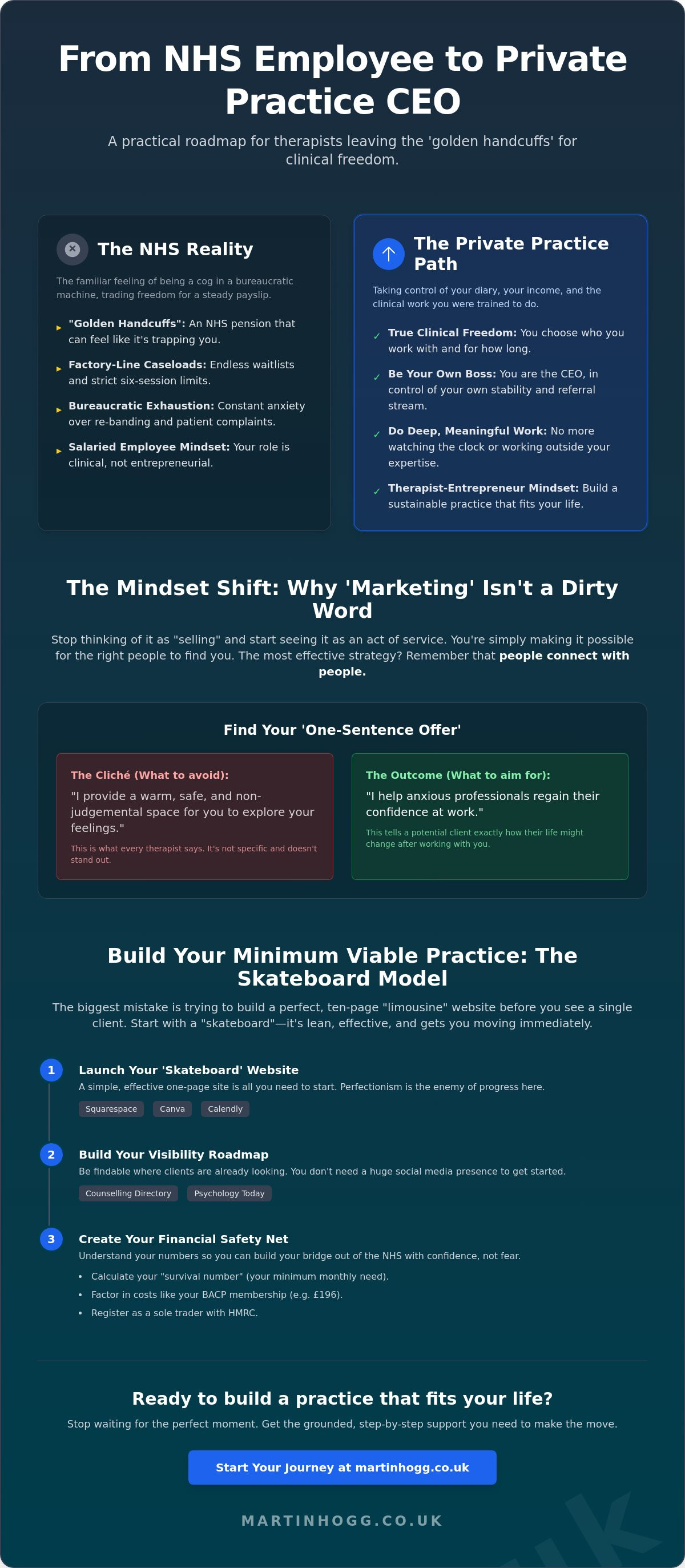
Building Your Minimum Viable Practice: The Skateboard Model
When you start transitioning from nhs to private practice, the temptation to overcomplicate things is massive. You might think you need a ten-page website, a professional podcast, and a perfectly curated Instagram feed before you can see a single person. I call this the "limousine" approach. It's expensive, slow, and usually ends in burnout before you've even seen a client. Instead, I want you to use the "skateboard model." A skateboard is simple, but it gets you moving immediately. You can add the steering wheel and the engine later.
Your essential tech stack is surprisingly lean. Use Canva for your basic graphics and Squarespace to build your site. Add Calendly so people can book a call without the back-and-forth emails. Before you open your doors, you'll need your professional foundations in place. This includes your professional indemnity insurance, which usually costs around £63.50 per year, and registering with the ICO. The annual data protection fee is £52, though you get a £5 discount if you pay by direct debit. You might also find it helpful to read a physiotherapist's experience moving from the NHS to private practice to see how these practicalities feel on the ground.
The One-Page MVP Website
Your website only needs three things to work: a clear headline that addresses a specific problem, a friendly photo of you, and a clear way to book. The most important real estate is "above the fold," which is the part of the screen people see before they scroll. Don't fall into the "About Me" trap. Your clients don't actually care about your life story yet. They want to know if you understand their struggle. Make the copy about them, not your CV.
Essential UK Directories
While your website is your home, directories like Psychology Today and Counselling Directory are your shop windows. You need to optimise your profiles with clear title and description tags so people can find you easily. If you're wondering how to fill your diary once the site is live, learn how to attract private pay therapy clients with our detailed guide.
Ready to stop overthinking and start building? Join our Private Practice Success Membership for a step-by-step roadmap that cuts through the noise.
From Invisible to In-Demand: Your Practice Visibility Roadmap
Transitioning from nhs to private practice often feels like moving from a crowded hospital corridor to a quiet room in the middle of a forest. Nobody knows you're there yet. But you don't need ten thousand Instagram followers or a viral TikTok dance to fill your diary. You just need a simple, 3-step visibility plan: optimise your directories, start local networking, and create 'rough and ready' content that shows you're a real human being. People connect with people, not with polished corporate logos.
I always tell therapists to stop thinking about 'selling' and start thinking about 'connecting.' A quick coffee with a local GP or a chat with other therapists in your area isn't being pushy; it's professional courtesy. Many therapists are actually over-subscribed and looking for someone trustworthy to refer to. The process of transitioning from nhs to private practice is as much about your visibility as it is about your clinical skill. Once those foundations are solid, you can look at my Practice Visibility Blueprint to scale things up without losing your mind.
Quick Wins for New Practices
Update your LinkedIn today. It sounds simple, but just telling your professional network that you now have capacity can lead to your first few referrals. Use the 'Title Tag' trick on your website too. Make sure Google knows you are a 'Counsellor in [Your Town]' rather than just 'Home Page.' It's a tiny change that makes a massive difference to how easily people find you in local searches.
Sustaining Growth and Avoiding Burnout
The freedom of private practice is wonderful, but it comes with the temptation to work all hours. Set your boundaries early. Decide when you will answer enquiries and when the phone goes on 'Do Not Disturb.' You didn't leave the NHS just to create a different kind of exhaustion for yourself. I've written more about setting healthy boundaries in your private practice if you feel the old habits of overworking creeping back in.
Transitioning is a journey, not a sprint. If you want a group of people who 'get it' and can offer practical advice when you're stuck, join the Private Practice Success Membership. We'd love to have you with us.
Taking Your First Step Toward Independence
You now have a grounded roadmap for transitioning from nhs to private practice without the usual overwhelm. We've covered why your human self is your best marketing tool and how the "skateboard model" keeps your initial setup lean and manageable. Remember that clinical freedom isn't just about escaping bureaucracy; it's about creating a space where you can do your best work for the clients who truly need you.
I've spent over 15 years coaching UK therapists through this specific journey. Our community uses the Practice Visibility Blueprint to build steady referral streams, and I've shared these insights through BACP-endorsed workshops across the country. You don't need to be a tech expert or a natural salesperson to succeed. You just need a practical plan and a bit of support from people who've been exactly where you are now.
Join the Private Practice Success Membership and bridge the gap from NHS to clinical freedom.
You've done the hard work of training and serving in the NHS. Now it's time to build a future that looks after you, too. I'll see you on the inside.
Frequently Asked Questions
Do I need to leave the NHS entirely to start a private practice?
No, you don't have to leave the NHS immediately, and many therapists start by seeing a few private clients in the evenings or on weekends. It's a sensible way to test the water while you're still transitioning from nhs to private practice. Just make sure you check your NHS contract for any restrictive covenants or "conflict of interest" clauses that might stop you from seeing private clients in the same geographical area as your trust.
How much does it cost to set up a private therapy practice in the UK?
Setting up is cheaper than you might think if you stick to the skateboard model. Your main fixed costs in 2026 include the BACP individual membership at £196 and the ICO data protection fee of £52, which drops to £47 if you pay by direct debit. Professional indemnity insurance usually costs around £63.50 per year. Beyond that, you'll just need a small budget for your Squarespace site and a professional directory listing to get started.
What insurance do I need for private practice?
You must have Professional Indemnity Insurance before you see your first private client. This protects you against claims of professional negligence or malpractice. Most policies for qualified therapists offer cover between £1 million and £5 million. It is a non-negotiable foundation of your practice, but it's relatively affordable at roughly £63.50 a year. It's about buying peace of mind for both you and your clients.
How do I take payments from private clients securely?
The most professional way to take payments is through a dedicated system like Stripe or Square. These allow you to send invoices or take card payments easily, and they handle the heavy lifting of data security for you. Some therapists prefer direct bank transfers to a dedicated business account to avoid transaction fees. Whatever you choose, make sure it's easy for the client; don't let a clunky payment process become a barrier to them starting therapy.
Is it ethical to market my therapy services?
Marketing is entirely ethical as long as you are honest, clear, and follow the BACP Ethical Framework. Think of it as being "findable" rather than "selling." If a person is in distress and looking for a specific type of help, it's your job to make sure they can find you. Transitioning from nhs to private practice means taking responsibility for your own visibility so you can reach the people who truly need your expertise.
Disclaimer
The information provided on this blog is for general informational purposes only and is not intended to be a substitute for professional medical or mental health advice, diagnosis, or treatment. Reading this content does not create a therapist-client relationship.


