
Using Feedback Forms in Therapy: A Guide for Counsellors

Article by
Martin Hogg
I help Private Practice counsellors in the UK set up and grow an ethical Private Practice they love, work with their ideal clients, and earn the income they deserve. All without guesswork and burnout. I have been a private practice counsellor myself for over 20 years, specialising in anger management. I set up a not-for-profit social enterprise, Citizen Coaching and Counselling, which delivers thousands of counselling sessions a year to adults and young people in Birmingham. I am a registered BACP Counsellor and the author of three books, My Anger Coach, My Anxiety Coach and My Relationship Coach. These are available on Amazon.
What if a feedback form could make room for a more honest conversation, rather than leave you with a score to interpret? I understand why using feedback forms in therapy can feel tricky. You want to know how the work is landing, but you don’t want a client to feel tested, obliged to reassure you or worried about giving the wrong answer.
The form itself isn’t the conversation. How you introduce it, and what you do with the response, matter just as much. A simple explanation that feedback is optional and intended to help you understand the client’s experience can ease some of that pressure.
I’ve spent 21 years in UK private practice, and I’d keep the process straightforward. In this guide, I’ll look at what to ask, when to invite feedback and how to respond when it’s difficult to hear. You’ll also find ways to use a client’s answers as a starting point for reflection, not a verdict on your work.
Key Takeaways
- Use a feedback form to explore how the work is landing, including the pace, goals and communication, rather than treating responses as a score.
- Choose neutral, open questions that let clients describe what has helped, felt difficult or could be different.
- When using feedback forms in therapy, explain how you’ll read and discuss responses so clients know what to expect.
- If feedback is hard to hear, pause and get curious about what the client means before deciding what might need to change.
Why use feedback forms in therapy, and what can they tell you?
A therapy feedback form is a structured invitation for a client to say how they’re experiencing the work. It gives you a starting point for a conversation that can be harder to begin from scratch. A client might say the pace feels too quick, their goals have shifted, or something you say leaves them unsure what to do next.
That’s useful information about the working relationship and how sessions feel to the client. It isn’t a verdict on you, and it won’t tell the whole story. Someone may find a session difficult because important material has come up, for example, while still feeling that the work is worthwhile. Use the form to ask what’s behind a response, rather than assuming you already know.
I’d think of the form as a prompt, not a scorecard. Psychotherapy can involve different goals and methods, as this broad overview of Psychotherapy describes. A few answers can point towards something worth exploring, but they can’t capture the full complexity of what happens between sessions or how a client understands their own progress.
Feedback forms and outcome measures are not the same thing
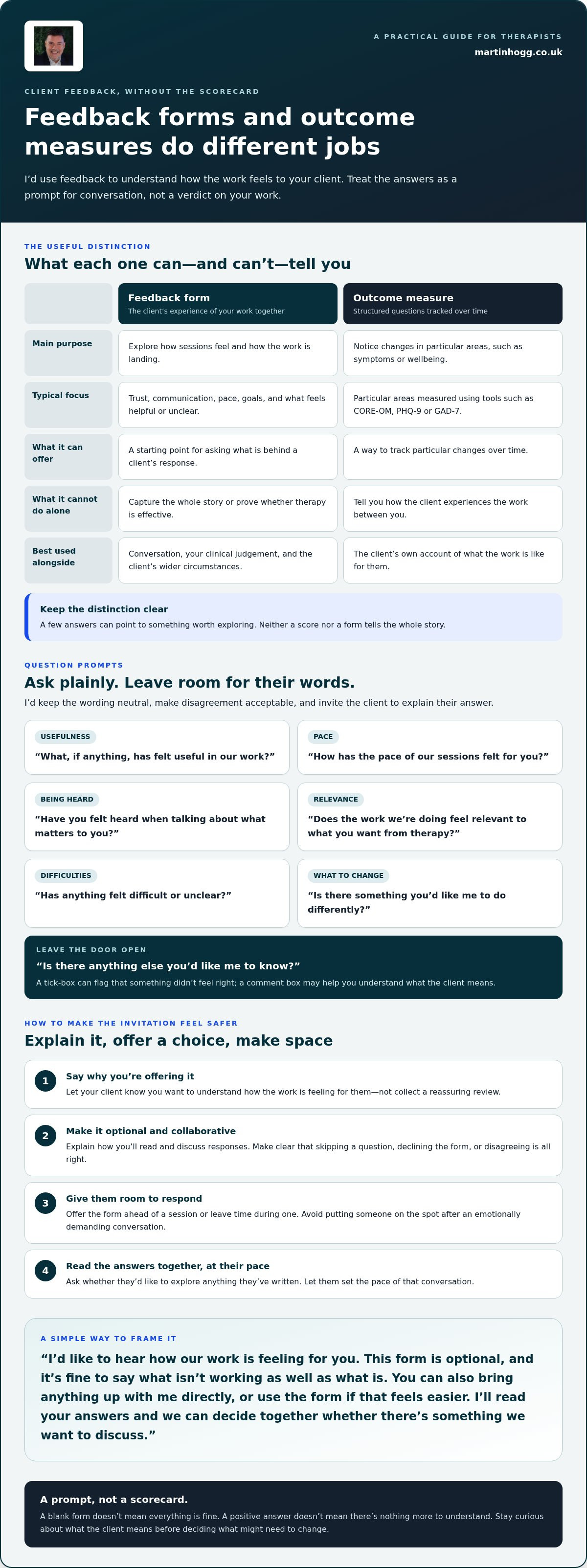
Feedback questions ask about the client’s experience of the work: “Have you felt able to talk about what matters?” or “Is there anything you’d like us to approach differently?” The answers can open a discussion about trust, communication, pace and what feels unhelpful.
Outcome measures have a different purpose. Tools such as the CORE-OM, PHQ-9 or GAD-7 use structured questions to track particular areas over time. They may help you notice changes in symptoms or wellbeing, but they don’t tell you on their own how the client experiences your work together. A feedback form alone can’t prove whether therapy is effective either. It offers one perspective to consider alongside conversation, clinical judgement and the client’s wider circumstances. That’s the practical value of using feedback forms in therapy: they can help you notice what needs attention and invite the client to shape the discussion.
What should a therapy feedback form ask?
A useful form asks about the client’s experience without steering them towards a particular answer. Keep the wording plain and neutral. You’re looking for what has felt helpful, difficult or unclear, not a reassuring review of your work.
I’d include an invitation to say what you could do differently. That can feel exposing for both of you, but leaving it out may suggest that only positive comments are welcome. Make it clear that disagreement is acceptable, and leave space for the client to explain their answer in their own words.
Examples of clear, non-leading feedback questions
Prompts like these can give you a starting point. Adapt them to your approach and the client in front of you:
- What, if anything, has felt useful in our work?
- How has the pace of our sessions felt for you?
- Have you felt heard when talking about what matters to you?
- Does the work we’re doing feel relevant to what you want from therapy?
- Has anything felt difficult or unclear?
- Is there something you’d like me to do differently?
Finish with an open prompt such as, “Is there anything else you’d like me to know?” A tick-box answer can show you that something didn’t feel right; a comment box may help you understand what the client means. Don’t assume a short answer tells the whole story.
Consider whether the language, layout and way you offer the form work for this client’s communication needs. Some people may prefer to talk through a question rather than write an answer. Use your professional judgement, and tailor the questions to your approach and the context of the work. There’s no prize for having the longest form. A handful of clear questions is often easier to answer and more useful to discuss.
Using feedback forms in therapy is one part of reflective practice, not a substitute for your own clinical thinking. For broader support with the practical side of private practice, the Martin Hogg Private Practice Success community supports UK practitioners. It’s business support, not a clinical feedback tool.
How to introduce and use feedback forms in therapy
A form is more likely to invite honest feedback if it doesn’t arrive as a surprise or feel like a test. Explain why you’re offering it and what you’ll do with the answers. Be specific about your process: for example, whether you’ll read responses before the next session and invite the client to talk them through with you. Don’t promise privacy or a particular follow-up unless that’s how you’ll handle it.
Make the invitation clear, optional and collaborative
You might say: “I’d like to hear how our work is feeling for you. This form is optional, and it’s fine to say what isn’t working as well as what is. You can also bring anything up with me directly, or use the form if that feels easier. I’ll read your answers and we can decide together whether there’s something we want to discuss.”
That wording makes disagreement acceptable and gives the client a choice about how to speak. It also leaves the responsibility with you to receive feedback thoughtfully, rather than asking the client to make sure you feel all right about it.
Give them space to respond. You could offer the form ahead of a session or leave time for it during one, depending on what suits your work together. Avoid putting someone on the spot at the end of an emotionally demanding conversation, when they may be keen to leave. Make clear that they can take their time, skip a question or choose not to complete it.
Then treat the response as an opening, not a conclusion. A blank form doesn’t tell you that everything is fine, and a positive answer doesn’t mean there’s nothing more to understand. The value of using feedback forms in therapy comes from making it possible to talk about the answers without pressure. Ask whether the client would like to explore anything they’ve written, and let them set the pace of that conversation.
If you’re also thinking about the practical side of building a private practice, you can read about the Private Practice Success community.
How to respond to feedback and make it useful
Critical feedback can sting. You might feel defensive, disappointed or suddenly unsure of your work. That reaction is human, but it’s yours to reflect on, not something the client should have to soothe. I’d pause before replying. Listen, then ask a question such as, “Could you tell me a little more about what felt difficult?” This helps you understand their meaning before explaining your choices.
When feedback is difficult to hear
Try to separate your first emotional response from the client’s account. You don’t have to agree with every interpretation to take their experience seriously. Reflect back what you’ve heard and check whether you’ve understood: “It sounds as though you felt rushed when I moved us on. Have I got that right?” Then explore what might help the client feel heard, without promising a change you can’t make.
Agree a proportionate next step together. Perhaps you slow the pace, revisit a shared goal or make more room to check in. Some requests may not fit the work or your professional judgement. Explain that respectfully, and discuss what other adjustment might help. If the feedback raises a clinical question you need to think through, take it to your existing reflective support, including clinical supervision where appropriate. Business coaching or a feedback form isn’t a substitute.
Connect feedback with your wider practice
Reflective practice is one part of running a sustainable counselling practice, alongside the practical decisions that keep your work manageable. My guide to building a sustainable counselling private practice looks at that wider picture.
Review your form from time to time. If a question repeatedly gets a blank answer, or doesn’t lead to a useful conversation, change it or take it out. Using feedback forms in therapy works best when you’re willing to learn from the process as well as the responses. For practical support with building or growing your practice, you can also find out about Private Practice Success.
Let feedback inform your next steps
Using feedback forms in therapy doesn’t need to become another bit of practice admin to perfect. Start with a simple intention: make it easier for clients to tell you what matters to them, in a way that suits the work you’re doing together.
As you decide what comes next, think about the kind of practice you want to build. Feedback can be one small part of a way of working where clients have a say, while your professional judgement remains yours to exercise. There’s no need to make the process elaborate to make it meaningful.
The wider work of running a private practice can bring its own questions, from finding the right structure to deciding where to focus your time. Private Practice Success supports UK counsellors and therapists who are building or growing a practice. If that wider support would be useful, you can explore the community.
Take the next step that fits your practice. Small, thoughtful choices can help you build work that feels more sustainable and true to the way you want to practise.
Frequently Asked Questions
What is a feedback form in therapy?
It’s a brief way to gather a client’s view of how therapy is working for them. Keep it separate from a testimonial or review: the purpose is to inform your work with that client, not to promote your practice. If you’re using feedback forms in therapy, make sure the form’s purpose is clear in its wording and in how you introduce it.
Should feedback forms in therapy be anonymous?
That depends on what you want the form to do. An anonymous option may help a client share something they find difficult to say face to face, but it can limit your ability to ask what they meant. If you offer anonymity, explain how it works in practice, including whether free-text answers might identify the writer through their details.
How often should therapists ask clients for feedback?
Choose a rhythm that has a clear purpose, rather than sending forms on autopilot. You might ask when you’re reviewing how the work is going, or after a change that could affect the client’s experience. If you ask regularly, notice whether clients still engage with the process. A form that’s routinely ignored may need a different approach.
What questions should a therapy feedback form include?
Choose questions that match what you’re trying to learn at that point in the work. For instance, if you’ve agreed a particular focus, ask whether it still feels like the right focus. Keep each question to one idea, and make sure the client can leave it unanswered. That makes the form easier to complete without turning it into a checklist of expected progress.
What should a therapist do if a client gives negative feedback?
Take the feedback seriously, then consider what follow-through is realistic and relevant. If you agree to try a different approach, make a note of what you both decided and return to it later. If you can’t meet a request, be honest about why and discuss what alternatives are possible. The aim is to keep the next steps clear, not to promise more than you can deliver.
Disclaimer
The information provided on this blog is for general informational purposes only. It is also not intended to be a substitute for professional medical or mental health advice, diagnosis, or treatment. Reading this content does not create a therapist-client relationship.


