
Using Technology in a Therapy Practice: A Practical UK Guide

Article by
Martin Hogg
I help Private Practice counsellors in the UK set up and grow an ethical Private Practice they love, work with their ideal clients, and earn the income they deserve. All without guesswork and burnout. I have been a private practice counsellor myself for over 20 years, specialising in anger management. I set up a not-for-profit social enterprise, Citizen Coaching and Counselling, which delivers thousands of counselling sessions a year to adults and young people in Birmingham. I am a registered BACP Counsellor and the author of three books, My Anger Coach, My Anxiety Coach and My Relationship Coach. These are available on Amazon.
Technology should protect your energy for the therapy room, not drain it before you even sit down. If you spend your evenings chasing unpaid invoices and wrestling with back-and-forth scheduling emails, you aren't alone. Most of us didn't train to become IT managers. For many counsellors, using technology in a therapy practice brings up immediate worries about breaking UK GDPR rules or falling foul of BACP ethical guidelines.
The truth is, you don't need a bloated, complicated system to run a safe and professional private practice. You can easily strip away the friction with a few sensible choices. In this guide, you will discover how to simplify your admin, protect client confidentiality, and choose the right digital tools without tech overwhelm. I will walk you through a lean, low-stress tech stack that reclaims your time and creates a seamless client journey from the very first enquiry.
Key Takeaways
- Learn how using technology in a therapy practice acts as an invisible boundary assistant, keeping admin from draining your clinical presence.
- Compare dedicated practice management platforms with simple modular tools like Calendly so you only pay for what your practice actually needs.
- Get clear on UK GDPR and ICO registration essentials, giving you total peace of mind over digital client confidentiality.
- Apply the "skateboard model" to roll out a lean, four-step tech setup that saves hours of manual work every week.
Why Using Technology in a Therapy Practice Protects Your Clinical Boundaries
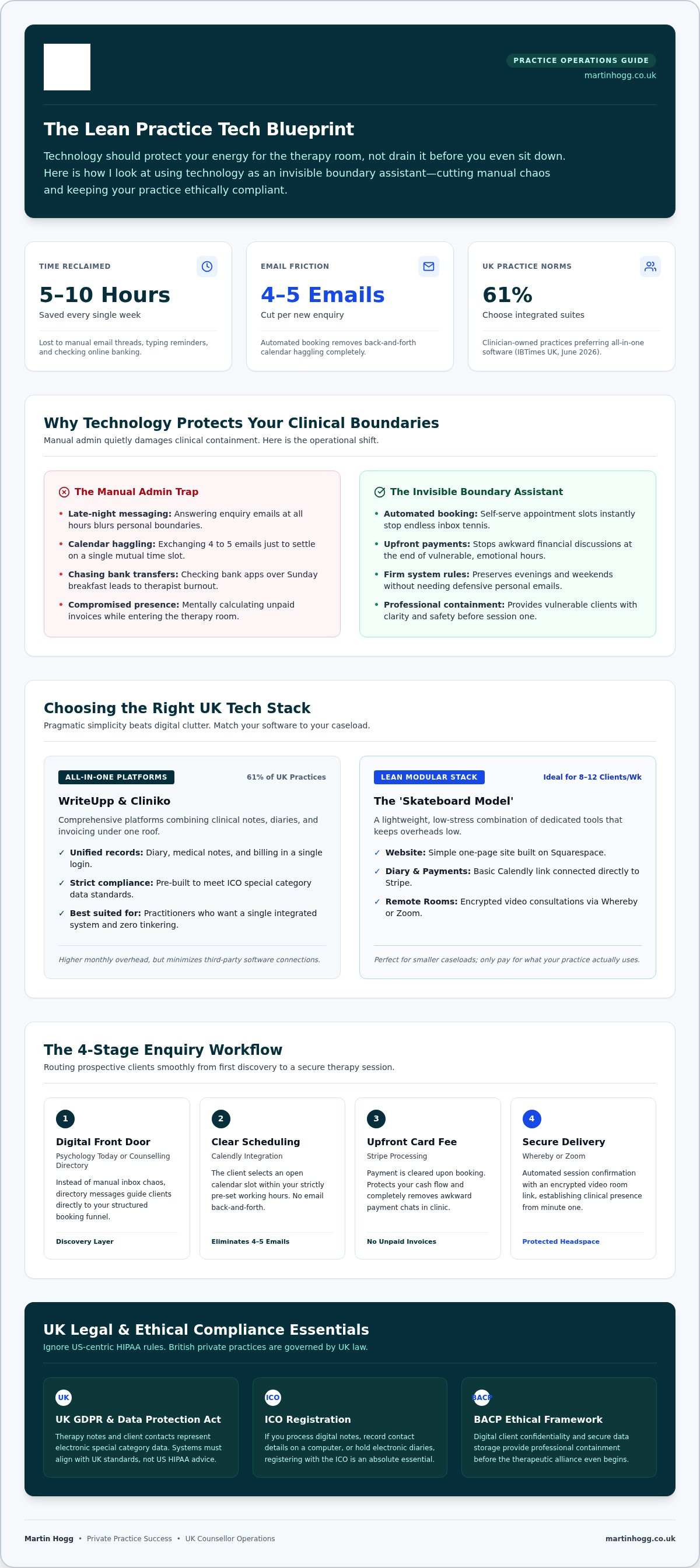
Many therapists view digital software as a cold wedge driven between practitioner and client. I see it differently. Thoughtfully using technology in a therapy practice provides an invisible boundary assistant. It quietly manages the operational friction that otherwise drains your emotional energy long before a session starts.
When you handle enquiries manually, personal and professional borders blur. You find yourself answering late-night messages, haggling over open calendar slots, and chasing overdue bank transfers over Sunday breakfast. That constant background hum leads straight to therapist burnout and emotional fatigue. Running a structured enquiry workflow means you stop reacting to chaos and start protecting your therapeutic headspace.
The Hidden Cost of Manual Practice Admin
Manual admin carries a heavy financial and emotional toll. Sifting through email threads, typing out appointment reminders, and checking online banking quietly eats five to ten unpaid hours every week. More dangerously, it scatters your focus. Walking into the therapy room while mentally calculating your unpaid invoices compromises your grounded presence.
Shifting from reactive paperwork to streamlined practice operations changes everything:
- Automated booking eliminates four or five emails per new enquiry.
- Upfront payment processing stops awkward financial discussions at the end of emotional hours.
- Pre-set system rules firmly protect your evenings and weekends without requiring defensive emails.
Enhancing the Client Experience Before Session One
A hesitant client seeking support often feels vulnerable and overwhelmed. A messy, protracted exchange of messages about availability only increases their apprehension. In contrast, clear digital onboarding provides an immediate sense of safety and professional containment. As the wider adoption of online counseling and teletherapy modalities has demonstrated, clients value accessibility and predictability just as much as clinical warmth. When your booking and intake run smoothly, you demonstrate reliability and competence before saying a single word.
Evaluating Practice Management Tools: Choosing the Right UK Tech Stack
Choosing software feels daunting when you are bombarded with enterprise platforms designed for massive medical clinics. Sensible practice management boils down to one question: do you need an all-in-one suite, or does a light toolkit serve you better? Pragmatic thinking beats digital clutter every single time when using technology in a therapy practice.
All-in-One Platforms vs Modular Toolkits
Comprehensive platforms like WriteUpp or Cliniko combine diaries, clinical notes, and invoicing into one place. According to an IBTimes UK report from June 2026, 61% of clinician-owned practices prefer these integrated systems. They keep everything tidy under strict security protocols aligned with ICO guidance on special category data.
Yet if you see eight to twelve clients a week, you might not need a heavy system. A simple modular approach works wonders:
- A one-page site built on Squarespace to explain your work clearly.
- A basic Calendly link connected to Stripe for automated bookings and upfront card payments.
- Encrypted video rooms via Whereby or Zoom for remote sessions.
If you want proven templates to set this up smoothly, my Counsellor Efficiency Bundle gives you pre-built administrative workflows ready to adapt.
Online Directory Profiles and Client Enquiries
Your tech stack extends to where clients find you. Listings on Psychology Today and Counselling Directory act as your primary digital front door. Instead of letting directory messages drop into a chaotic inbox, route prospective clients straight into your structured booking funnel.
Getting your systems to talk to each other takes the dread out of growing your caseload. If you ever feel stuck choosing between software options, joining our Private Practice Success community is a great way to get straightforward feedback from peers walking the exact same path.
Ethical Compliance: UK GDPR, ICO Registration, and Digital Client Records
US-centric advice often talks about HIPAA compliance. As a British practitioner, you operate under an entirely different legal framework. Safely using technology in a therapy practice means aligning your workflow with UK GDPR and Data Protection Act standards alongside your professional body's ethical code.
If you process electronic notes, maintain a digital diary, or store client emails on a laptop, you are legally a Data Controller. That means registering with the Information Commissioner's Office (ICO). For most solo therapists, the Tier 1 fee is £52 per year, reduced to £47 if paid by Direct Debit. It is a mandatory requirement, and failing to register carries an automatic fine.
Managing Digital Notes and Data Subject Rights
You do not need to be a cyber specialist to protect your records. Keep things simple. Turn on full-disk encryption across your laptop, use separate passwords for your clinical accounts, and mandate two-factor authentication everywhere.
Distinguish between personal reflective notes and factual clinical records. Factual summaries belong in secure, cloud-based storage. Under the Data (Use and Access) Act 2025, clients can submit a Subject Access Request (SAR), and your searches must be reasonable and proportionate. Clean, digital filing ensures you can locate records promptly without panic.
Video Platform Security and Remote Therapy Contracts
The BACP Ethical Framework 2026 places clear responsibility on therapists to maintain strict digital boundaries. Never use personal WhatsApp or domestic messaging apps for client dialogue. When conducting video sessions, platforms like Zoom or Whereby provide encrypted rooms, but your contract needs to outline what happens if a connection drops.
State your emergency contact protocols clearly before session one. A robust written agreement ensures both you and your client share identical expectations around digital privacy.
The Skateboard Model: Building a Lean, Sustainable Tech System
If you set out to build a car, you don't start with an engine block and wait months to travel anywhere. You start with a skateboard. It moves you forward straight away. The exact same rule applies when using technology in a therapy practice. You don't need an elaborate digital infrastructure to support clients safely. A simple, reliable setup gets you working without the friction.
Many counsellors delay modernising because they think everything must look pristine. In reality, rough and ready content beats polished perfection every time. Clear, direct communication connected to a working booking link will always outperform an over-engineered website that took six months to build.
Four Steps to Automate Your Therapy Admin
You can assemble a workable, low-stress tech system in a single afternoon:
- Automated booking: Place a Calendly link on your contact page to eliminate back-and-forth email scheduling entirely.
- Upfront payments: Connect Stripe to your booking calendar so session fees are cleared before you meet.
- Standardised paperwork: Use digital forms to collect client details and signed agreements automatically.
- Invoicing on autopilot: Let your system generate and email receipts without touching a spreadsheet.
Sustainable Scaling and Ongoing Peer Support
Automating these friction points protects your energy and creates a solid foundation for sustainable growth. When software quietly handles your daily admin, scaling a therapy practice becomes a manageable reality rather than an exhausting burden. Once your core tools run smoothly in the background, you can focus on clarifying who you serve best. Exploring niche building secrets helps you attract your ideal clients directly, letting your lean digital setup do the heavy lifting.
Reclaim Your Time and Protect Your Practice
Sensible digital tools should serve you, not the other way around. Successfully using technology in a therapy practice isn't about becoming a software expert overnight. It is about setting up quiet, reliable systems that guard your clinical boundaries, keep you safely on the right side of UK GDPR, and eliminate hours of unpaid admin.
As a BACP-endorsed CPD workshop leader with decades of UK practice experience, I know how easily admin fatigue creeps in. You don't have to configure these systems alone. Inside, you will find a vibrant community of UK counsellors sharing tested, compliant tech setups and actionable business frameworks designed specifically for private practice therapists.
Take it one step at a time. Put your lean system in place today, and give yourself the breathing room you deserve.
Frequently Asked Questions
Is it ethical to use automated scheduling software in a counselling practice?
Yes, absolutely. Ethical practice relies on clear boundaries and reliability. Using technology in a therapy practice to manage bookings gives clients transparent control over appointment times while protecting your personal hours. Automated scheduling actually supports client autonomy. It sets clear expectations about when you are available without the emotional ambiguity of messy, reactive messaging chains.
Do UK therapists have to register with the ICO if they keep digital records?
Yes, registration is legally mandatory. The moment you store client names, contact details, or case notes on a computer or phone, you act as a Data Controller under UK data protection law. You must register with the Information Commissioner's Office and pay the annual data protection fee. Operating digitally without registering leaves you vulnerable to statutory fines.
Can I use standard Zoom for online therapy sessions under UK GDPR?
Yes, you can use standard Zoom, provided you configure the privacy settings correctly. You must enable end-to-end encryption, use the waiting room feature, lock meetings once the client arrives, and turn off local or cloud recording. You also need a signed Data Processing Agreement in place to ensure your client communications fully align with UK GDPR standards.
What should I do if a client's video connection drops during an online session?
Fall back immediately to the contingency plan set out in your therapy contract. Agree beforehand on what steps you will take if a technical dropout occurs. Usually, this means waiting two minutes while the client attempts to reconnect. If the platform stays down, switch to an encrypted phone call to complete the session safely without leaving the client feeling abandoned.
How do I choose between an all-in-one practice management tool and separate apps?
Base your decision entirely on your client volume and technical comfort. When using technology in a therapy practice with a smaller caseload, a simple modular setup like Calendly and Stripe keeps overheads minimal. If your diary is nearly full and you want digital intake forms, clinical notes, and billing handled in one single platform, an all-in-one system is worth the monthly subscription.
Disclaimer
The information provided on this blog is for general informational purposes only. It is also not intended to be a substitute for professional medical or mental health advice, diagnosis, or treatment. Reading this content does not create a therapist-client relationship.


