What Counsellors Can Learn About Referrals From Other Professions
What if the secret to a steady stream of clients isn't about becoming a "salesperson," but simply understanding how trust moves between professionals? It's a common struggle in our field. We often feel isolated and worry that promoting our practice feels a bit undignified. However, for 82% of small business owners, referrals remain the primary source of new business. When we look at what counsellors can learn about referrals from other professions, we see that sectors like law and architecture don't "sell" in the traditional sense. Instead, they create systems of trust that feel natural and ethical.
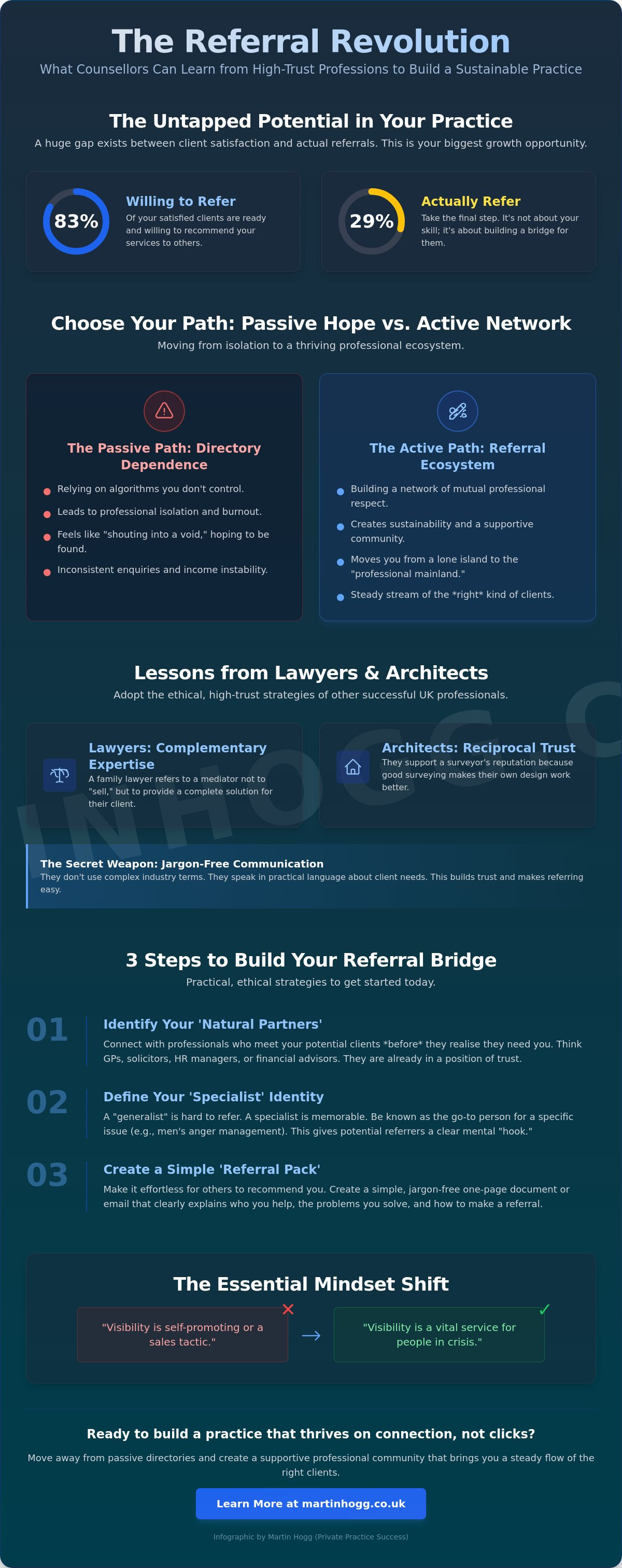
You probably already know that 83% of satisfied clients are willing to refer your services, yet research shows only 29% actually take that step. This gap doesn't exist because you aren't good at your job. It exists because the bridge between "liking your work" and "making an introduction" hasn't been built yet. I want to show you a practical, grounded way to bridge that gap without losing your professional integrity or feeling like you're pushing a product.
Discover how to build a sustainable referral network by adopting the ethical, high-trust strategies used by other successful UK professionals. We will explore how to describe your niche clearly to non-therapists and how to move away from the isolation of the therapy room into a supportive, professional community that brings you a steady flow of the right clients.
Key Takeaways
- Learn how to move away from passive directory listings by building active, trust-based relationships that prevent burnout and create consistent enquiries.
- Discover how solicitors and architects use complementary expertise to support each other's reputations ethically and professionally.
- Identify your Natural Partners to connect with those who meet your potential clients before they even realise they need therapeutic support.
- Explore what counsellors can learn about referrals from other professions to create a simple Referral Pack that makes it easy for others to recommend you.
- Shift your perspective on visibility, seeing it as a vital service for people in crisis rather than a self-promoting sales tactic.
Redefining the Referral: Why It Is More Than a Clinical Handover
Many of us were taught that a referral is simply a clinical necessity, something we do when a case is too complex or outside our expertise. We see it as a "handover." But this narrow view misses the bigger picture of how a healthy practice actually thrives. When we look at what counsellors can learn about referrals from other professions, it becomes clear that a referral is actually an act of trust between two practitioners. It's a professional recommendation that says, "I value your work enough to put my reputation on the line."
If you rely solely on directories, you are using a passive strategy. It can feel like you're shouting into a void, hoping the right person clicks your profile among hundreds of others. This passivity often leads to practitioner burnout because your income depends on an algorithm you don't control. A referral ecosystem is a network of mutual professional respect where practitioners support one another's growth while ensuring clients receive the most appropriate care. It moves you from being a lone island to being part of a professional mainland.
I know the word "selling" makes many therapists recoil. We worry about looking desperate or unprofessional. However, if we reframe this as "resource sharing," the anxiety starts to lift. You aren't pushing a product; you are offering a solution to a colleague who has a client in need. Other sectors understand this well. For instance, a Lawyer referral service isn't about "selling" a case. It's about ensuring the client gets the specific legal expertise required for their situation. We can adopt that same mindset of service.
The Shift from Clinical Duty to Practice Growth
Most of our training focuses on "onward" referrals, the ethical duty to send a client elsewhere. While that's vital, we must also consider "inward" referrals. This is where your visibility comes in. When you are visible to your peers, you aren't just "marketing." You are making it easier for the people who truly need your specific niche to find you. If you specialise in trauma or addiction, being known by local GPs or solicitors is a service to the client in crisis.
This shift from being a "hidden gem" to a visible professional is a core part of the Practice Visibility Blueprint. It helps you move beyond the isolation of the therapy room. By building these professional bridges, you ensure that your practice stays sustainable while you continue to do the deep, meaningful work you trained for.
Lessons from High-Trust Industries: What Lawyers and Architects Know
I often see counsellors worry that reaching out to other professionals feels like "bothering" them. However, when we look at what counsellors can learn about referrals from other professions, we see that high-trust sectors like law and architecture view this quite differently. Solicitors, for example, build their practices through "complementary expertise." A family lawyer knows that a client going through a divorce might also need a mediator or a specialist in child law. They don't see this as a sales pitch; they see it as providing a complete solution for the person in front of them.
Architects and surveyors operate on a similar principle of "reciprocal trust." They support each other's reputations because they know that one person's expertise makes the other person's job easier. The common thread here is that these professionals never "sell." They simply solve problems through trusted connections. They focus on creating a referral-worthy client experience so that when a colleague makes a recommendation, they know the client is in safe hands.
The secret weapon of these successful referrers is jargon-free communication. A solicitor doesn't use complex legal Latin when talking to a mortgage broker. They speak in practical, everyday terms about what the client needs. As therapists, we can sometimes hide behind clinical language, but the most effective referral relationships are built on simple, clear descriptions of how we help people get their lives back on track.
The Power of the 'Specialist' Identity
In any profession, generalists are much harder to refer to than specialists. If you tell a local GP or a solicitor that you "work with everyone," they won't know when to think of you. But if you are known as the person who works with men or someone who specialises in anger management, you give them a clear mental "hook." They will remember you the next time a client mentions those specific struggles.
Refining this niche is a vital part of your professional journey. Investing in the right CPD for Counsellors UK can help you develop the specialist skills that make you stand out. When you can describe your work in a way that a non-therapist understands, you move from being another name on a list to a trusted local expert. If you want to explore how to position yourself this way, our private practice community offers a grounded space to develop these skills.
Implementing a Professional Referral System in Your Practice
Building a system for your practice doesn't have to feel cold or clinical. It's really about making it easier for other professionals to help the people they serve. By looking at what counsellors can learn about referrals from other professions, we can see that a system is simply a series of small, thoughtful actions that build a bridge between you and your peers. It moves you away from the anxiety of "selling" and into a space of professional collaboration.
- Identify your Natural Partners: Think about who sees your clients before they realise they need therapy. If you work with burnout, an HR manager is a natural partner. If you work with divorce, a family solicitor is often the first point of contact.
- Create a Referral Pack: Don't expect people to remember your bio. A simple "Referral Pack," perhaps a one-page PDF or a physical folder, should clearly state who you help and how to contact you. It removes the guesswork for the referrer.
- Schedule Professional Coffee Dates: Forget high-pressure networking events. They are often exhausting and rarely build deep trust. Instead, invite a colleague for a 20-minute coffee. It's a grounded way to see if your values align.
- Establish a Communication Loop: This is where most practitioners fail. Keeping a referrer informed, within the bounds of confidentiality, shows that you are a reliable professional.
The Ethical Communication Loop
You can't share clinical data, and you should never reveal sensitive client details. However, you can share professional courtesy. Saying "thank you" for a referral lets the other person know their trust was well-placed and that the person they were concerned about is now being looked after. It also keeps you "top of mind" for future needs. If you want to learn how to build these relationships with confidence, joining our private practice success community is a great next step.
A simple, professional follow-up email to a GP or solicitor might look like this: "Thank you for the referral you sent my way today; I have now made contact with the individual and we are discussing how my services might help them get their life back on track." This sentence is clear, maintains privacy, and confirms that you have taken action. It’s a small gesture that builds significant professional respect over time.
From Professional Isolation to Practice Visibility
Solo private practice can be a lonely place. When you spend your days behind a closed door, it is easy to feel disconnected from the wider world. However, by looking at what counsellors can learn about referrals from other professions, you begin to see yourself differently. You aren't just a therapist in a room; you are a vital part of a professional community. When you connect with solicitors, local business owners, or healthcare providers, that sense of isolation fades. You realise that these professionals are often looking for someone exactly like you, a trusted expert they can confidently recommend to their own clients.
I want to encourage you to see visibility as a service. It is not about ego or "shouting the loudest." For a person in a crisis, your visibility is a lifeline. If you remain hidden because of a fear of "selling," that person might never find the specific help they need. Moving from "accidental" referrals, the ones that happen by chance, to a strategic network allows you to take control. It means your practice is no longer at the mercy of a directory algorithm. Instead, it is supported by a web of professional relationships built on mutual respect and shared goals.
By adopting these high-trust strategies, you position your practice as a respected member of the UK professional community. You move from being a hidden gem to a known resource. This shift doesn't just bring in more enquiries; it brings in the right enquiries. It ensures that the people sitting in your chair are the ones you are best equipped to help, allowing you to do your best work while getting your practice back on a sustainable track.
Your Next Steps for Practice Growth
Building a referral system is a practical skill that you can master with the right support. If you are wondering how Marketing for Therapists in the UK fits into this wider strategy, I have developed a guide that avoids the hype and focuses on what actually works for our profession. It’s about being effective without losing your integrity.
I also invite you to keep an eye on the Martin Hogg Events Calendar for upcoming workshops where we explore these themes in a supportive, small-group environment. Finally, if you want to connect with peers who are building similar systems, consider joining the Private Practice Success Membership. It is a grounded space designed to help you move away from isolation and toward a flourishing, visible practice.
Building Your Professional Bridge
You now have a clearer path toward a practice that feels both sustainable and dignified. We have explored how trust moves through professional networks and why being a specialist makes you the obvious choice for a referrer who needs a solution. It's about moving away from the isolation of the therapy room and stepping into your role as a respected local expert. By applying what counsellors can learn about referrals from other professions, you move from simply hoping for clients to building a resilient, high-trust network.
It is time to stop feeling like a salesperson and start feeling like the professional resource your community needs. If you are ready to take these practical, UK-focused strategies further, I invite you to join us. I lead BACP-endorsed workshops designed specifically for the unique challenges we face in private practice. As the founder of Citizen Coaching, I have spent years refining these methods to ensure they remain ethical, grounded, and effective for therapists at every stage of their career.
Ready to build a visible, respected practice? Explore the Practice Visibility Blueprint today.
You don't have to do this alone. With the right tools and a supportive community of peers, you can get your practice back on track and focus on the deep, meaningful work that truly matters.
Frequently Asked Questions
Is it ethical for counsellors to ask for referrals from other professionals?
Yes, it is entirely ethical to build professional relationships that help clients find the right support for their needs. Ethical guidelines in the UK focus on the client's best interest, and ensuring a person in crisis reaches a competent specialist is a vital part of that duty. This proactive approach is a key part of what counsellors can learn about referrals from other professions; it is about being a visible, reliable resource within your local community.
How do I explain my counselling niche to a non-therapist like a solicitor or GP?
You should use clear, outcome-focused language that describes the specific problems you solve rather than the clinical modalities you use. Instead of mentioning "CBT for anxiety," you might tell a GP that you "help men struggling with work-related burnout to get their lives back on track." This practical description helps them immediately recognise which of their patients would benefit most from your specific expertise and support.
Should I offer a 'referral fee' to people who send me clients?
No, you should never offer or accept financial incentives for referrals in the counselling profession. While some industries like architecture may use "finder's fees," our ethical codes generally prohibit this to avoid any conflict of interest. A referral must always be based on the client's clinical needs and the practitioner's competence. Building a network based on mutual professional respect is far more sustainable and keeps your integrity firmly intact.
What should be included in a professional referral pack for a private practice?
Your referral pack should be a concise, professional document, such as a one-page PDF or a simple physical folder. It needs to include your specialist areas, your current availability, and clear instructions on how a client can book their first session. Including a link to your online calendar or a few business cards makes it effortless for a busy professional to pass your details to someone who needs them.
How can I maintain client confidentiality when someone refers a client to me?
You maintain confidentiality by focusing your communication on the professional process rather than the clinical details of the sessions. It is a professional courtesy to thank a referrer for the introduction and confirm that you have made contact with the individual. However, you must never share clinical notes or sensitive information without the client's explicit written consent. This approach respects the professional relationship while protecting the client's privacy at all times.

Article by
Martin Hogg
I help Private Practice counsellors in the UK set up and grow an ethical Private Practice they love, work with their ideal clients, and earn the income they deserve. All without guesswork and burnout. I have been a private practice counsellor myself for over 20 years, specialising in anger management. I set up a not-for-profit social enterprise, Citizen Coaching and Counselling, which delivers thousands of counselling sessions a year to adults and young people in Birmingham. I am a registered BACP Counsellor and the author of three books, My Anger Coach, My Anxiety Coach and My Relationship Coach. These are available on Amazon.
Disclaimer
The information provided on this blog is for general informational purposes only and is not intended to be a substitute for professional medical or mental health advice, diagnosis, or treatment. Reading this content does not create a therapist-client relationship.


