What Counsellors Can Learn From Other Professionals' Marketing: A Practical UK Guide
You can be an exceptional therapist and still feel like a complete failure when it comes to running a business. It's a heavy weight to carry, especially when you see other local professionals like physiotherapists or solicitors seem to attract clients with ease. You aren't alone in feeling this way. Most of us entered this field to help people, not to get bogged down in technical jargon or the fear of appearing "salesy."
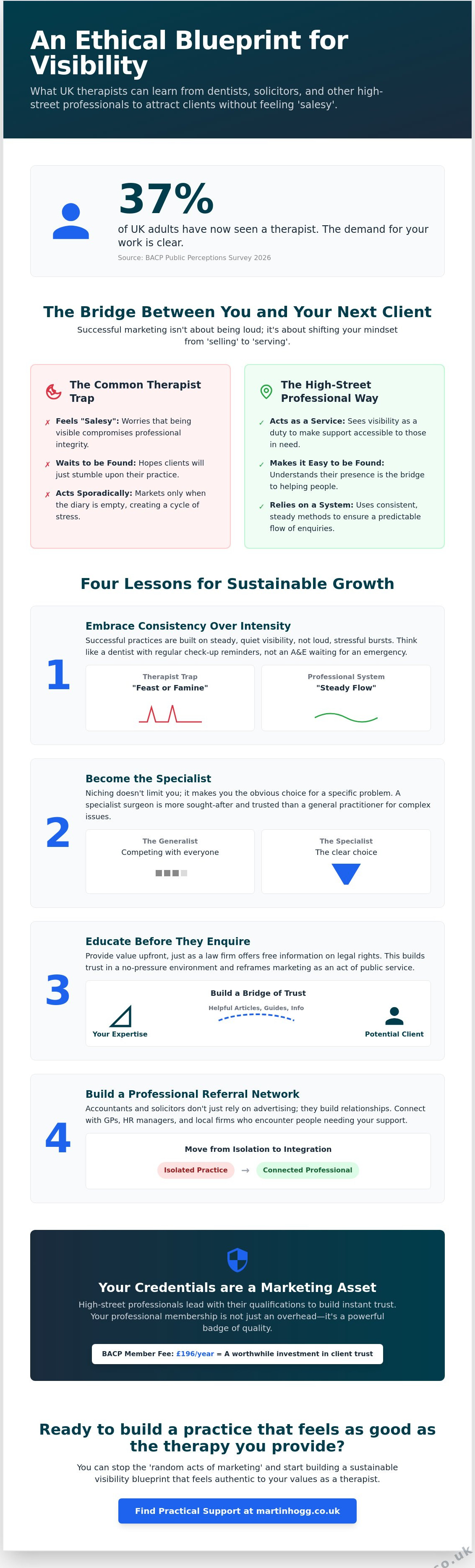
The truth is that 37% of UK adults have now seen a therapist, according to the BACP Public Perceptions Survey 2026. The demand is there, but the bridge between your practice and the people who need you often feels broken. By looking at what counsellors cna learn form other professionals' marketing, we can find a way to be visible that feels authentic and helpful rather than pushy. I promise to show you how to borrow the best systems from successful non-therapy businesses while maintaining your ethical integrity. We will explore practical ideas to ensure consistent client enquiries, allowing you to focus on the clinical work you love.
Key Takeaways
- Reframe visibility as a vital act of service that helps potential clients find the support they need without you feeling 'salesy'.
- Understand what counsellors cna learn form other professionals' marketing by adopting the simple consistency and educational systems used by local dentists and solicitors.
- Discover why niching like a medical specialist builds deeper trust and allows you to command professional fees that reflect your expertise.
- Learn how to reduce client anxiety before they even step into the room by borrowing clear communication techniques from hospitality and architecture.
- Stop relying on 'random acts of marketing' and start building a sustainable visibility blueprint that feels authentic to your values as a therapist.
Why Therapists Often Struggle Where Other Professionals Succeed
Many of us feel a distinct sense of unease when we think about promoting our work. We've spent years honing our empathy and clinical skills, yet the idea of "marketing" often feels like it belongs to a different world entirely. This discomfort usually stems from a clash between our therapist mindset, which prioritises the client’s needs, and a misunderstood business mindset that feels predatory or loud. We worry that being visible might compromise our professional integrity or make us look like we care more about profit than people.
If you look at your local high street, you'll see solicitors, dentists, and architects who don't share this internal conflict. They understand that their presence in the community is a responsibility. When we look at what counsellors cna learn form other professionals' marketing, the first lesson is that visibility is not about ego; it's about accessibility. If a person in your town is struggling with a specific issue and cannot find your practice, they remain stuck. Professional marketing is the bridge between a person in pain and the support they need.
Understanding the principles of marketing for service-based professions helps us see that we are not selling a physical product. We are offering a professional relationship. Other UK professionals succeed because they've accepted that being visible is the only way to be helpful. They don't wait for people to guess they exist. They make it easy for those in need to find them.
The Ethical Bridge: Marketing as Helpful Information
Think about how your GP surgery or a local law firm operates. They often provide free, high-quality information about common health issues or legal rights long before a client ever pays a penny. They aren't "selling" in the traditional sense; they are educating. By providing value upfront, you move away from that "salesy" feeling and toward a model of public service. This is the most ethical way to attract private pay clients. It allows them to get to know your approach and expertise in a safe, no-pressure environment before they ever book a session.
Lessons in Visibility: Borrowing Systems from High-Street Professionals
Think about your local dentist. They don't wait for you to wake up with a toothache before they reach out. Instead, they have a system of regular check-up reminders and educational newsletters about oral health. This is exactly what counsellors cna learn form other professionals' marketing; the power of a system over a sporadic "burst" of activity. When we only market our practice when our diary is empty, we create a cycle of stress and feast-or-famine that is difficult to sustain.
High-street professionals like accountants or solicitors also understand the value of a referral network. They don't just rely on cold advertising; they build relationships with other businesses that serve the same clients. You can replicate this by focusing on networking for therapists, connecting with GPs, HR managers, or even local solicitors who may encounter people in need of emotional support. It is about becoming a trusted name in a wider professional circle.
Consistency Over Intensity
The most successful private practices are built on steady, quiet visibility rather than loud, one-off campaigns. Other professionals automate their reminders and social presence so they can focus on their clinical work. If you only focus on marketing when you feel desperate for clients, you risk therapist burnout because the pressure becomes overwhelming. A simple, automated email or a scheduled weekly post is far more effective than a monthly frantic search for new enquiries.
The Specialist Advantage
In the medical world, a surgeon who only operates on knees is often more sought after than a general practitioner. They command higher trust because their focus is narrow. Many therapists fear that niching down will limit their client base, but the opposite is usually true. When you are "the person for anger management" or "the specialist for working with men," your marketing becomes ten times easier because you are no longer competing with every generalist on a large directory. You become the obvious choice for a specific problem.
Your membership in professional bodies like the BACP or UKCP is a significant marketing strength. While you might see the annual fee—which for an individual BACP member is £196 as of April 2026—as a simple overhead, it is actually a badge of quality. High-street professionals lead with their credentials because it builds immediate trust. If you are looking for a structured way to build this kind of professional presence, you might find my Private Practice Success Membership a helpful place to start.
Beyond the Therapy Room: Learning from Service-Based Client Journeys
When a potential client visits your website, they are often in a state of high anxiety or emotional distress. High-end hospitality businesses and private medical clinics understand this feeling well. They use the "pre-arrival" phase to lower blood pressure and build a sense of safety before a guest even walks through the door. This is a core part of what counsellors cna learn form other professionals' marketing. By providing clear, reassuring information before the first session, you make the transition into therapy feel secure rather than intimidating.
We can also learn a great deal from how architects communicate. They take complex, overwhelming structural processes and explain them to laypeople using simple language and clear stages. You can do the same by stripping away clinical jargon. Describe the "journey" of therapy in a way that helps a client understand exactly what to expect. This clarity replaces the fear of the unknown with a sense of professional partnership, mirroring the transparency found in other trusted professions.
Many therapists worry about sounding like a salesperson during initial enquiries. However, if you look at a specialist doctor's consultation, they aren't "selling" a procedure. They are listening, assessing, and proposing a path forward based on their expertise. When you adopt this "Consultant Model," your discovery calls stop feeling like sales pitches and start feeling like the first step of clinical care. You are simply ensuring that you are the right person to help them find a resolution.
Reducing Friction in the Enquiry Phase
A simple "Contact Me" page is often the weakest link in a counselling private practice. It puts the entire burden of the first move on a person who is already feeling overwhelmed. Other professionals reduce this friction by offering a clear, low-pressure next step, such as a brief assessment call. By framing these calls as a professional triage rather than a sales opportunity, you maintain your integrity while making it easier for clients to reach out. If you want to build these professional systems into your practice, you can join our Private Practice Success Membership for practical, step-by-step guidance.
Turning Inspiration into a Sustainable Practice Visibility Plan
We have explored how dentists, solicitors, and architects manage their professional presence. Now, the challenge is to move away from "random acts of marketing" and toward a consistent system. Most therapists only tweak their directory profiles or post on social media when their diary feels worryingly empty. This reactive approach creates a cycle of anxiety that is hard to break. By looking at what counsellors cna learn form other professionals' marketing, we see that success comes from having a reliable blueprint that runs steadily in the background.
You do not need to spend 40 hours a week on business tasks to see results. In fact, the most effective systems are those that require only a few hours of focused attention each month. This level of efficiency is much easier to achieve when you aren't working in isolation. Starting and growing a private practice is a significant undertaking, and having a community of like-minded peers can provide the practical and emotional support needed to keep going.
Building Your Practice Visibility Blueprint
It is perfectly natural to feel a sense of "visibility vulnerability" when you begin to promote your work more actively. Putting your name and face into the community can feel like a risk to your professional identity. However, your clinical skills are far too valuable to remain hidden behind a stale, uninspiring directory listing. When you frame your marketing as a way to help people find the right support, the fear of being "seen" often begins to lift.
If you are ready to move through these hurdles with expert guidance, I invite you to check the Martin Hogg Calendar for our upcoming training sessions. We focus on practical, ethical strategies that respect your boundaries as a therapist while ensuring your practice remains sustainable. Your work deserves to be found by the people who need it most. By borrowing the best systems from other professions, you can build a practice that is both clinically excellent and commercially sound.
Building a Practice That Reflects Your Values
Creating a practice that thrives doesn't require you to become someone you aren't. We've seen that by shifting your focus toward visibility as an act of service, you can reach the people who truly need your help. Whether it's adopting the consistency of a local dentist or the clear communication of an architect, what counsellors cna learn form other professionals' marketing is that a reliable system beats sporadic effort every time.
I've spent over 20 years in the UK counselling sector, and I know how isolating this journey can feel. My coaching is always practical and jargon-free, designed to move you past the overwhelm of technical business tasks. If you're ready to stop feeling like a "failed" business person and start feeling like a visible, helpful professional, I'd love to welcome you into our community. We offer BACP-endorsed workshops and accredited CPD to help you build a practice that lasts.
Join the Private Practice Success community and start your Visibility Blueprint today. Your skills are far too valuable to stay hidden; it's time to build the practice you deserve.
Frequently Asked Questions
Is it ethical for a UK counsellor to use marketing techniques from other industries?
It is entirely ethical to use marketing systems from other sectors, provided they are adapted to meet your professional body's standards. High-street professionals like solicitors use visibility systems to ensure those in need can find their services. You aren't compromising your clinical integrity by making your practice accessible; you are simply providing the information necessary for a client to make an informed choice about their care.
How can I market my practice without sounding like I'm 'selling' a cure?
You can avoid sounding "salesy" by focusing on the therapeutic process and the specific groups you support. Instead of promising a guaranteed result, describe your way of working and the types of struggles you help with. This approach is exactly what counsellors cna learn form other professionals' marketing; it is about being a professional guide who explains the journey rather than a salesperson making exaggerated claims.
What is the most effective marketing channel for UK therapists in 2026?
A well-optimised directory profile and a clear, user-friendly website remain the most effective tools for reaching clients. According to the BACP Public Perceptions Survey 2026, 37% of UK adults have seen a therapist, which means a significant portion of the population is actively looking for support. Being visible in the places where people already search ensures you connect with those who are ready to start therapy.
Do I need a huge marketing budget to be as visible as other professionals?
You don't need a large budget to build a sustainable and visible practice. Most successful high-street professionals win through steady consistency and local networking rather than expensive, flashy ad campaigns. Small, regular actions like updating your website or building relationships with local GPs are often free. These efforts are far more effective for long-term growth than a one-off, costly advertisement that lacks a clear strategy.
How do I handle negative feedback or 'visibility' anxiety as a therapist?
Visibility anxiety is a common hurdle, but it often eases when you view your marketing as an act of service. If you encounter negative feedback, try to treat it with the same professional curiosity you would bring to a clinical session. It isn't a reflection of your worth as a therapist. Surrounding yourself with a supportive community of peers can provide the reassurance you need to stay visible and helpful.

Article by
Martin Hogg
I help Private Practice counsellors in the UK set up and grow an ethical Private Practice they love, work with their ideal clients, and earn the income they deserve. All without guesswork and burnout. I have been a private practice counsellor myself for over 20 years, specialising in anger management. I set up a not-for-profit social enterprise, Citizen Coaching and Counselling, which delivers thousands of counselling sessions a year to adults and young people in Birmingham. I am a registered BACP Counsellor and the author of three books, My Anger Coach, My Anxiety Coach and My Relationship Coach. These are available on Amazon.
Disclaimer
The information provided on this blog is for general informational purposes only and is not intended to be a substitute for professional medical or mental health advice, diagnosis, or treatment. Reading this content does not create a therapist-client relationship.


