
What is Niching? A Practical Definition for UK Therapists

Article by
Martin Hogg
I help Private Practice counsellors in the UK set up and grow an ethical Private Practice they love, work with their ideal clients, and earn the income they deserve. All without guesswork and burnout. I have been a private practice counsellor myself for over 20 years, specialising in anger management. I set up a not-for-profit social enterprise, Citizen Coaching and Counselling, which delivers thousands of counselling sessions a year to adults and young people in Birmingham. I am a registered BACP Counsellor and the author of three books, My Anger Coach, My Anxiety Coach and My Relationship Coach. These are available on Amazon.
What if I told you that trying to help everyone is the quickest way to ensure you end up helping almost nobody? It feels counterintuitive, doesn't it? You've spent years training to be a compassionate counsellor, and the idea of narrowing your focus feels like you're slamming the door on people in need. Most therapists I talk to are terrified that a tight niching definition means their diary will stay empty. You want to be inclusive, but right now, your marketing is likely just white noise on the Counselling Directory or Psychology Today.
Niching isn't about exclusion; it's about being found by the people who truly need your specific expertise. In this guide, I'll help you move past the dry dictionary terms to understand how 'niching down' actually works for a private practice in the UK. I'll show you how to attract a sustainable flow of the 'right' clients without sounding like a pushy salesperson, so you can finally stop feeling like a jack of all trades and start feeling like the specialist you are.
Key Takeaways
- Understand why a practical niching definition is less about a dictionary entry and more about becoming the 'go-to' expert for a specific, urgent struggle.
- Learn how to overcome the fear of 'missing out' by using a clinical strategy that attracts a steady flow of the right people to your practice.
- Discover how to use my 'Skateboard Model' to test your niche on platforms like Psychology Today without needing a massive, polished website first.
- Use a simple two-step audit to find your niche based on the work you already find most fulfilling and effective.
The Definition of Niching: Beyond the Dictionary
If you look up a standard niching definition in a dictionary, you'll likely find references to a "recess in a wall" or a "suitable position." While that is lovely for interior designers, it is useless for a private practice counsellor trying to pay the mortgage. In our world, niching is a deliberate clinical strategy. It is the process of becoming the obvious, trusted expert for a specific struggle or demographic.
I see many therapists struggle because they confuse what they can do with what they should market. Your training allows you to work with a wide range of issues, and that is vital for your BACP membership. However, marketing for "everything" makes you invisible. Niching is the intersection of your clinical passion and a specific client pain point.
Neesh or Nitch? The Great Pronunciation Debate
I personally prefer "neesh", but I won't hold it against you if you say "nitch". The pronunciation matters far less than the clarity it brings to your Psychology Today profile. If a client is in distress, they aren't checking your phonetics. They are looking for a sign that you understand their world and have the tools to help them move forward.
Generalist vs. Specialist in the UK Therapy Market
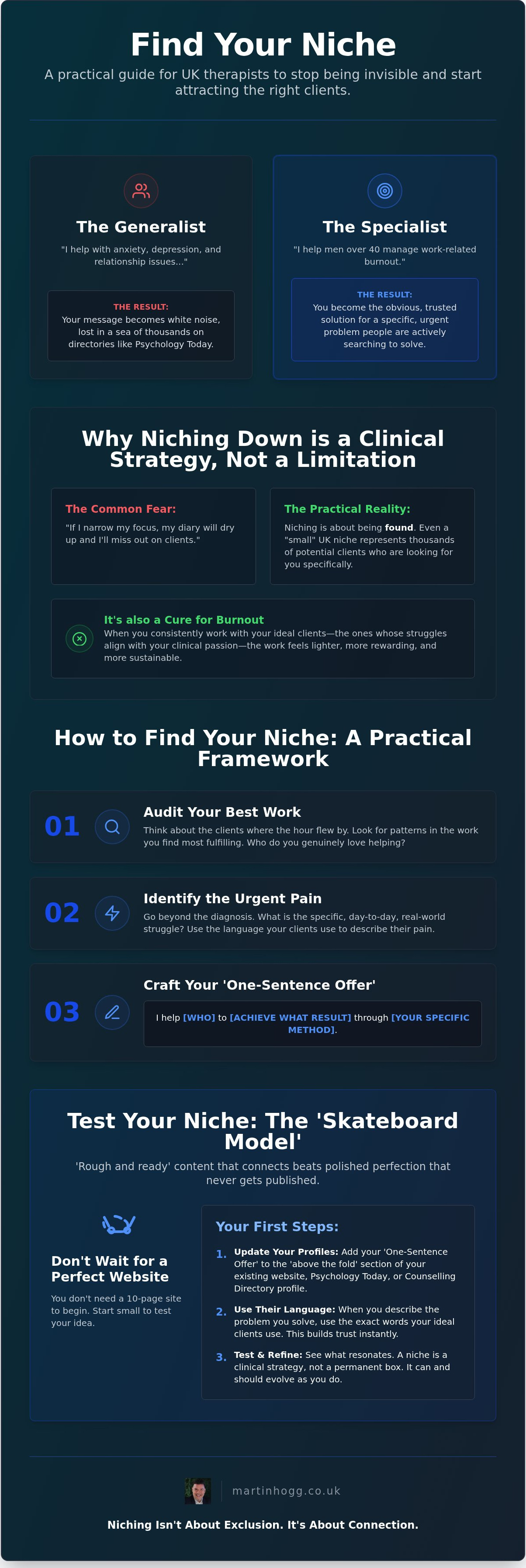
The Counselling Directory is a crowded place. If your profile says you help with "anxiety, depression, and relationship issues", you are competing with thousands of others. Specialists build trust faster. When a client sees that you specifically help men over 40 with work-related burnout, they don't just see a therapist; they see a solution. This focus doesn't limit your skills. It amplifies your visibility and helps you build a practice that actually stands out.
Why Niching Down Feels Scary (and Why It’s Essential)
I often hear the same worry from therapists: "If I niche down, my diary will dry up." It is a classic case of FOMO. However, the practical niching definition I use is about being found, not about being limited. Even a "small" niche in the UK represents thousands of potential clients. If you try to speak to everyone, your message gets lost. By narrowing your focus, you become visible to those actively searching for your specific help.
You don't need a polished, 10-page website to start testing this. I advocate for the "skateboard model," which involves a simple, rough and ready approach. Update your "above the fold" content on Squarespace or Wix with a clear one-sentence offer. When you refine your title and description tags to reflect a niche, search engines can finally categorise you. If you're feeling stuck, my Niche Building Secrets can help you move past that initial "what if" stage.
The Ethics of Specialisation
Some worry that specialising is exclusionary. I'd argue it is often more ethical to refer a client to a specialist than to struggle through as a generalist. Aligning your niche with your BACP professional development goals ensures you provide the highest standard of care. It is about depth, not just breadth.
Niching as a Cure for Burnout
Working with "draining" clients is a fast track to exhaustion. When you work with your ideal client, the work feels lighter and more rewarding. Niching is a vital component of any therapist burnout guide. It allows you to build a sustainable practice where you actually enjoy your clinical hours. To see how this fits into a larger strategy for growth, you might find our Private Practice Success community a helpful place to start.
How to Find Your Niche: A Practical Framework
Finding your niche doesn't have to be a spiritual quest. It's a logical process. I'd start by auditing your past clients. Think about the individuals who made you look at your watch and wonder where the hour went. These are usually the people whose struggles align with your clinical passion. If you can identify three or four similar cases, you've found the seeds of your niche.
Once you've spotted a pattern, identify the specific, urgent pain they feel. It's rarely just a general diagnosis. It's the practical, day-to-day impact of that struggle. From there, you can craft your "one-sentence offer." This is a simple formula: I help [who] to [achieve what result] through [your specific method]. For example, "I help busy mums to reclaim their identity through solution focused therapy."
Don't guess. Check the demand on Google or even Canva to see what people are searching for. Look at the language clients use on Psychology Today when they describe their pain. This data-driven approach turns a vague idea into a solid niching definition for your practice. It moves you from "hoping" for clients to "knowing" they are out there looking for you.
The Passion + Profit + Problem Venn Diagram
You want to find the sweet spot where your specialised training, like my Anger Management CPD, meets a genuine market need. "Anxiety" is too broad for a niche. However, "Anxiety for new business owners" is specific enough to attract the right people. It solves a clear problem for a clear group. This focus makes your marketing feel less like a sales pitch and more like a helpful resource.
Testing Your Niche Without the Overwhelm
You don't need a total rebrand to start. Use the Counsellor Efficiency Bundle to streamline the transition. Remember, rough and ready content on social media often beats a polished, expensive rebrand that takes six months to launch. Just start where you are. People connect with people, not with perfect logos.
Implementing Your Niche in the UK Market
Now that we've nailed down a practical niching definition, it's time to put it to work. Implementation is where most therapists stall. I would start with your website, specifically the "above the fold" area on your Squarespace or Wix site. This is the first thing people see before they scroll. Don't waste it on a generic picture of a sunset. Use your one-sentence offer here so a visitor knows instantly they are in the right place.
Next, look at your Psychology Today bio. Most read like a dry CV. Instead, write directly to your niche. Use the language they use. When you speak to a specific pain, you build trust before the first enquiry even hits your inbox. It's about being a human, not a list of qualifications.
Don't forget your peers. When you specialise, you become a referral asset. Other therapists will happily send you clients that fall outside their own expertise if they know you are the "go-to" person for that specific issue. It's a much easier way to grow than constantly fighting for new leads from scratch.
Visibility Beyond the Therapy Room
Your niche should guide everything, from your blog posts to your SEO strategy. If you want a deeper dive into the technical side, my Marketing for Therapists UK guide covers the nuts and bolts. Using your niche to inform your content makes you far more searchable for the people who need you most. Rough and ready blog posts that solve a real problem will always beat polished, academic articles.
When to Pivot Your Niche
It is okay to change course. Your niching definition isn't set in stone. Sometimes a niche doesn't click, or you simply outgrow it. Recognising this early saves a lot of heartache. This is where an outside perspective, like one-to-one practice growth coaching, becomes invaluable to help you see the wood for the trees. For ongoing support and a community of peers doing the same, consider joining the Private Practice Success Membership.
Take the Next Step Toward a Sustainable Practice
Moving from being a generalist to a specialist is the most effective way to build a practice that actually works. We've explored how a practical niching definition moves you away from dusty dictionary terms and toward your ideal client. By using the "skateboard model" and refining your one-sentence offer, you stop shouting into the void and start speaking directly to those who need your specific help.
I've spent over 20 years in the UK therapy sector. As a BACP-endorsed training provider, I know that marketing doesn't have to be clinical or cold. It should be human, direct, and grounded in your clinical passion. You have the skills to help people; now you just need to make it easy for them to find you.
You don't have to figure this out on your own. Start building a practice that feels rewarding rather than draining. I'll see you on the inside.
Frequently Asked Questions
Is 'niching' the same as 'specialising' in a clinical area?
Specialising is about your clinical training, while niching is about your marketing focus. You might specialise in bereavement but niche specifically in helping parents who have lost a child. It's the practical application of your niching definition. I would suggest that your niche should be narrow enough that a potential client feels you are speaking only to them. This clarity builds trust quickly.
Can I have more than one niche in my therapy practice?
You certainly can, but I wouldn't recommend it when you're starting out. If your website tries to speak to three different groups at once, you'll likely confuse everyone. It is better to pick one area, like my Anger Management CPD focus, and get that working first. Once you have a steady flow of the right clients, you can consider adding a second, distinct landing page for another area.
What if I choose the wrong niche and nobody calls?
This is a common fear, but the "skateboard model" prevents it from being a disaster. By testing your ideas on Psychology Today or a single page first, you aren't committing to a massive rebrand. If the phone doesn't ring, you haven't failed; you've just gathered data. I would then tweak your one-sentence offer or look at different keywords on Canva to see what language actually resonates.
How do I describe my niche without sounding like a salesperson?
The secret is to stop "selling" and start "solving." When you use a clear niching definition, your marketing becomes an act of service. Use your bio to describe the specific, urgent pain your clients feel and the transformation they can expect. If you speak their language, you won't sound like a pushy salesperson. You'll sound like a specialist who finally understands exactly what they are going through every day.
Do I need a new website if I change my niche?
Definitely not. Most therapists I work with just need to update their "above the fold" content and their bio. Whether you use Squarespace, Wix, or a simple one-page site, the tech matters less than the message. I always say that rough and ready content beats polished perfection. Just update your title tags and description to reflect your new focus and let the search engines do the work.
Disclaimer
The information provided on this blog is for general informational purposes only. It is also not intended to be a substitute for professional medical or mental health advice, diagnosis, or treatment. Reading this content does not create a therapist-client relationship.


