
What to Write in Client Notes: Professional Guide

Article by
Martin Hogg
I help Private Practice counsellors in the UK set up and grow an ethical Private Practice they love, work with their ideal clients, and earn the income they deserve. All without guesswork and burnout. I have been a private practice counsellor myself for over 20 years, specialising in anger management. I set up a not-for-profit social enterprise, Citizen Coaching and Counselling, which delivers thousands of counselling sessions a year to adults and young people in Birmingham. I am a registered BACP Counsellor and the author of three books, My Anger Coach, My Anxiety Coach and My Relationship Coach. These are available on Amazon.
What if your client notes weren't a source of looming dread, but a simple five-minute task that actually helped you sleep better at night? Most of us started our private practices to help people, not to become full-time filing clerks drowning in a sea of digital folders. I know that specific brand of anxiety that comes from staring at a blank screen at the end of a long day, wondering exactly what to write in client notes to keep the BACP happy without accidentally writing a second-rate novel. It's exhausting to worry that you're saying too much, or even worse, that a client might one day request their file and find it's a disorganised mess.
I understand the pressure of trying to balance clinical accuracy with the strict requirements of GDPR and the EU AI Act. In this guide, I'm going to show you a repeatable, professional process that keeps you compliant and audit-ready without the soul-crushing admin burnout. We'll look at how to stay concise and clinical, so you can stop overthinking the paperwork and get back to growing your practice and focusing on the work that actually matters. You'll finish this feeling confident that your notes are a tool for your success, rather than a weight on your shoulders.
Key Takeaways
- Learn why your notes should be a professional record of the therapeutic journey rather than a word-for-word transcript of every session.
- Discover exactly what to write in client notes using factual observations and the "Judge in the Room" test to keep your records safe and professional.
- Understand the reality of GDPR and Subject Access Requests so you can manage your data with calm confidence instead of fear.
- Adopt a "rough and ready" system that lets you complete your admin in minutes, giving you more time to focus on your practice growth.
- Simplify your process using the "Skateboard Model" to create a manageable routine that meets BACP standards without the usual burnout.
The Purpose of Client Notes: Why We Scribble
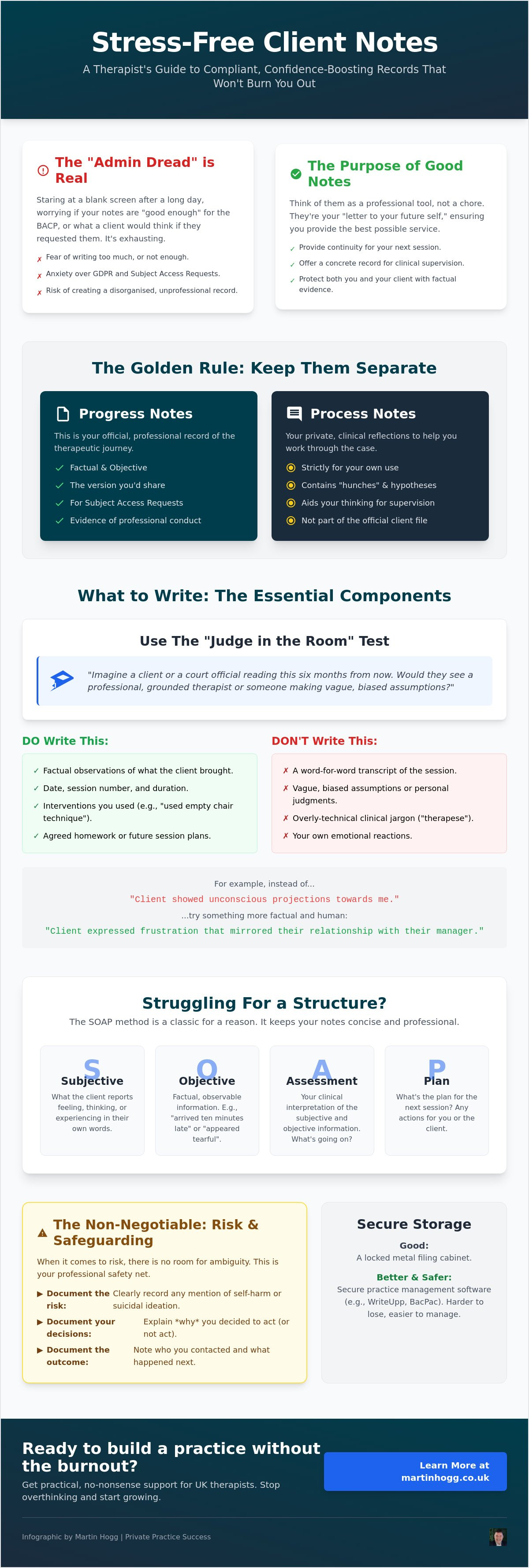
Let’s be honest; most of us didn't spend years training as therapists because we had a burning passion for filing. That familiar "admin dread" usually kicks in on a Friday afternoon when the last thing you want to do is face a blank screen. We often over-complicate the process because we're terrified of doing it "wrong." Your notes shouldn't be a word-for-word transcript of every sentence uttered. Instead, think of them as a professional record of the therapeutic journey. If you are questioning what are client notes in a practical sense, they are the factual evidence of your professional conduct and the client’s clinical status.
The BACP expects us to keep "accurate and appropriate" records. This serves as a baseline for safety, but it's also a "letter to your future self." These notes provide essential continuity for your next session and give you something concrete to bring to clinical supervision. When you understand what to write in client notes, you stop the guesswork and start creating a clear, professional trail. This protects both you and the person sitting across from you, ensuring the work remains grounded and focused on the client's progress.
Progress Notes vs. Process Notes
I find it helpful to keep these two categories distinct. Progress notes are the official version. They are factual, objective, and what you’d share if a court or a client requested them. Process notes are your private clinical reflections; the "hunches" and hypotheses that help you work through the case. Keeping them separate is vital for your peace of mind. With the 2026 regulatory focus on the "right to erasure" and data transparency, having a clean, factual official record makes managing your admin much less of a headache. It keeps your private reflections private and your professional records professional.
What to Write in Client Notes: The Essential Components
Deciding what to write in client notes doesn't have to be a guessing game. I always tell my coaching clients to focus on factual observations. What did the client actually bring to the room? What interventions did you use? If you find yourself writing a five-page essay, you're doing too much. Stick to the essentials: the date, the session number, and any agreed homework or future plans. It’s about creating a clear, professional snapshot that anyone could pick up and understand.
I like to use the "Judge in the Room" test. When you're typing away, imagine the client or a court official reading your words six months from now. Would they see a professional, grounded therapist or someone making vague, biased assumptions? Avoid clinical jargon or "therapese" where possible. Instead of writing about "unconscious projections," try "the client expressed frustration that mirrored their relationship with their manager." It’s more human and far more useful in the long run. If you're feeling overwhelmed by the technical side of things, joining a supportive community for therapists can help you find your feet.
The Simple SOAP Method for Counsellors
If you’re struggling for a structure, the SOAP method is a classic for a reason. While it can feel a bit medical, it’s a brilliant way to keep things concise. First, record the Subjective: what the client reports feeling. Next is Objective: factual things you noticed, like "client appeared tearful" or "arrived ten minutes late." Then, add your Assessment and Plan. This is your clinical take on the session and what happens next. While we focus on UK standards, looking at HIPAA requirements for psychotherapy notes helps illustrate why keeping these factual "progress" records separate from your private reflections is a global best practice.
Risk and Safeguarding: The Non-Negotiables
When it comes to risk, there is no room for ambiguity. If a client mentions self-harm or thoughts of ending their life, you must document it clearly. Don't just record the risk; record your decision-making process too. Why did you decide not to break confidentiality? Or if you did, who did you call and what was the outcome? This is your safety net. It shows you've acted reasonably, professionally, and in line with BACP ethical standards. It’s not just about the notes; it’s about proving you’ve done your job well.
GDPR, Confidentiality, and the Fear of Disclosure
The mere mention of a Subject Access Request (SAR) is enough to make many therapists break out in a cold sweat. We worry that a client will read our reflections and feel judged, or that we've somehow failed a secret legal test. When you're deciding what to write in client notes, this fear often leads to "defensive writing," where we say almost nothing at all. This doesn't help you, and it certainly doesn't help the client. GDPR for therapists is a framework for respect and transparency, not just a set of hurdles to jump over.
Storage is another area where we tend to overthink things. A locked metal cabinet in your home office is perfectly fine, but practice management software is often safer and much harder to lose in a move. You also need to navigate the "Right to be Forgotten." While the European Data Protection Board has made the right to erasure a key enforcement priority in 2026, this doesn't mean you delete everything the moment a client asks. The standard seven-year retention rule for therapy records usually overrides a deletion request because you have a professional obligation to maintain those records for legal and insurance purposes.
Handling Subject Access Requests Without Panic
If a client asks to see their notes, don't panic. You have exactly one month to respond to the request. Your first step should be to review the file calmly. You are allowed to redact information that identifies third parties or data that a healthcare professional believes would cause serious harm to the client's physical or mental wellbeing. It's about being transparent while remaining protective of the therapeutic process. If you want to build a practice that feels secure and professional, come and join us in the Private Practice Success Membership where we talk through these practicalities every day.
Systems for Success: Getting Notes Done in Minutes
Admin is often the biggest hurdle to Scaling a Therapy Practice. If you spend an hour on paperwork for every hour of therapy, you’ll burn out before you even get started. I’m a huge fan of the "Rough and Ready" philosophy. A completed, five-minute note that meets professional standards is infinitely better than a "perfect" one that exists only in your head because you’re too tired to type it. Perfectionism in admin is just another form of procrastination.
I recommend using the "Skateboard Model" for your back-office. Don't try to build a complex, all-singing, all-dancing database on day one. Start with the simplest system that works. For many, this means utilizing the "golden 10 minutes" right after a session. If you write your notes while the client’s words are still fresh, you won't waste time later trying to remember exactly what to write in client notes or staring at a blank screen on a Sunday evening. While some prefer batching at the end of the day, immediate entry usually saves hours of mental labour across the week.
Tools to Speed Up Your Admin
You don't need fancy tools to be efficient. Simple templates in Word or even Canva can keep your structure consistent so you aren't reinventing the wheel every time. If you’re ready to automate the boring bits, practice management software like WriteUpp or Cliniko can handle the date, session numbers, and reminders for you. These tools are designed to take the weight off your shoulders, letting you focus on the human side of the work rather than the filing.
Building a Sustainable Practice
Mastering your admin isn't just about compliance; it's about freedom. When you aren't drowning in paperwork, you have the headspace for getting more counselling clients and actually enjoying your business. If you want to professionalise your back-office and stop feeling like an overwhelmed amateur, our Private Practice Success Membership is the place to be. We focus on easy wins and practical steps that help you build a practice that serves your life, rather than consuming it.
Take Back Your Friday Afternoons
I hope you’re feeling a bit more at ease with your paperwork now. Learning exactly what to write in client notes shouldn't be a source of constant anxiety; it’s simply about creating a professional safety net that protects both you and your clients. Remember to keep things factual, use the "Judge in the Room" test, and always choose "rough and ready" over a perfectionism that never gets finished. If you can master those golden ten minutes right after a session, you’ll find your weekends start feeling a lot lighter and your mind stays much clearer.
Building a private practice is a big undertaking, and I know how quickly admin dread can sap your energy. With over 20 years of experience and a range of BACP-endorsed workshops under my belt, I’m here to provide the practical, no-nonsense support that UK therapists actually need. If you are ready to spend less time on admin and more time with clients, come and join the Private Practice Success community today. We’ll help you professionalise your back-office so you can focus on the work you love. You've got this.
Frequently Asked Questions
Can a client legally see the notes I write about them?
Yes, they absolutely can via a Subject Access Request. Under GDPR, clients have a legal right to access any personal data you hold on them, which includes their session records. This is why knowing what to write in client notes is so important; you want to ensure your records are professional, factual, and wouldn't cause undue distress if read by the client. You can only redact information if it identifies someone else or if a professional believes it would cause serious harm.
How long am I required to keep client records in the UK?
The standard rule of thumb is seven years after the therapy has ended. While the BACP doesn't set a hard and fast timeframe, most insurance companies and legal advisors suggest seven years to align with the limitation period for legal claims. If you're working with children, the rules are different; you usually need to keep those records until they turn 25 or 26. Always check your specific insurance policy to stay on the safe side.
Do I have to take notes during the session or can I wait until after?
It’s entirely up to you and how you work best. Some therapists find taking brief notes during the session helps them stay focused, while others feel it breaks the human connection. I personally prefer the "golden 10 minutes" immediately after the client leaves. It keeps the session feeling natural while ensuring the details are still fresh enough to record accurately without spending your whole evening staring at a screen.
What happens to my notes if I am suddenly unable to work?
You need a Clinical Will to handle this. This is a professional requirement for BACP members and involves appointing a "Clinical Trustee" who can access your records and contact your clients if you’re incapacitated or pass away. It sounds a bit morbid, but it’s a vital part of your duty of care. Your trustee needs to know where your notes are stored and have the keys or passwords to get to them securely.
Is it better to keep paper notes or use digital software for GDPR?
Neither is inherently "better" as long as they are secure. A locked filing cabinet is perfectly acceptable, but digital software often makes life easier for modern practice management. Platforms like WriteUpp or Cliniko offer encryption and automatic backups that are hard to replicate with paper. With the 2026 focus on the "right to erasure" and data transparency, digital systems often make responding to client requests much faster and less stressful.
Disclaimer
The information provided on this blog is for general informational purposes only and is not intended to be a substitute for professional medical or mental health advice, diagnosis, or treatment. Reading this content does not create a therapist-client relationship.


