What's the best course to do if I want to be a counsellor in the UK?
The most expensive mistake you can make in this profession is choosing a training provider based on price or convenience rather than long term accreditation. You are likely asking yourself, whats the best course to do if i want to be a counsellor in the UK because you want to help people, but you also need to know your qualification will actually allow you to find work. With the BACP now supporting over 70,000 members and the SCoPEd framework changing the standards as of February 2026, the requirements for becoming a therapist have become more specific and demanding than they used to be.
I understand the anxiety that comes with looking at a four year training commitment while you are still balancing a full time job. It feels like a lot of pressure to get it right the first time without wasting your savings. This guide provides a clear, practical roadmap through the UK training system, from your initial Level 2 certificate to the essential Level 4 Diploma. I will explain the real differences between bodies like the BACP and UKCP, and show you how to manage the costs of personal therapy and supervision so you can focus on getting your new career on track.
Key Takeaways
- Learn why the Level 4 Diploma is the essential "Gold Standard" for anyone starting their journey toward professional practice.
- Understand the practical differences between the academic university route and the vocational college pathway to find your best fit.
- Discover how to decide whats the best course to do if i want to be a counsellor in the UK based on your long term career goals and time commitments.
- Get clear on the roles of professional bodies like the BACP and UKCP so you can build a practice that clients trust.
- Prepare for the transition into private practice early so you can avoid the common struggle of finding work after you qualify.
Navigating the UK Counselling Qualification Pathway
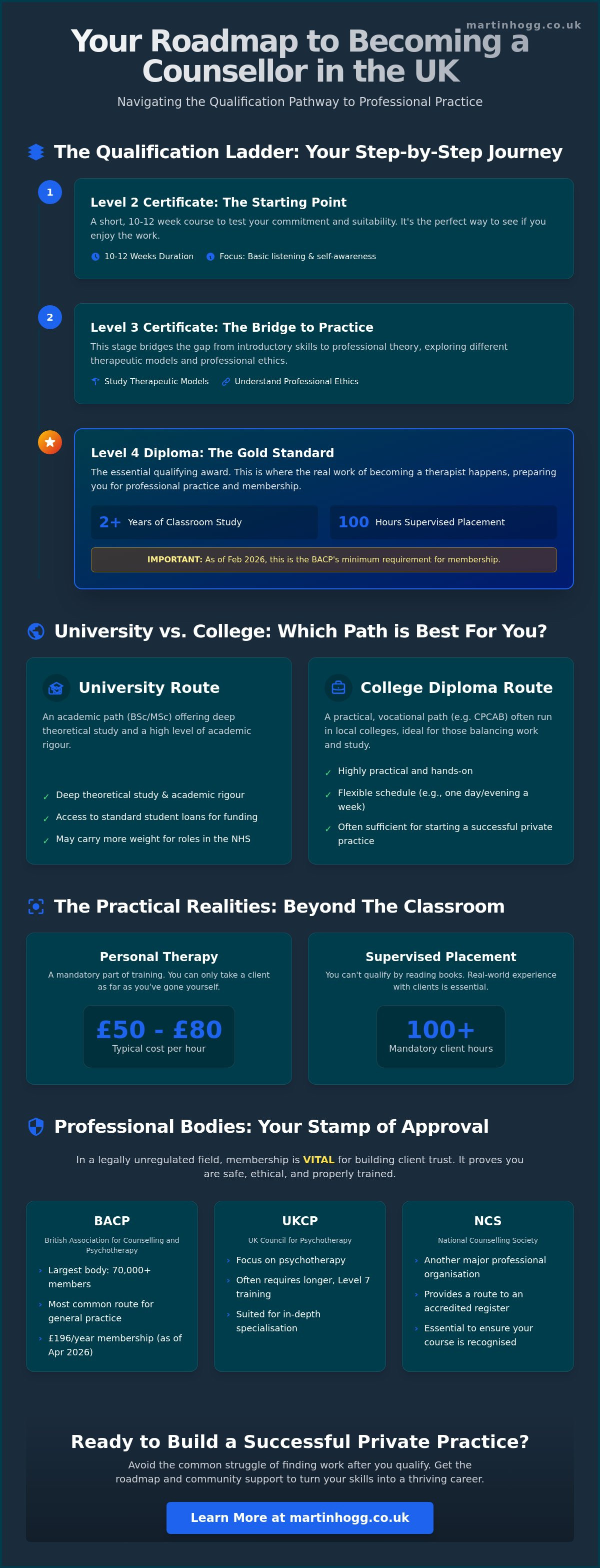
Becoming a counsellor isn't about finding a single magic course. It is a structured journey that requires patience and a willingness to look inward. If you are searching for whats the best course to do if i want to be a counsellor in the UK, you must look for courses that are qualifying rather than just introductory. The distinction is vital. Introductory skills courses are great for teachers or managers, but they don't give you the right to practice. As of 1 February 2026, the BACP requires a minimum of a Level 4 Diploma for membership, involving at least two years of classroom study and 100 hours of supervised placement.
This journey is as much about your own personal growth as it is about academic learning. You’ll likely find that the post-qualification cliff is easier to handle if you've built a solid foundation. The history and regulation of Counselling in the United Kingdom show that while the field isn't legally regulated yet, the industry standards are high. Expect to spend money on your own therapy during this time. It's a necessary part of the process that ensures you are grounded before you try to help others get their lives back on track.
The Progressive Levels: From Level 2 to Level 4
Most students follow a three step ladder. Each step is designed to test your commitment and suitability for the role.
- Level 2 Certificate: A short, 10 to 12 week course. It focuses on basic listening skills and self-awareness. It's the best way to see if you actually enjoy the work.
- Level 3 Certificate: This is the bridge. You’ll study different therapeutic models and begin to understand the ethics of the profession.
- Level 4 Diploma: The qualifying years. This is where the real work happens. You’ll complete a clinical placement with real clients while receiving supervision to ensure your practice is safe and effective.
University Degree vs. College Diploma: Which is Best for You?
Choosing between a university degree and a college diploma is one of the biggest hurdles for new trainees. The vocational route, often through awarding bodies like CPCAB or ABC, is highly practical. These courses usually run one day or evening a week in local further education colleges. This makes them ideal if you are working another job to pay the bills. On the other hand, the academic route through a BSc or MSc offers deep theoretical study and a higher level of academic rigour. According to Prospects.ac.uk, both routes lead to a professional career, provided the course meets the standards of a recognised professional body.
Funding is a major factor in this decision. Universities allow you to access standard student loans, which can cover tuition and sometimes living costs. College diplomas are often self funded, though you might qualify for an Advanced Learner Loan for Level 3 or Level 4. If you want a smoother path to professional registration, look for a "BACP Accredited" course. These have been pre-vetted to meet high standards, meaning you won't have to go through a lengthy individual application process later. When people ask me whats the best course to do if i want to be a counsellor in the UK, I always suggest looking at the end goal. If you want to work in the NHS, a degree might carry more weight. If you want to start your own practice, a vocational diploma is often more than enough.
The Practical Reality of Placements and Personal Therapy
You cannot become a therapist solely by reading books. You need a course that supports you in finding a clinical placement. This is where you'll gain your 100 mandatory hours of experience. You also need to budget for the "hidden" costs of training. Most reputable courses require you to be in personal therapy yourself. Trainees often pay between £50 and £80 per hour for these sessions, which can add up over two years. This isn't just a box-ticking exercise. Personal growth is just as important as academic theory in UK training because you can only take a client as far as you have gone yourself. If you are already thinking about how to turn these skills into a career, you might find our community for private practice success a helpful place to start.
Professional Bodies: Understanding BACP, UKCP, and the NCS
In the UK, anyone can technically call themselves a counsellor without any training at all. This lack of legal regulation is exactly why joining a professional body is so vital for building trust with your future clients. It provides a stamp of approval that says you are safe, ethical, and properly trained. When you are researching whats the best course to do if i want to be a counsellor in the UK, you must ensure the training provider is recognised by one of the main professional organisations.
The British Association for Counselling and Psychotherapy (BACP) is the largest body. It has over 70,000 members and is the most common route for general practice. As of April 2026, their individual membership fee is £196 per year. If you want to specialise in psychotherapy, the UK Council for Psychotherapy (UKCP) often requires longer, Level 7 training. Their full clinical membership fee for 2025-2026 is £314. Alternatively, the National Counselling and Psychotherapy Society (NCPS) offers an accessible but equally robust path for many. Information from the National Careers Service confirms that membership in these bodies is the standard for professional practice.
Why the 'Accredited Register' is Your Goal
Your ultimate aim is to get onto a register accredited by the Professional Standards Authority (PSA). This is a badge of quality that employers, particularly the NHS, look for when hiring. It also gives you access to an ethical framework. This framework acts as a guide for your practice. It helps you manage the self doubt that often creeps in when you are dealing with complex client issues. Having a clear set of ethical rules means you aren't alone when making difficult decisions.
Deciding which body to join can feel overwhelming, but it is really about where you feel you belong. If you want to start thinking about how to build a career beyond just getting your certificate, you can join our community for private practice success to connect with others on the same path. We help you move past the anxiety of starting out and focus on the practical steps of helping people.
Beyond the Certificate: Preparing for Private Practice
Many students reach the end of their Level 4 Diploma and feel a sudden sense of panic. This is often called the "post-qualification cliff". You spend years focusing on theory and skills, but suddenly you are a qualified professional with no clients and no clear idea of how to find them. When you are deciding whats the best course to do if i want to be a counsellor in the UK, look for programmes that acknowledge this transition rather than just handing you a certificate and wishing you luck.
Building a counselling private practice uk requires a shift in mindset. You need to start thinking like a practitioner and a business owner while you are still in training. This might mean starting to think about your niche early on. For example, working with men is a growing area that requires a specific, direct approach that many general courses do not cover in depth. If you want to stand out, you need to understand who you are helping and why. Truly understanding whats the best course to do if i want to be a counsellor in the UK involves looking at how that training prepares you for the "day after" graduation.
Investing in Your Future Visibility
Most training providers focus heavily on clinical safety but leave out the practicalities of being seen by those who need your help. Understanding marketing for therapists uk is often the missing piece of the training puzzle. It isn't about being "salesy" or pushy. It's about letting people know you are there to help them get their lives back on track. If you ignore this side of the profession, you may find your skills going to waste because your practice stays empty.
You don't have to do this alone. Joining a supportive group like our Private Practice Success community can provide the encouragement you need to overcome perfectionism and the fear of visibility. I also recommend checking our CPD calendar for workshops designed to bridge the gap between being a student and becoming a thriving practitioner. Taking action now, even while you are still studying, is the best way to ensure your new career is both fulfilling and sustainable.
Taking Your First Step Toward a New Career
Choosing your training is a big decision, but it doesn't have to be a source of constant anxiety. Remember that the Level 4 Diploma remains the essential baseline for safe practice. Whether you choose the academic university route or a vocational college course, ensure your training is recognised by a professional body like the BACP or NCPS. This membership is what builds trust with your clients and ensures you are working within a safe, ethical framework.
Finding out whats the best course to do if i want to be a counsellor in the UK is only the start of your professional journey. Many trainees focus so much on the certificate that they forget to prepare for the reality of running a practice. I founded Citizen Coaching to help people move from theory to real world results. If you want to bridge that gap between being a student and a successful therapist, I invite you to join us.
Ready to plan your path to a successful practice? Join our Private Practice Success Membership today. You'll get practical, no-nonsense business support and access to BACP-endorsed workshops designed to help you get your career on track. You have the potential to make a real difference in people's lives. I am here to help you make it happen.
Common Questions About Counselling Training
Can I become a qualified counsellor with an online-only course?
No, you cannot become a fully qualified, accredited counsellor through a course that is 100% online. As of 1 February 2026, the BACP requires that at least 70% of your core practitioner training must be delivered in person, in a classroom setting. While some theory can be learned remotely, the development of clinical skills and your mandatory 100-hour placement require face-to-face interaction to ensure you are safe to practice with the public.
How much does it cost to become a counsellor in the UK in 2026?
The total cost varies significantly depending on your chosen training route, but you should budget for more than just tuition. Beyond course fees, you will need to pay for student membership, which for the BACP is £94 for the 2026-2027 year. When considering whats the best course to do if i want to be a counsellor in the UK, remember to include personal therapy costs, which typically range from £50 to £80 per hour over at least two years.
What is the difference between a counsellor and a psychotherapist?
The distinction between these roles is primarily based on the depth and duration of the training involved. A counsellor usually qualifies at Level 4, while a psychotherapist typically completes a more intensive Level 7 Masters degree. Under the SCoPEd framework adopted in 2026, these roles are now more strictly defined by the complexity of the psychological issues they are trained to handle, with psychotherapy often involving longer-term, more deep-seated work.
Do I need a degree to be a counsellor in the UK?
No, you do not need a university degree to practice as a counsellor in the UK. A Level 4 Diploma in Therapeutic Counselling is the minimum requirement for joining an accredited professional register and starting your practice. Many people find the vocational college route more accessible than a degree because it often offers evening classes, making it easier to manage if you are currently working in another profession.
How long does it take to qualify if I am working full-time?
You should expect the process to take between three and four years when studying part-time. You will progress through Level 2 and Level 3 certificates before spending two years on your Level 4 Diploma. When deciding whats the best course to do if i want to be a counsellor in the UK, be realistic about your energy levels. Balancing a clinical placement and personal therapy with a full-time job is a significant commitment that requires careful planning.

Article by
Martin Hogg
I help Private Practice counsellors in the UK set up and grow an ethical Private Practice they love, work with their ideal clients, and earn the income they deserve. All without guesswork and burnout. I have been a private practice counsellor myself for over 20 years, specialising in anger management. I set up a not-for-profit social enterprise, Citizen Coaching and Counselling, which delivers thousands of counselling sessions a year to adults and young people in Birmingham. I am a registered BACP Counsellor and the author of three books, My Anger Coach, My Anxiety Coach and My Relationship Coach. These are available on Amazon.
Disclaimer
The information provided on this blog is for general informational purposes only and is not intended to be a substitute for professional medical or mental health advice, diagnosis, or treatment. Reading this content does not create a therapist-client relationship.


