
Why Counsellors Fail in Private Practice & How to Thrive

Article by
Martin Hogg
I help Private Practice counsellors in the UK set up and grow an ethical Private Practice they love, work with their ideal clients, and earn the income they deserve. All without guesswork and burnout. I have been a private practice counsellor myself for over 20 years, specialising in anger management. I set up a not-for-profit social enterprise, Citizen Coaching and Counselling, which delivers thousands of counselling sessions a year to adults and young people in Birmingham. I am a registered BACP Counsellor and the author of three books, My Anger Coach, My Anxiety Coach and My Relationship Coach. These are available on Amazon.
Why is it that some of the most gifted, empathetic therapists I know are the ones struggling to pay their room rent? It is a frustrating reality that explains why counsellors fail to thrive in Private Practice, and it usually has nothing to do with their clinical skills. You likely went into this work to help people, not to spend your weekends wrestling with SEO or feeling "salesy" on social media. I know how heavy that financial anxiety feels when the enquiries dry up and your website feels like a digital ghost town.
I believe that private practice failure isn't a clinical deficit; it is simply a visibility gap caused by treating a professional business like a hobby. You don't need to become a corporate marketing machine to fix this. I'm going to show you how to build a practice that feels manageable and professional without losing your soul in the process. We will look at the common business pitfalls that stall most therapists and the practical, "rough and ready" shifts you can make to finally attract a steady stream of your ideal clients.
Key Takeaways
- Stop relying on the "build it and they will come" myth by understanding the vital difference between clinical skills and running a professional business.
- Learn why counsellors fail to thrive in Private Practice when they hide behind clinical jargon instead of speaking directly to what a client actually needs.
- Master the "above the fold" rule to ensure your website or directory profile captures a prospective client's interest in the first three seconds.
- Remove the "tech friction" that's quietly killing your conversions by using simple tools like Calendly to make booking a session effortless.
- Shift from isolation and imposter syndrome to professional authority by embracing a specific niche and a supportive community of peers.
The Clinical Excellence Trap: Why Being a Great Counsellor Isn’t Enough
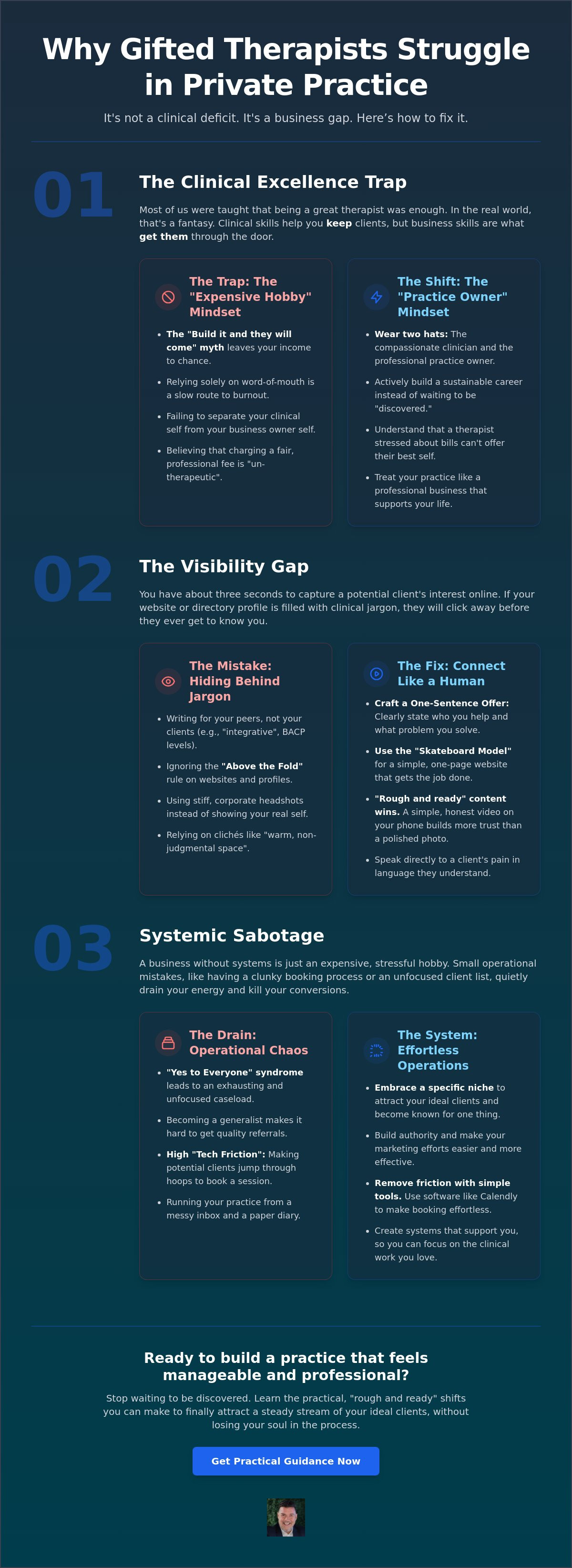
Most of us left our training with a head full of theory and a heart full of hope. We were told that if we were good at what we do, the clients would naturally find us. It is a lovely sentiment, but in the real world, it is a fantasy. The "Build it and they will come" approach is one of the primary reasons why counsellors fail to thrive in Private Practice. You can be the most talented therapist in the country, but if nobody knows you exist, your diary will stay empty.
The Clinical Excellence Trap is the belief that being a good therapist is your only marketing job. While clinical skills help you keep clients, business skills are what get them through the door in the first place. Relying solely on word-of-mouth is a slow route to burnout because it leaves your income to chance. It puts your livelihood in the hands of others, leaving you waiting for the phone to ring instead of actively building a sustainable career.
You have to learn to wear two hats. One hat is for the therapy room, where you are the compassionate clinician. The other is for the "Practice Owner" mindset, where you treat your work as a professional service that needs to be managed, marketed, and maintained. Without this shift, you are essentially running an expensive hobby rather than a professional business. You want a practice that supports your life, not one that drains your savings while you wait to be "discovered."
The Gap in Therapeutic Training
Most UK counselling courses are brilliant at teaching you how to hold a person's pain, but they are often utterly silent about the reality of self-employment. You likely spent years learning about the "therapeutic frame" while never being taught how to price that frame or handle a tax return. This creates a massive psychological barrier. Many therapists feel that charging a fair, professional fee is somehow "un-therapeutic" or greedy. In reality, a therapist who is stressed about their own bills cannot offer their best self to their clients. To bridge this gap, you can access a practical guide to building a sustainable practice that covers the business essentials your tutors missed.
The Visibility Gap: Why Your Profile Isn’t Getting Clicks
If you have ever spent hours agonising over your Counselling Directory profile only to be met with total silence, you are likely falling into the jargon trap. One major reason why counsellors fail to thrive in Private Practice is that they often write for their peers instead of their clients. A person in crisis doesn't care if you are "integrative" or what level your BACP accreditation is. They are sitting on their sofa at 11 PM wanting to know if you can help them stop feeling like their world is falling apart.
You have about three seconds to make an impression. This is the "Above the Fold" rule. If the first thing a visitor sees on your Psychology Today profile or website is a block of academic text, they will click away. Instead, consider a "rough and ready" video. A simple, honest clip recorded on your phone feels human and approachable. It beats a stiff, corporate-style headshot every time because people connect with people, not qualifications. They want to see your face and hear your voice to decide if they feel safe with you.
Crafting Your One-Sentence Offer
Ditch the fluff and the therapist clichés. Every counsellor claims to offer a "warm, non-judgmental space," so saying it doesn't help you stand out. Instead, focus on client-centred outcomes. Tell people exactly who you help and what problem you solve. A clear one-sentence offer like, "I help stressed parents regain their calm without feeling guilty," is far more effective. For more on this, you can check out my guide on marketing for therapists in the UK.
The Skateboard Model for Websites
You don't need a complex, ten-page Squarespace site to start getting enquiries. I always recommend the "skateboard model." This is a simple, one-page site that does one job well. Focus your energy on your title tags and description tags. These are the snippets people see in Google search results. If your tag says "Counsellor in Birmingham," it is forgettable. If it says "Anxiety support for men in Birmingham," you are speaking directly to someone's pain. If you want to refine your message alongside others who get it, joining our private practice success community is a great next step.
Systemic Sabotage: The Operational Mistakes That Drain Your Energy
It is incredibly tempting to say yes to every enquiry that hits your inbox, especially when you are starting out. You want to help, and frankly, you want the fee. But this "Yes to Everyone" syndrome is a primary reason why counsellors fail to thrive in Private Practice. You end up with a caseload that feels like a heavy weight because you are constantly shifting gears between vastly different issues. It is exhausting, and it usually leads to poor referrals because you aren't known for doing one thing exceptionally well. A business without systems is just an expensive, stressful hobby; you deserve a practice that supports you rather than drains you.
Then there is the tech friction. If a prospective client has to email you, wait for a reply, and then go back and forth three times just to find a slot for a phone call, they will often give up. We live in an age of convenience, and making it hard to book kills your conversions before you've even spoken. Don't forget about the financial leakage either. If you aren't accounting for your room hire, insurance, BACP fees, and those vital CPD courses, your bank balance will always feel like a mystery. You need to know your numbers to stay in the game long-term.
The Power of the Niche
Trying to be a generalist in a crowded UK market is like trying to be heard by whispering in a gale. You become invisible. When you specialise in something specific, like Anger Management or Working with Men, you stop being "just another counsellor" on a list. You become an authority. People don't want a "one size fits all" approach when they are in pain; they want the person who understands their specific struggle and has the tools to help them move forward.
Streamlining the Client Journey
You don't need a marketing degree to look professional. Use Canva to create simple, "rough and ready" social posts that show your personality. Set firm boundaries around your "admin creep" so you aren't answering emails at 10 PM. Using a tool like Calendly for initial calls can save you hours of administrative headache every week. This protects your clinical energy for the work that actually matters. If you are ready to stop the sabotage and start building a practice that actually works, come and join our Private Practice Success Membership for the support and systems you need.
From Survival to Success: Shifting Your Practice Mindset
Trying to grow a practice in total isolation is a recipe for failure. We are social creatures, and the loneliness of private work can amplify every doubt you have. This is a huge part of why counsellors fail to thrive in Private Practice; they have nobody to bounce ideas off or to tell them that their fear of sounding "salesy" is actually just a desire to be helpful. You need a community that understands the specific weight of this profession and can offer a grounded perspective when things feel overwhelming.
Moving from "Imposter Syndrome" to "Professional Authority" isn't about becoming arrogant. It is about recognising that you have a set of skills that can literally change lives. You don't need another certificate to start helping people. You just need to own your space. I often tell my students that business coaching is essentially "business supervision." We wouldn't dream of seeing clients without a supervisor, so why try to handle the complexities of marketing and niche building alone?
The Practice Visibility Blueprint
Waiting for perfection is just a fancy form of procrastination. I much prefer consistent, "imperfect" action over a polished plan that never launches. A structured approach like The Practice Visibility Blueprint removes the guesswork. It stops you from flitting between different ideas and gives you a clear path to follow. You don't need a corporate image; you just need to be visible enough for your ideal client to find you and feel a connection.
Protecting Your Wellbeing
Your humanity is your best marketing tool. People don't connect with a blank screen; they connect with a real person they can trust. However, you can't help anyone if you're running on empty. Recognising the signs of therapist burnout is crucial before it stalls your business entirely. The philosophy that "people connect with people" is central to everything I teach; your humanity is actually your best marketing tool.
If you want to increase your visibility in the next seven days, here are your practical next steps:
- Day 1: Rewrite your Directory introduction to focus on one specific client pain instead of your qualifications.
- Day 3: Record a 60-second "rough and ready" video for your profile or website.
- Day 5: Set up a Calendly link to make booking initial calls effortless for you and the client.
- Day 7: Reach out to a peer or join a community to end the cycle of isolation.
Building a Practice That Actually Works
Building your practice shouldn't feel like a constant uphill battle against tech and silence. We have looked at how the clinical excellence trap and the visibility gap explain Why counsellors fail to thrive in Private Practice. It isn't about working harder; it is about working smarter by speaking your client's language and setting up simple, human systems that protect your energy. You don't need a corporate makeover to be successful; you just need to be visible to the people who are already looking for your help.
You don't have to figure this out by trial and error. I have spent over 20 years in the UK counselling landscape, and I know exactly what it takes to move from survival to a full diary. My BACP-endorsed workshops and accredited CPD training are designed to provide practical, jargon-free strategies that you can start using today. You already have the skills to change lives; now you just need the professional business identity to let those people find you.
Ready to stop struggling and start growing? Join the Private Practice Success Membership and get the support you need to build a sustainable, client-rich career. You have got this, and you don't have to do it alone.
Frequently Asked Questions
Is it really possible to make a full-time living from private practice in the UK?
It is absolutely possible to earn a full-time living, but you have to move past the common reasons why counsellors fail to thrive in Private Practice, such as treating your work like a hobby. Success comes down to understanding your numbers and being very clear about who you serve. If you account for your overheads and set a professional fee, you can build a practice that supports your life comfortably.
How long does it typically take to fill a private therapy practice?
Typically, it takes between six and eighteen months to build a steady, reliable caseload. This timeframe depends heavily on how much effort you put into your visibility and how specific your niche is. Therapists who actively engage with their local community and refine their online message often see results much faster than those who simply wait for the phone to ring.
Do I need to be "good at marketing" to succeed as a counsellor?
You don't need to be a marketing guru; you just need to be a clear communicator who isn't afraid to be seen. Marketing for therapists is really just about letting the right people know you can help them. If you can explain how you solve a specific problem without using academic jargon, you are already ahead of most of your competition in the UK.
Why am I getting profile views on Psychology Today but no enquiries?
If people are clicking but not calling, your profile is likely failing to bridge the emotional connection gap. This is a classic reason why counsellors fail to thrive in Private Practice. Prospective clients need to feel understood within the first few sentences of your bio. If your profile is a list of BACP accreditations rather than a direct response to their struggle, they will simply click away.
What is the single biggest mistake new therapists make when going private?
The biggest mistake is trying to do everything in total isolation without any systems in place. Many new therapists spend too much time on a polished website and not enough time on making it easy for clients to actually book. Using a simple tool like Calendly and joining a supportive community can prevent the overwhelm that leads to burnout before your practice even gets off the ground.
Disclaimer
The information provided on this blog is for general informational purposes only and is not intended to be a substitute for professional medical or mental health advice, diagnosis, or treatment. Reading this content does not create a therapist-client relationship.


