
Why Counsellors Need Self-Care: Enhancing Your Practice

Article by
Martin Hogg
I help Private Practice counsellors in the UK set up and grow an ethical Private Practice they love, work with their ideal clients, and earn the income they deserve. All without guesswork and burnout. I have been a private practice counsellor myself for over 20 years, specialising in anger management. I set up a not-for-profit social enterprise, Citizen Coaching and Counselling, which delivers thousands of counselling sessions a year to adults and young people in Birmingham. I am a registered BACP Counsellor and the author of three books, My Anger Coach, My Anxiety Coach and My Relationship Coach. These are available on Amazon.
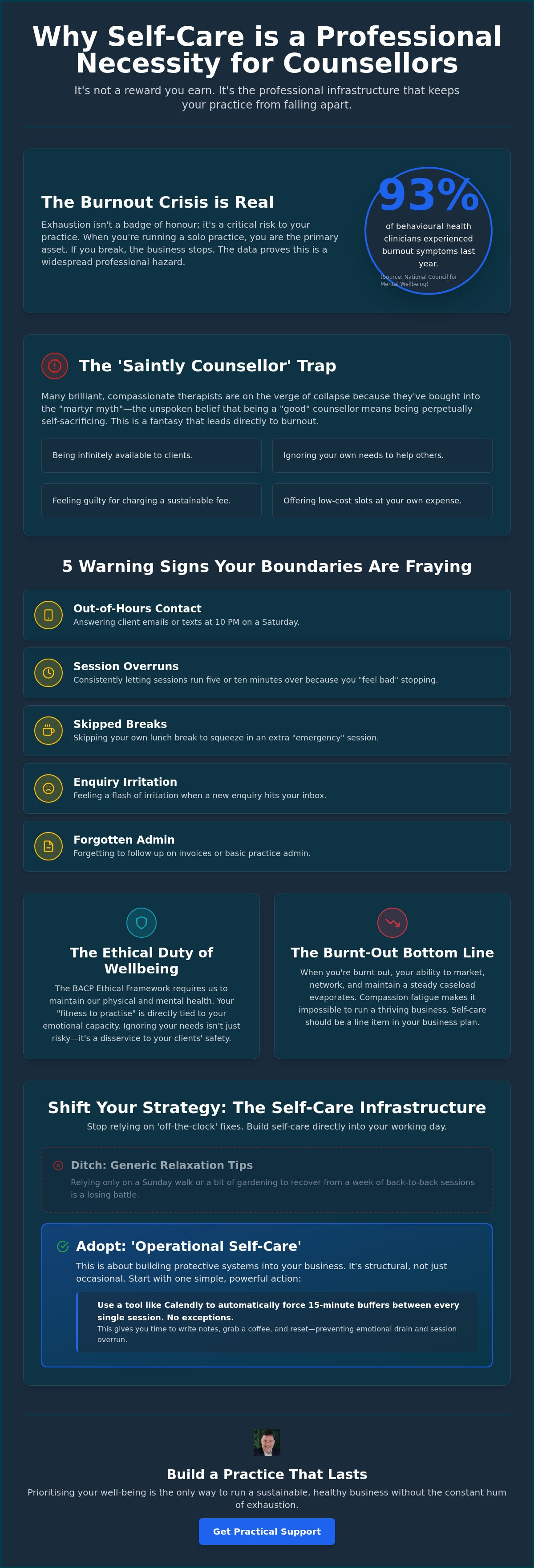
Self-care isn't a reward you earn for surviving a week of back-to-back sessions; it's the professional infrastructure that keeps your practice from falling apart. If you think taking a Friday afternoon off is a luxury you can't afford, you're likely already feeling the weight of the "saintly counsellor" trap. Recent data from the National Council for Mental Wellbeing shows that over 93% of behavioural health clinicians experienced burnout symptoms in the last year. That's a staggering number that proves Why Counsellors need self care to be treated as a professional necessity rather than a guilty pleasure.
I know how it feels to sit in that chair, feeling emotionally drained and isolated in your solo practice. You want to give your best to your clients, but you can't do that if you're running on fumes. I promise that prioritising your own well-being won't make you a "bad" therapist. In fact, it's the only way to build a practice that actually lasts. In this post, I'll share how to bake self-care into your daily schedule using simple tools like Calendly and how to shift your mindset so you can finally run a sustainable, healthy business without the constant hum of exhaustion.
Key Takeaways
- Ditch the "martyr myth" and stop feeling guilty for setting boundaries or charging a sustainable fee in your UK practice.
- Identify the specific warning signs of a "burnt-out bottom line" and see Why Counsellors need self care to keep their business financially healthy.
- Swap generic relaxation tips for "operational self-care" by using tools like Calendly to force 15-minute buffers between every session.
- Shift your focus from surviving back-to-back days to acting like a CEO who prioritises longevity and professional connection.
The 'Saintly Counsellor' Trap: Why We Ignore Our Own Needs
I see it all the time in my coaching sessions. A brilliant, compassionate therapist is on the verge of collapse because they've bought into the "martyr myth." This is the unspoken belief that being a "good" counsellor means being infinitely available, always empathetic, and perpetually self-sacrificing. It's the idea that your needs don't matter as long as the client is making progress. Let's be clear: this isn't just unsustainable; it's a fantasy that leads directly to Occupational burnout.
In the UK, this pressure is often amplified by a culture of "giving back." We feel a heavy weight to offer low-cost or pro-bono slots even when our own bank accounts are looking thin and our energy is lower. While your heart is in the right place, providing discounted therapy at the expense of your own mental health is a recipe for disaster. This is exactly Why Counsellors need self care baked into their business model. You cannot pour from an empty cup, and you certainly cannot run a thriving private practice if you're resentful of your own schedule. Self-care is the clinical and operational baseline for safe practice.
The BACP Ethical Framework doesn't view looking after yourself as an optional extra or a weekend treat. It's a core requirement. We have a professional obligation to maintain our own physical and mental health to ensure we are fit to work with vulnerable people. When we ignore this, we aren't being "saintly." We're being reckless.
The Ethical Duty of Wellbeing
Your "fitness to practise" is directly tied to your emotional capacity. If you're sitting in a session feeling like a hollowed-out shell, you aren't providing the service your client is paying for. You miss the subtle shifts in body language. You lose the thread of the narrative. You might even find yourself feeling irritated by a client's distress.
Ignoring your own needs is a disservice to your clients' safety. A tired, overwhelmed brain is prone to clinical errors and poor boundary management. Taking time for yourself isn't selfish; it's a protective measure for the people who walk through your door. If you want to be a high-quality practitioner, you have to start by being a well-regulated human being.
The High Cost of the 'Empty Cup': Burnout and the Bottom Line
When you're running a solo practice, you are the primary asset. If you break, the business stops. It's a blunt reality that many of us try to ignore while we're busy looking after everyone else. We often view exhaustion as a badge of honour, but the financial truth is much grimmer. A 2023 survey found that approximately 45% of mental health practitioners experience burnout. For a private practitioner, that doesn't just mean feeling a bit tired; it means your ability to market yourself, network with colleagues, and maintain a steady caseload begins to evaporate. This is exactly Why Counsellors need self care to be a line item in their business plan.
Burnout often starts with subtle shifts. You might notice a creeping sense of cynicism or find yourself dreading specific clients who used to energise you. Brain fog becomes a regular visitor, making it harder to stay present in the room or tackle the admin waiting for you on Squarespace. This is often where compassion fatigue sets in. Unlike everyday tiredness that a good night's sleep can fix, compassion fatigue is an emotional physical erosion that happens when you've absorbed too much of others' trauma without a way to process it. It's why the ethical imperative of self-care is so critical. If you're already feeling the slide, have a look at this therapist burnout guide for specific recovery steps.
Identifying the Warning Signs Before the Crash
You don't usually wake up one morning suddenly "burnt out." It's a slow leak. Here are five signs your professional boundaries are starting to fray:
- Answering client emails or texts at 10 PM on a Saturday.
- Consistently letting sessions run five or ten minutes over because you "feel bad" stopping.
- Skipping your own lunch break to squeeze in an extra "emergency" session.
- Feeling a flash of irritation when a new enquiry hits your inbox.
- Forgetting to follow up on invoices or basic practice admin.
The Resentment Barometer
I like to use what I call the "resentment barometer." It’s a simple way to gauge your internal state. If you feel a twinge of resentment when a client books into your diary, that's your barometer telling you that your self-care infrastructure is failing. Your feelings are a practical guide to where you need to tighten up your boundaries. If you're struggling to find that balance on your own, you might find the support you need in our Private Practice Success Membership, where we tackle these business hurdles together.
Building Your Self-Care Infrastructure: Practical Strategies
Let's move away from the idea that self-care is something you do only when you're off the clock. If your only plan for recovery is a Sunday afternoon walk or a bit of gardening, you're fighting a losing battle. Real sustainability comes from what I call "operational self-care." This is about how you build your business day-to-day; it's the reason Why Counsellors need self care to be part of their actual clinical setup rather than a weekend afterthought.
One of the easiest wins you can implement today is the "15-minute buffer" rule. Running back-to-back sessions is a recipe for clinical errors and emotional exhaustion. You need time to breathe, stretch, and reset your brain before the next person walks in. I always suggest using a tool like Calendly to automate this. By setting your availability to include these gaps automatically, you remove the "people-pleasing" urge to squeeze someone in. You aren't manually saying no to a client; the software is simply managing your professional capacity for you. True self-care for a therapist is often found in a well-managed diary, not a scented candle.
Setting Non-Negotiable Practice Boundaries
You also need to designate "CEO days" in your calendar. These are specific days where no client work happens at all. Use this time for your marketing on Canva, updating your Psychology Today profile, or just thinking about your business strategy. If you're always in "therapist mode," you'll never have the headspace to grow your practice effectively.
Another massive drain on your energy is taking on clients who aren't the right fit. This is where a "one-sentence offer" comes in. When you know exactly who you help and how, you stop trying to be everything to everyone. It saves you from the emotional drag of sessions that feel like hard work because they're outside your niche. Setting these boundaries can feel incredibly lonely when you're working solo. If you want a supportive group to help you stay firm, come and join us in the Private Practice Success Membership, where we help you build a practice that serves you as much as it serves your clients.
Sustaining Your Practice: From Overwhelmed to CEO
Most counsellors I talk to started their private practice because they wanted freedom. They wanted to set their own hours and escape the bureaucracy of agency work. But without a plan, it's easy to end up feeling like you've just bought yourself a very demanding job with a boss who never lets you take a holiday. To move from surviving to thriving, you have to start acting like a CEO. A CEO doesn't just do the work; they ensure the person doing the work is in top condition to deliver results. This is a fundamental reason Why Counsellors need self care that is proactive and strategic rather than reactive.
Professional isolation is arguably the biggest threat to UK therapists working in private practice. When you spend your entire day alone in a room, your perspective can easily become warped. You might start thinking your struggles with marketing, tech, or emotional exhaustion are unique personal failings rather than common industry hurdles. Peer support and business coaching aren't just "nice to haves." They are essential tools for reducing the emotional load of solo work. I encourage you to view your own business and personal growth as a valid part of your cpd for counsellors uk. Learning how to run a better business is, ultimately, learning how to be a more sustainable therapist, which is exactly Why Counsellors need self care at the heart of their professional development.
Finding Your Support Network
Clinical supervision is vital for keeping your clients safe, but it isn't always the right space for the business side of therapy. Your supervisor might be an expert in psychodynamic theory, but they may not know how to help you with your Counselling Directory profile or your Squarespace SEO. You need a community that understands both worlds. A supportive group of peers helps normalise the common fears we all face, from the dread of being "visible" to the guilt of increasing your fees.
You don't have to figure this out on your own in a vacuum. If you're ready to stop feeling overwhelmed and start building a practice that actually supports your life, join us in the Practice Visibility Blueprint. It's designed to help you create a professional setup that looks after you just as much as you look after your clients. Let's make your practice a place where you can truly thrive for the long term.
Take the First Step Toward a Sustainable Practice
You started this journey to help people, but you can't do that effectively if you're a burnt-out version of yourself. We've explored how shifting your mindset from a "saintly" martyr to a practice CEO changes everything. By automating your boundaries and acknowledging Why Counsellors need self care as a clinical necessity, you're actually protecting your clients as much as yourself. It isn't about the occasional day off; it's about building a business that respects your capacity every single day.
Building a solo practice in the UK doesn't have to be a lonely slog. I've spent over 20 years in this profession and developed the Practice Visibility Blueprint to help therapists just like you. As a BACP-endorsed workshop provider, I've seen first-hand how the right support can turn a struggling practice into a thriving business. If you're ready to stop the guesswork and start building a practice that actually fuels your life, I'd love to help. You can build a sustainable practice with the Private Practice Success Membership and join a community that really gets it. You've looked after everyone else; it's time to look after the person who makes it all possible. You've got this.
Frequently Asked Questions
Is self-care an ethical requirement for UK counsellors?
Self-care is absolutely an ethical requirement under the BACP Ethical Framework. Specifically, the principle of "Self-respect" means we have a professional obligation to maintain our own physical and mental health to ensure our "fitness to practise." If you are too exhausted or emotionally drained to be fully present, you aren't providing a safe or effective service. This is a core reason Why Counsellors need self care to be at the top of their professional priority list.
How do I deal with the guilt of taking a holiday as a solo practitioner?
You deal with holiday guilt by reframing your time off as a professional investment rather than a luxury. If you don't take a break, your clinical work will eventually suffer, and that's a disservice to your clients. I suggest setting clear "out of office" messages and using Calendly to block out your dates weeks in advance so there's no last-minute panic. When you return with a fresh perspective, your clients get a much more effective version of you.
What are the first signs of therapist burnout I should look for?
The first signs are usually subtle, like feeling a flash of irritation when a new enquiry hits your inbox or dreading a specific client who used to energise you. You might also notice a sense of cynicism or "brain fog" during sessions where you struggle to stay focused on the narrative. These are the early warnings of Why Counsellors need self care interventions before they hit a total wall. Watch out for physical signs like tension headaches or disturbed sleep too.
Can I count self-care activities as part of my CPD hours?
Generally, you can't count things like a weekend away or a gym session as your 30 hours of BACP CPD. However, you can count structured professional development that focuses on practice growth, boundary-setting, or managing the emotional load of solo work. If you're attending a workshop that helps you build a more sustainable business model, that's a valid contribution to your professional competence. It's about the intentionality and the learning outcome for your practice.
How many clients a day is too many for a private practice therapist?
There isn't a magic number, but most private practitioners find that 4 to 6 sessions a day is their limit for maintaining high-quality clinical work. If you're consistently hitting 7 or 8, you're likely entering the danger zone for clinical errors and emotional exhaustion. Listen to your own "resentment barometer" to find your personal sweet spot. It's much better to have four well-held sessions than a packed diary that leaves you feeling like a hollowed-out shell.
Disclaimer
The information provided on this blog is for general informational purposes only and is not intended to be a substitute for professional medical or mental health advice, diagnosis, or treatment. Reading this content does not create a therapist-client relationship.


