
Why Counsellors Often Ignore Local Marketing (and How to Fix It in 2026)
Why are so many gifted therapists spending hours battling complex social media algorithms when the people who need them most are literally walking past their front door? It feels like a massive disconnect. You have done the hard work of clinical training, yet you are still facing those quiet weeks and gaps in your diary that keep you up at night. It is a common struggle; counsellors often ignore local marketing because the idea of "selling" feels clinical or even a bit unethical. You do not want to be a corporate brand; you just want to help people get their lives back on track.
I understand that fear of being perceived as salesy by your peers. However, your local community is actually your most overlooked source of private-pay clients. I promise that you can build a visible, ethical practice without the exhaustion of trying to go viral. In this guide, I will show you how to step away from national directories and create a marketing strategy that feels practical, human, and deeply rooted in your own neighbourhood. We are going to look at the simple, grounded steps you can take to ensure your practice thrives in 2026 by simply being present where you live.
Key Takeaways
- Understand why counsellors often ignore local marketing and how you can bridge the "visibility gap" to become a trusted, reachable professional in your own community.
- Learn how to manage the unique imposter syndrome and fear of professional judgment that often stops therapists from putting themselves out there.
- Discover the practical essentials of your Google Business Profile to ensure your practice shows up when local people search for support.
- Identify the key "gatekeepers" in your local area, such as GPs and HR managers, to build a referral network that doesn't rely on social media.
- Create a calm, sustainable weekly routine that keeps your practice visible and your client list healthy without the risk of burnout.
The Visibility Gap: Why UK Counsellors Often Ignore Local Marketing
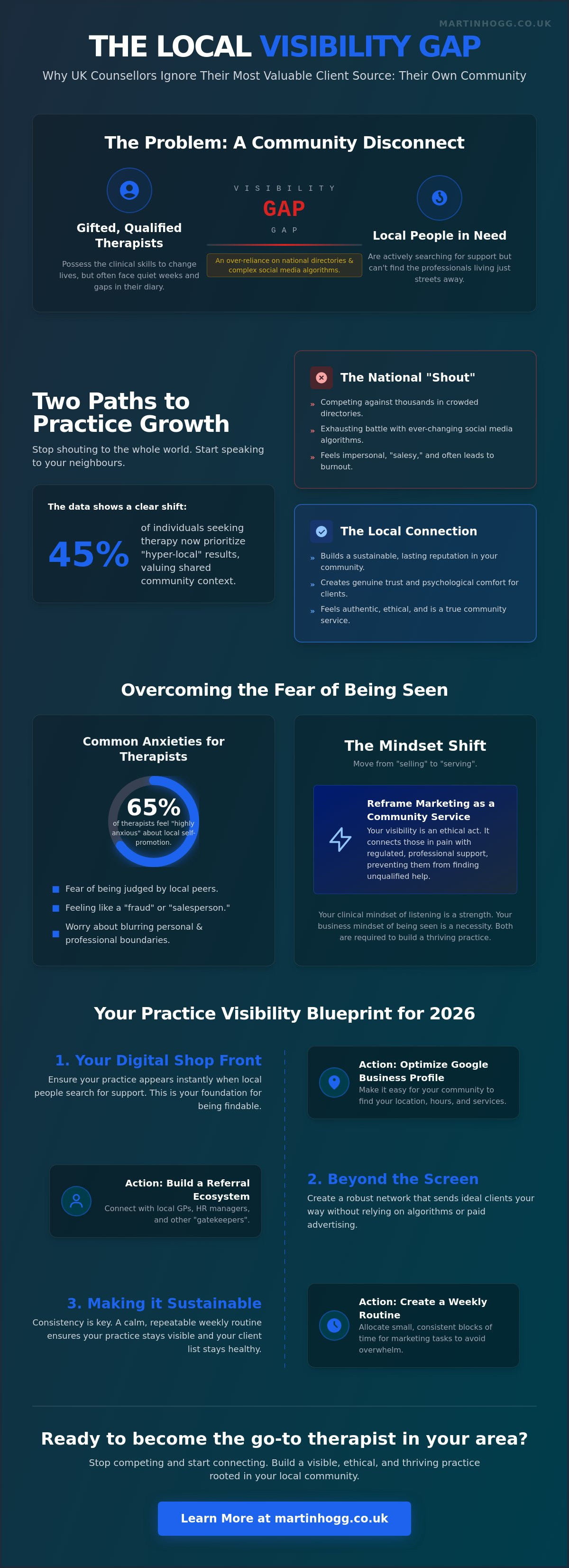
I see it every week. A brilliant, compassionate therapist finishes their training, sets up a room, and waits for the phone to ring. They have the skills to help people get their lives back on track, yet their diary remains half-empty. This is the visibility gap. It’s the space between your clinical expertise and the person in your town who is currently struggling to get out of bed. In 2026, this gap has widened because many practitioners are trying to shout to the whole world instead of speaking to their neighbours.
It is a strange irony. We are living through a period where mental health services are stretched to breaking point, yet many private practices remain "hidden gems." Counsellors often ignore local marketing because the idea of "marketing" feels cold or corporate. You might feel that your work should speak for itself. However, if the people living three streets away don't know you exist, you can't help them. Relying on national directories or competing for broad keywords like "online therapy" puts you in a race against thousands. By 2026, search data shows that 45% of individuals seeking support now prioritise "hyper-local" results, looking for a professional who understands their specific community and environment.
Focusing on your immediate area is simply more sustainable. Applying fundamental local marketing principles allows you to build a reputation that lasts. It’s about being a known presence in your part of the UK, whether that’s a busy borough in London or a quiet village in the Cotswolds. When you stop trying to be everything to everyone, you start becoming the right person for the people right outside your door.
The Myth of the "Global" Private Practice
The rise of Zoom and Teams changed how we work, but it didn't change how we feel. Even when sessions are remote, clients in 2026 still report a higher level of psychological comfort knowing their therapist is nearby. They like knowing you walk the same streets or shop at the same local markets. This shared context builds a foundation of trust that a generic national brand cannot match. Local visibility makes your practice feel grounded and real, rather than just another face on a screen.
Reframing Marketing as a Community Service
I want you to stop thinking about marketing as "selling" your services. Instead, look at it as a way of becoming findable for those in pain. There is an ethical side to this. If a person in your town is in crisis and they cannot find your professional, regulated practice, they might end up with an unqualified "coach" who lacks your depth of training. Being visible is an act of service to your community. Local marketing is the bridge between a community's quiet struggle and the clinical support waiting just around the corner.
The Psychology of Avoidance: Overcoming the Fear of Being Seen
Putting yourself out there in your own town feels different to running a national ad. It is deeply personal. Many therapists tell me they feel like a fraud the moment they hit 'publish' on a local community post. This isn't just standard imposter syndrome; it is a specific fear of being judged by local peers or seen by potential clients while you are out doing the school run. It feels like a loss of the "blank slate" we were taught to maintain during our training.
Counsellors often ignore local marketing because the clinical mindset can sometimes work against the business owner mindset. In the therapy room, we are trained to listen, observe, and stay in the background. Marketing requires the opposite. It asks you to stand up and be noticed. This shift can feel like a boundary violation to your own professional identity, yet without visibility, the people who need your help the most will never find you. Balancing your personal privacy with professional visibility is a skill that develops with time and practice.
Data from private practice surveys suggests that around 65 percent of therapists feel "highly anxious" about self-promotion within their local area. This anxiety often stems from the fear of being perceived as "unprofessional" by colleagues. However, your local reputation is your most valuable asset. When you overcome the fear of being seen, you stop being a hidden secret and start becoming a known resource for your community.
Breaking the "Salesperson" Stigma
In the UK, we have a natural allergy to anything that feels "pushy" or "hypey." The word marketing often brings up images of aggressive sales tactics, but that is not what local visibility is about. If you have a solution for someone's chronic anxiety or a struggling marriage, keeping that solution a secret is not helpful. It is actually a disservice to your community.
Try reframing your outreach. You aren't selling a product; you are helping someone get their life back on track. When you talk about your work, focus on the tangible results. Instead of saying "I offer person-centred therapy," try "I help people in the West Midlands manage their stress so they can enjoy their family time again." This feels less like a sales pitch and more like a genuine offer of support.
Ethical Visibility in the UK Context
You might worry that being visible violates BACP or UKCP guidelines. These organisations do not forbid advertising; they simply require it to be honest, decent, and professional. You can be active in local community spaces without crossing ethical lines. It is about being a "citizen coach" who is part of the local fabric. If you feel your clinical confidence is holding back your business growth, investing in specific CPD for Counsellors UK can help you bridge that gap between being a great therapist and a confident practice owner.
Building a practice requires both sets of skills to work in harmony. If you want to learn how to balance these roles alongside other professionals who understand the struggle, you might find our Private Practice Success community a helpful place to find your feet.
Your Digital Shop Front: Optimising for Local Search
When you walk down a high street, you notice the shops with clean windows and clear signs. In the digital world, your Google Business Profile (GBP) is that shop front. By 2026, local search has become the primary way people find support. Data from 2024 showed that 46% of all Google searches have local intent. If you aren't visible when someone types "counsellor near me" into their phone, you're missing the moment they reach out for help. Counsellors often ignore local marketing because they feel the internet is a global space, but therapy is deeply rooted in community and proximity.
To appear in the "Local Map Pack", those three coveted spots at the top of search results, Google needs to trust you. This trust is built through consistency. Your Name, Address, and Phone number (NAP) must be identical across every directory you use. If your BACP profile says "Street" and your website says "St", it creates a tiny bit of friction in Google's algorithm. Keep it simple; keep it identical. Even if you only offer online sessions, local signals tell Google you are a real person operating in a real UK town, which boosts your overall credibility.
Google Business Profile Masterclass
Setting up your profile doesn't mean inviting strangers to your front door. If you work from home, you can set your profile as a "Service Area Business". This allows you to show up in searches for your town or county without displaying your exact house number. It protects your privacy while keeping you on the map. It's a practical solution for the modern private practice.
Reviews are a sensitive area in our profession. You shouldn't ask current or past clients for reviews; it's ethically complex and can compromise the therapeutic relationship. Instead, focus on the "Updates" section. Use this space to post a weekly grounded tip or a thought on local mental health. It shows Google your profile is active and shows potential clients that you're a living, breathing human being who understands their struggles.
Local SEO for Therapists
Your website copy should reflect the area you serve. Don't just say you're a therapist. Say you're a "Counsellor in Birmingham" or "Therapist in Solihull". Mentioning local landmarks or specific county needs makes your page feel personal. Counsellors often ignore local marketing by using generic language that could apply to any city in the world. People want to know you understand their environment.
Creating specific landing pages for different areas can be very effective. If you live on the border of two counties, have a page for each. For a deeper look at how this fits into your wider strategy, you can read this guide on marketing for therapists in the UK. It's about being found where people are already looking. It’s about making it easy for someone in distress to find the right gate to walk through.
Beyond the Screen: Building a Local Referral Ecosystem
I've noticed a recurring pattern in my work with therapists across the UK. We spend hours tweaking a website or worrying about an algorithm we can't control, yet we overlook the person sitting in the office three doors down. Counsellors often ignore local marketing because the digital world offers a shield; it's easier to post a quote on a screen than it is to walk into a local GP surgery. However, the most resilient practices aren't built on "likes" or "shares." They're built on the ground, in your own postcode, through genuine human connection.
You don't need to be a natural extrovert to do this well. Effective local marketing is simply about identifying the gatekeepers in your community. These are the people who already have the trust of your potential clients. Think about HR managers in local firms, leaders of community charities, or even the person running the local library. Your goal isn't to "sell" your services to them. It's to let them know you're a reliable pair of hands for the people they support. A single conversation with a local GP can be worth more than 1,000 Instagram followers.
Developing Professional Referral Partners
Approaching a GP surgery can feel daunting, but remember that they're often overwhelmed. Don't ask for a meeting to "pitch" yourself. Instead, drop off a concise, professional pack that includes your specialisms, your availability, and how you work. Focus on how you can make their life easier. Similarly, look for complementary practitioners like osteopaths or yoga teachers. A 2023 study of UK private practices found that 65% of consistent referrals come from these reciprocal professional relationships. If you offer a value-first approach, such as a free 30-minute talk for their staff on stress management, you instantly move from being a stranger to a trusted authority.
Community Engagement and Local Branding
Physical presence matters. While digital ads disappear in a second, a well-placed notice in a parish newsletter or a local magazine often sits on a coffee table for a month. I've found that active participation in community events usually outperforms passive sponsorship. Rather than just paying £50 to have your logo on a banner, offer to hold a "mental health check-in" stall at a local fair. It makes you a visible, approachable part of the community. People want to know that their therapist is a real person who understands the local area. When you show up consistently, you stop being just another name on a directory and start being the local expert.
If you're ready to move past the screen and build a practice that thrives on real-world connections, I can help you bridge that gap.
Join our community for practical practice-building strategiesThe Practice Visibility Blueprint: Making it Sustainable
Building a thriving practice doesn't require you to become a full-time marketing executive. I've seen how counsellors often ignore local marketing because it feels like an overwhelming addition to an already heavy clinical load. The secret isn't doing more; it's doing the right things consistently. You can manage your local presence in just 90 minutes a week if you have a system in place. This moves you away from "random acts of marketing," like posting on social media once a month when you're feeling anxious about a gap in your diary, and toward a calm, predictable flow of enquiries.
Tracking is a vital part of this process that many practitioners skip. If you don't know whether a client found you through a local directory, a GP referral, or your Google Business Profile, you're essentially flying blind. A simple spreadsheet or a consistent habit of asking, "How did you hear about me?" can save you hours of wasted effort. In 2024, industry data showed that 46% of all Google searches are seeking local information. By positioning yourself as the go-to expert for a specific niche, such as "workplace stress in Birmingham" rather than just a "general counsellor," you become the obvious choice for people in your immediate area.
Creating Your 90-Day Visibility Plan
I suggest looking at your growth in three-month blocks. It's a manageable timeframe that allows you to see real results without the pressure of seeking overnight fame. Spend the first month optimising your local listings, the second on building one solid local professional connection, and the third on refining your message. This approach focuses on sustainable growth that respects your energy levels and clinical boundaries. You can check our Calendar for upcoming workshops where we map these steps out together in a practical, hands-on environment.
Joining a Community of Like-Minded Professionals
Growing a private practice can feel isolating, but you don't have to carry the burden alone. Counsellors often ignore local marketing because they feel they must figure out the business side of therapy by themselves. Peer support is vital for staying motivated and sharing what's actually working in the UK market right now. You don't need to be a marketing guru; you just need a supportive environment where you can ask questions and share experiences. Join the Private Practice Success Membership to start your Visibility Blueprint today and get your practice back on track with a community that understands your journey.
Taking the Next Step Toward a Visible Practice
It’s a quiet truth in our profession that counsellors often ignore local marketing because the idea of "selling" feels at odds with the desire to help. However, staying hidden doesn't serve the people in your town who are struggling right now. By focusing on a clear digital shop front and building a genuine referral ecosystem, you can create a practice that is both visible and deeply respected. It isn't about being flashy; it's about being findable.
Martin Hogg, a BACP-endorsed trainer with more than 20 years of experience, developed these strategies specifically for the UK private practice landscape. His approach is built on Citizen Coaching principles, which focus on making therapy accessible and practices sustainable for the long term. You don't need to be a marketing expert to see results. You just need a practical plan that respects your professional boundaries while ensuring your phone actually rings.
Ready to stop being the best-kept secret in your town? Explore the Practice Visibility Blueprint
Building a visible practice takes a bit of courage, but you have the tools to make it happen. Your community needs your expertise, and now you have the map to reach them.
Frequently Asked Questions
Is it ethical to market my counselling practice locally?
Yes, it is entirely ethical and often a professional responsibility to ensure people in your community can find the help they need. The BACP Ethical Framework suggests that any advertising you do must be factual, honest, and professional. Counsellors often ignore local marketing because they worry about looking "salesy," but clear communication about your services is actually a form of public service for those in distress.
How do I use Google Business Profile if I work from a home office?
You can set up your profile as a "Service Area Business" which allows you to hide your specific home address while still appearing in local searches. This feature lets you define the specific towns or postcodes you serve, such as a 10 mile radius around your home. Data from 2023 shows that 76% of people who search for something nearby visit a related business within one day.
Can I ask clients for reviews to help my local SEO?
No, you should not ask current or past clients for reviews as it can create a power imbalance and breach ethical boundaries. Instead, you can improve your local visibility by asking for testimonials from clinical supervisors or professional colleagues who can vouch for your character. Building these professional backlinks is a practical way to show Google you are a trusted member of the local healthcare community.
What is the most effective way to get referrals from local GPs?
The most effective method is to provide a clear, one page summary of your specialism and how it helps their patients. Most GPs in the UK see between 30 and 40 patients every day and have very little time for long letters. If you offer a specific service like EMDR or CBT, send a professional introductory pack with three or four business cards they can easily hand out.
How much time should I spend on local marketing each week?
You only need to set aside about 120 minutes each week to maintain a consistent local presence. While counsellors often ignore local marketing due to time constraints, breaking it down into 30 minute chunks makes it manageable. Spend your time updating your Google profile, writing a local blog post, or connecting with a local business owner. Consistency over several months is what builds a steady stream of enquiries.
Do I still need a website if I have a strong local presence?
Yes, your website is the place where you build the deep trust required for someone to book a first session. While a directory listing or a map pin shows you exist, 80% of potential clients will visit your website to read about your approach before making contact. It serves as your digital consulting room where you can explain how you help people get their lives back on track.
How can I maintain my privacy while being visible in my community?
You can maintain a professional distance by using dedicated business tools instead of your personal details. Use a VOIP phone service for a landline number that routes to your mobile and keep a separate professional email address. A 2024 survey of private practitioners found that 68% of therapists felt more secure after setting up a separate business identity that kept their private life and work life distinct.
What should I do if my local area is already "saturated" with counsellors?
You should focus on a very specific niche rather than trying to be a generalist for everyone. If there are 50 counsellors in your town, don't just list "anxiety" as a service; instead, be the specialist for "anxiety in high performing professionals." When you narrow your focus, you stop competing with every other therapist and become the obvious choice for a specific group of people who need your help.

Article by
Martin Hogg
I help Private Practice counsellors in the UK set up and grow an ethical Private Practice they love, work with their ideal clients, and earn the income they deserve. All without guesswork and burnout. I have been a private practice counsellor myself for over 20 years, specialising in anger management. I set up a not-for-profit social enterprise, Citizen Coaching and Counselling, which delivers thousands of counselling sessions a year to adults and young people in Birmingham. I am a registered BACP Counsellor and the author of three books, My Anger Coach, My Anxiety Coach and My Relationship Coach. These are available on Amazon.
Disclaimer
The information provided on this blog is for general informational purposes only and is not intended to be a substitute for professional medical or mental health advice, diagnosis, or treatment. Reading this content does not create a therapist-client relationship.


