
Why 'Good Enough' is Better Than Perfect in Your Online Marketing
Last Tuesday, a talented counsellor named Sarah discovered that spending four hours on a single 100-word social media post didn't make her feel more professional; it just left her feeling like a fraud. It's a common struggle in our profession. You likely feel that your reputation depends on being beyond reproach, which makes every update feel like a high-stakes exam. I understand that weight. I want to show you why good enough is better than perfect in your online marketing so you can finally stop hiding and start helping the people who need you.
By the end of this article, you'll know how to overcome the perfectionism holding your private practice back and start attracting the clients who need your help today. We'll look at how to trade those hours of unnecessary stress for a marketing style that feels human, authentic, and remarkably effective. It's time to move past the fear of judgment from peers or the BACP and get your practice back on track by focusing on what truly matters: your clinical work and your clients.
Key Takeaways
- Recognise how "marketing paralysis" stops you from reaching the people in your community who need your professional support the most.
- Explore why authentic, human content is more ethical and effective at building trust than a perfectly polished clinical image.
- Understand why good enough is better than perfect in your online marketing to protect your practice from the financial costs of waiting for the "right" moment.
- Learn how to use the 80% rule to publish your work sooner and avoid the heavy burden of therapist burnout caused by over-thinking.
- Discover a practical, community-led path to visibility that prioritises real-world results over abstract marketing theory.
The Perfectionism Trap in Private Practice Marketing
Most of us entered this profession because we care deeply about getting things right for our clients. In the therapy room, precision is vital. You listen for the subtle shifts in tone and the unspoken words. However, when you bring that same level of scrutiny to your website or social media, it often leads to a complete standstill. You might find yourself stuck in "marketing paralysis," where the fear of a typo or a slightly imperfect sentence stops you from reaching out to people who genuinely need your help.
We often conflate clinical excellence with marketing perfection. You might worry that if your "Contact" page isn't flawless, potential clients will think you're an incompetent therapist. This simply isn't the case. Most people searching for help are looking for a human connection, not a literary masterpiece. When you spend weeks tweaking a single paragraph, you aren't improving your service; you're likely procrastinating because being visible feels vulnerable. Realising that why good enough is better than perfect in your online marketing is the first step toward building a sustainable practice.
The Clinical vs. Marketing Mindset
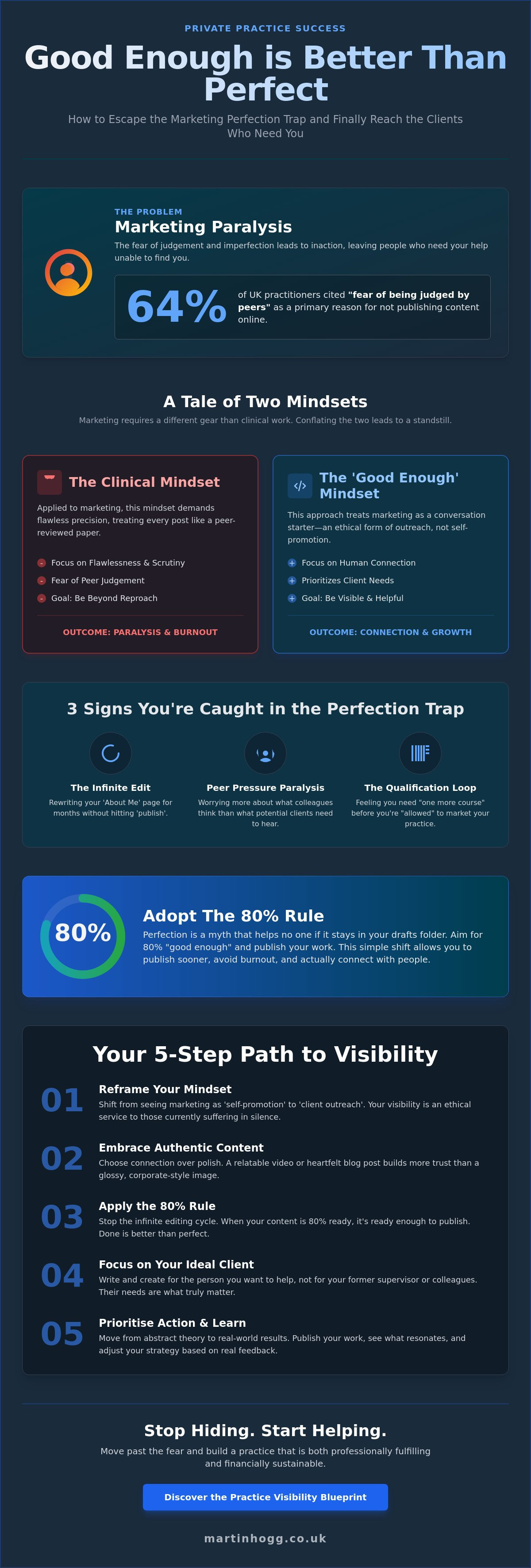
Your training taught you to weigh every word in a case study or a clinical assessment. Marketing requires a completely different gear. A blog post is a conversation starter, not a legal document. By adopting a decision-making strategy known as satisficing, you can choose the option that meets your needs rather than searching indefinitely for the "best" one. Marketing perfectionism is a barrier to client access that keeps those in distress from finding the support they need. In a 2023 survey of UK private practitioners, 64% cited "fear of being judged by peers" as a primary reason for not publishing content online. It's time to shift your focus back to the client.
Common Signs You Are Stuck in the Perfection Trap
It's easy to tell yourself you're just being thorough, but there are clear signs that perfectionism has taken the wheel and is steering you away from growth. Recognising these patterns is essential for moving forward.
- The Infinite Edit: Rewriting your "About Me" page for three months without ever hitting the "publish" button.
- Peer Pressure: Worrying more about what your former supervisors or colleagues will think of your tone than what your ideal client needs to hear.
- The Qualification Loop: Falling into "one more course" syndrome, where you feel you need a marketing diploma before you're allowed to post a simple update on LinkedIn.
If you wait for every light to be green before you start your journey, you'll never leave the driveway. This is why good enough is better than perfect in your online marketing; it gets you out of your own way and into the lives of the people you are trained to support. Perfection helps no one if it stays hidden in your drafts folder.
Why 'Good Enough' Marketing is Actually More Ethical
I often talk to counsellors who feel that marketing is somehow 'un-therapeutic' or even manipulative. In reality, staying hidden is a disservice to the person currently suffering in silence. If you are a skilled practitioner but your website is stuck in draft mode because the font isn't quite right, you are effectively making yourself unavailable to someone in crisis. Why good enough is better than perfect in your online marketing becomes clear when we look at it as a form of outreach rather than self-promotion. Reframing your visibility as a service helps shift the focus from your own ego to the needs of the client.
We already use the concept of the good enough parent, a term coined by Donald Winnicott back in 1953, to help our clients lower their impossible standards. It's time we applied that same therapeutic compassion to our own digital presence. When we wait for perfection, we buy into the myth of perfection in business, which suggests that any flaw will ruin our reputation. In the world of mental health, the opposite is usually true. Your willingness to be seen as an imperfect human is often the very thing that gives a client the courage to reach out.
Connection Over Polish
A slightly shaky smartphone video recorded in your practice room often performs better than a £2,000 studio production. Potential clients are looking for a human they can relate to, not a distant, clinical authority figure. When you show up with your natural voice, you reduce the power dynamic barrier that often prevents people from booking that first session. Showing your own humanity proves that you are a real person who can handle their real, messy problems without judgment. It creates a sense of safety that a glossy, corporate brochure simply cannot replicate.
Staying Within UK Ethical Guidelines
Being good enough doesn't mean being reckless or unprofessional. You must still adhere to BACP or UKCP guidelines by being honest and avoiding exaggerated claims. There is a massive difference between an imperfect, heartfelt social media post and an unethical promise of a guaranteed cure. You can remain professionally responsible without being stiff or robotic. Ensure your marketing reflects your true practice style; if you are a warm, direct therapist in the room, let that come across online. If you want to explore how to build this kind of authentic presence alongside other practitioners, you might find our private practice community a helpful place to start. Keeping things simple and honest is the best way to ensure why good enough is better than perfect in your online marketing remains a core part of your ethical practice.
The Practical Cost of Waiting for Perfect
Every week you spend "polishing" your website or tweaking a single blog post is a week your practice remains invisible to those who need you. In the UK private practice market, the financial impact of this delay is measurable. If your average session fee is £60 and you have just three empty slots per week, you are losing £720 every month. Over a year, that is nearly £9,000 in lost revenue. This is the real price of the "wait and see" approach. Why good enough is better than perfect in your online marketing becomes clear when you look at these figures; an imperfect website that is live can accept bookings, but a perfect one that's still a draft cannot.
Marketing works like compound interest. The sooner you start, the more time your content has to build authority. Search engines reward consistency over occasional brilliance. A therapist who posts a helpful, simple 400-word article every fortnight will almost always outrank the one who spends six months crafting a single masterpiece. Your website doesn't need to be a work of art to start attracting clients. It just needs to be functional and findable.
Lost Opportunities and Empty Rooms
Think about the people searching for support in your local area today. If they can't find your profile because you're still worried about the exact shade of blue on your homepage, they will book with someone else. The reality of SEO is that "done" content starts ranking immediately. Google's algorithms prioritise sites that show regular signs of life. I've found that practitioners who embrace "good enough" see a 30% higher engagement rate over six months compared to those stuck in the planning phase. Research highlights the dangers of perfectionism in content marketing, noting that the quest for a flawless delivery often leads to total stagnation.
The Mental Load of Perfectionism
Perfectionism isn't just bad for your bank balance; it's a significant contributor to therapist burnout. Running a solo practice is already isolating. When you add the pressure of maintaining a "flawless" professional image online, you create an unsustainable mental load. You don't have to be a marketing expert to get your life and business back on track. Why good enough is better than perfect in your online marketing is because it allows you to move from a state of overwhelm to one of active service. By taking small, imperfect steps, you reduce the anxiety of visibility and create a business model that actually breathes. You are a counsellor, not a digital agency; your clients are looking for your empathy, not your graphic design skills.
5 Steps to 'Good Enough' Marketing for Therapists
Moving from a perfectionist mindset to a practical one doesn't mean lowering your standards. It means raising your efficiency. When you understand why good enough is better than perfect in your online marketing, you stop being a bottleneck in your own business growth. Here are five practical steps to get your message out there without the stress.
- Apply the 80% Rule: Stop at "mostly there." The final 20% of polishing often takes 80% of your time but adds very little value to the reader. If the core message is clear, it's ready.
- Focus on one message: Don't try to explain your entire therapeutic philosophy in a single Facebook post. Data from the Nielsen Norman Group shows that 79% of users always scan any new page they come across. Stick to one helpful thought per post to keep them engaged.
- Use 'The Human Test': Read your draft aloud. Would you say these exact words to a colleague in a Birmingham coffee shop? If it sounds too clinical or "salesy," change it to reflect your natural, warm voice.
- Set a 'Timer of Truth': Give yourself exactly 30 minutes to write a blog post or social update. When the alarm goes off, hit publish. This prevents "over-thinking" from turning into "not-doing."
- Iterate in public: A website isn't a printed book. You can change a word, update a link, or swap a photo in roughly 60 seconds. Treat your marketing as a living document that grows as your practice grows.
Simplifying Your Content Strategy
A person in crisis doesn't want a 2,000-word academic essay on the origins of trauma. They want to know you understand their pain and can help them get their life back on track. One clear, helpful tip is always more effective than a complex dissertation. For example, a simple post titled "Three ways to settle your mind before bed" is far more useful to a struggling client than a deep dive into the history of psychotherapy. Keep your language accessible and your advice immediate.
The 'Done is Better Than Perfect' Checklist
Before you get stuck in a loop of endless editing, run through these three essential points. If you can answer yes to all of them, you have permission to stop tinkering.
- Is the spelling correct? Basic professionalism is important for building trust.
- Is the contact info clear? Make sure the "book now" or "call me" button is easy to find.
- Does it offer value? Will the reader feel slightly more hopeful or informed after reading this?
If you've ticked those boxes, hit send. Embracing why good enough is better than perfect in your online marketing allows you to focus on what really matters: your clients. If you're ready to stop struggling with tech and start growing your practice, you can join our private practice success community for more practical, no-nonsense support.
Moving Forward with the Practice Visibility Blueprint
Perfectionism is a lonely place. It keeps you stuck in your head, wondering if your website is "right" while people who need your help are still searching. This is why a structured plan is vital. It takes the guesswork away. When you follow a blueprint, you don't need to be a marketing genius; you just need to be consistent. A no-nonsense approach prioritises results over abstract theory. It’s about doing what works to get you in front of the people who need you most.
Moving from "hiding" to "helping" requires a shift in mindset. You aren't "selling" yourself; you're making it easier for a person in distress to find a solution. In my experience working with hundreds of UK therapists, those who commit to a simple, weekly visibility habit see far more enquiries than those who spend six months polishing a single page. This is the core reason why good enough is better than perfect in your online marketing; it allows you to actually exist in the digital space where your clients are looking.
Finding Support for Your Practice Growth
Growing a practice in the UK shouldn't feel like an uphill struggle you face alone. I created the Private Practice Success Membership to help you overcome those visibility fears within a community of like-minded professionals. We focus on getting the balance right between your clinical work and business development so you don't feel overwhelmed. If you want to dive into a specific topic, I invite you to check the training calendar for upcoming marketing workshops designed specifically for counsellors.
A Final Encouragement from Martin
I care about you getting your practice out there because I know the impact your work has on our communities. Whether you are in Birmingham, Manchester, or a small village, there are people waiting for the specific type of support only you provide. The reality is that your "perfect" competitor is often just someone who started six months sooner than you did. They aren't more qualified; they're just more visible.
Don't let another week pass by waiting for the stars to align. Your "good enough" post could be the exact thing someone needs to read today to take the first step toward their own recovery. I am inviting you to take one imperfect action today. Send that introductory email, post that helpful tip on social media, or finally hit "publish" on that blog post. You'll find that why good enough is better than perfect in your online marketing is simply because it gets the job done and gets your life, and your practice, back on track.
Start Connecting with the People Who Need You
Perfectionism doesn't just slow you down; it keeps your support away from the people in Birmingham and across the UK who are searching for it right now. We've explored how waiting for the "right time" often leads to missed opportunities and unnecessary stress. The Practice Visibility Blueprint is designed to help you move past these hurdles with a focus on what actually works. Understanding why good enough is better than perfect in your online marketing allows you to show up as a real human being rather than a polished, distant brand.
With over 20 years of experience in the UK private practice sector, I've seen that the most successful counsellors aren't the ones with the flashiest websites, but the ones who are consistently visible. As an accredited CPD training provider with BACP-endorsed workshops, I'm here to help you bridge the gap between your clinical expertise and your business growth. You don't have to figure this out on your own. Ready to stop overthinking and start growing? Join the Private Practice Success community today. Your future clients are waiting, and you're already more than ready to meet them.
Frequently Asked Questions
Is it unprofessional to have a typo or a basic website as a therapist?
It is not unprofessional to have a simple website, as 82 percent of therapy seekers in a 2022 survey prioritised clear contact information over a modern design. Clients are looking for a human connection, not a digital masterpiece. A small typo rarely turns a client away, but a website that is never launched because you are worrying about the layout certainly will. Focus on being present and reachable rather than being flawless.
How often should I post if I am aiming for good enough instead of perfect?
You should aim to post once a week to maintain a steady presence without burning out. This consistent approach is exactly why good enough is better than perfect in your online marketing, because it allows you to stay visible for the long term. Many counsellors start with five posts a week then quit after a fortnight. One helpful, honest update every Tuesday is far more effective for building trust with your local community.
Will clients judge me if my marketing does not look like a big agency's work?
Most clients actually prefer the personal, unpolished feel of a solo practitioner because it feels more approachable and less corporate. When someone is struggling with anxiety or depression, they want to see a real person they can talk to, not a slick marketing campaign. A 2023 report from the Digital Health Council found that 74 percent of users trust a service more when the content feels authentic rather than overly produced.
Can I really get more clients by being less polished in my marketing?
Yes, you can, because being less polished often makes you appear more relatable and trustworthy to those in distress. If your marketing is too slick, it can create a barrier that makes you seem distant or clinical. By sharing practical advice in your own voice, you lower the hurdle for someone to reach out. This shift in perspective shows why good enough is better than perfect in your online marketing, as it prioritises the helping relationship over a polished image.
How do I deal with the fear of my peers seeing my good enough marketing?
Remind yourself that your marketing is a tool to reach people in pain, not a submission for a peer reviewed journal. Your colleagues are not the ones who will be sitting in the chair opposite you, so their potential judgment is secondary to your client's needs. Focus on the one person in Birmingham or your local town who needs to hear your message today. When you prioritise helping over ego, the fear of what other professionals think tends to fade away.
What is the most important thing to focus on if I only have one hour a week for marketing?
Spend your sixty minutes writing one helpful piece of content that answers a specific question your clients often ask in their first session. Research from the Content Marketing Institute suggests that 60 percent of successful small businesses thrive by simply being useful. Don't worry about complex funnels or expensive ads. Just provide one clear, practical solution that helps someone understand their struggles a bit better, and make sure your phone number is easy to find.
Is good enough marketing ethical according to the BACP guidelines?
Good enough marketing is entirely ethical as long as you remain honest, accurate, and work within your competence. The BACP Ethical Framework 2018 update emphasises integrity and being trustworthy, which is much easier to achieve when you aren't hiding behind a hyper-polished corporate mask. As long as you don't make exaggerated claims or promise guaranteed cures, a simple and direct approach is a very responsible way to promote your practice.
What if I publish something and then change my mind about my niche?
You can simply update your website or social media profiles whenever your practice evolves, as nothing on the internet is permanent. It is common for therapists to shift their focus every 2 or 3 years as they gain more experience in specific areas like trauma or bereavement. If you wait until you are 100 percent certain about your niche, you might never start. Start where you are now, and allow your marketing to grow alongside your clinical practice.

Article by
Martin Hogg
I help Private Practice counsellors in the UK set up and grow an ethical Private Practice they love, work with their ideal clients, and earn the income they deserve. All without guesswork and burnout. I have been a private practice counsellor myself for over 20 years, specialising in anger management. I set up a not-for-profit social enterprise, Citizen Coaching and Counselling, which delivers thousands of counselling sessions a year to adults and young people in Birmingham. I am a registered BACP Counsellor and the author of three books, My Anger Coach, My Anxiety Coach and My Relationship Coach. These are available on Amazon.
Disclaimer
The information provided on this blog is for general informational purposes only and is not intended to be a substitute for professional medical or mental health advice, diagnosis, or treatment. Reading this content does not create a therapist-client relationship.


