
Why Insurance is Essential in Private Practice: A Practical Guide for UK Counsellors
Last October, a dedicated counsellor in Birmingham sat down with his morning tea only to find a formal solicitor's letter waiting in his inbox. It wasn't about a lack of care, but a misunderstanding over a session note that had spiralled. Most of us didn't spend years training in CBT or person-centred therapy to spend our nights worrying about legal fees or professional conduct hearings. You likely started your practice to offer a safe space for others, which is exactly why insurance is essential in private practice. It's perfectly normal to feel overwhelmed by the administrative side of things when your heart is in the therapy room.
I know that ticking regulatory boxes can feel like a distraction from your real work, but professional cover is actually the foundation of a sustainable career. I'll help you make sense of the confusing terms, from professional indemnity to public liability, so you can meet BACP or UKCP requirements with total confidence. This guide provides a clear path through the business requirements, giving you the peace of mind to focus on helping your clients get their lives back on track.
Key Takeaways
- Learn how the right cover acts as a quiet support in your therapy room, protecting your personal assets and reducing the background noise of professional anxiety.
- Discover the practical differences between Professional Indemnity and Public Liability to understand why insurance is essential in private practice for shielding your clinical advice.
- Identify why generic business policies often fall short and how to ensure your cover specifically accounts for the nuances of psychological distress and therapeutic work.
- Follow a simple checklist to verify that your policy meets UK professional body requirements and covers your specific way of working, from online sessions to group work.
- Understand the link between professional safety and visibility, allowing you to market yourself with confidence and take on more complex, rewarding cases.
Beyond the BACP: Why Insurance is the Foundation of Your Professional Confidence
When you first transition into private practice, the weight of responsibility can feel quite heavy. It's a significant shift from working within an organization where a legal team handles the "what ifs" behind the scenes. In your own practice, Professional liability insurance acts as your primary safety net. It's a contract designed to protect your personal assets and your hard-earned reputation if a claim of negligence or harm ever arises. Understanding why insurance is essential in private practice starts with recognizing that it isn't just a box to tick; it's the bedrock of your professional stability.
There's a psychological shift that happens when you're properly covered. I've noticed that many therapists carry a quiet, persistent hum of anxiety about potential complaints or legal issues. This "background noise" can interfere with your presence in the therapy room. When you know you're protected, that noise settles down. You can focus entirely on the person sitting across from you, knowing that you've managed your professional risks responsibly. This isn't just about paperwork; it's about giving yourself the mental space to do your best work.
Professional bodies like the BACP, UKCP, and NCS don't make indemnity insurance a requirement just to be difficult. They mandate it because it's a cornerstone of professional standards in the UK. Being a "Citizen Coach" means you have a duty to remain a sustainable resource for your community in Birmingham or wherever you practice. If you don't protect yourself, you can't continue to serve others. Insurance ensures that one difficult situation won't end your career or your ability to support your clients.
The Ethical Duty to Your Clients
We all strive for excellence, but we're also human. Mistakes can happen even to the most experienced practitioners. Having insurance is an ethical commitment to your clients. It ensures that if a genuine mistake occurs, the client has a clear path to compensation. Transparency about your insured status builds immediate trust with new enquiries. It shows you're a professional who takes their safety and your own accountability seriously, which strengthens the therapeutic alliance from the very first session.
Moving from Employee to Practice Owner
In the NHS or a large charity, you're an employee. In private practice, you're the HR department, the manager, and the legal lead. Taking ownership of your safety net early on is vital for getting your life back on track as a business owner. You need to be proactive about your professional safety. If you're feeling a bit overwhelmed by these logistics, you can always check my calendar to book a time to talk through your setup. For more context on building a solid foundation, you might also find my guide on Counselling Private Practice UK useful for your journey.
Professional Indemnity vs. Public Liability: Decoding the Essential Protections
When you start your own practice, the paperwork can feel heavy. I remember the first time I looked at insurance policies; it felt like a different language. But understanding these two specific covers is exactly why insurance is essential in private practice. It gives you the mental space to focus on your clients instead of worrying about the "what ifs." These two protections act as your safety net, making sure a single mistake or accident doesn't end the career you've worked so hard to build.
Professional Indemnity: Protecting Your Clinical Judgment
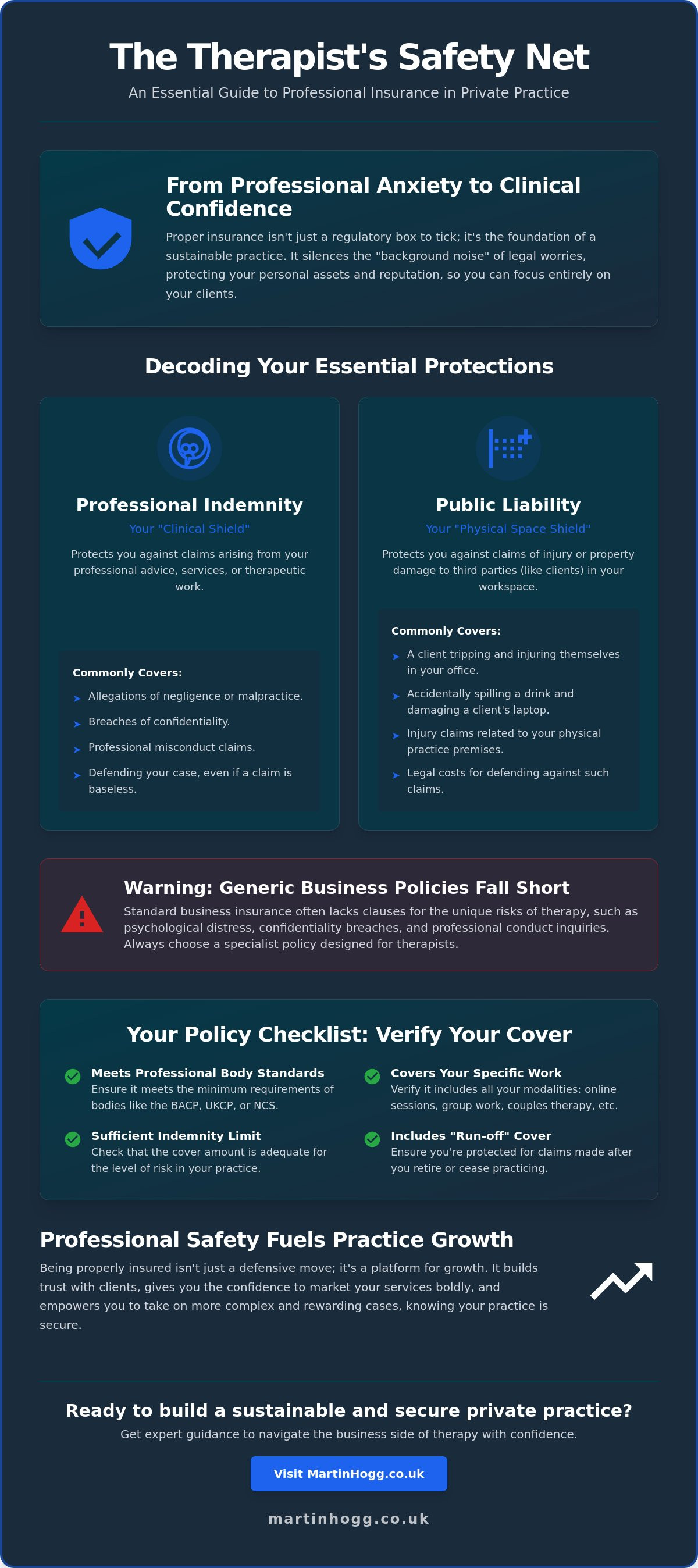
Think of this as your clinical shield. Professional Indemnity is the coverage for the work you do with your head and heart. It's designed to protect you if a client claims that your professional advice, interventions, or conduct caused them harm. This includes allegations of negligence, breaches of confidentiality, or professional misconduct. Even if you've done everything by the book, a client might still make a claim.
It's not just about paying a settlement. In fact, the legal costs are often the most expensive part of any dispute. A 2023 report by the British Insurance Brokers' Association (BIBA) noted that legal defence costs in professional negligence cases can easily exceed £20,000 before a case even reaches court. This insurance ensures you have an expert legal team in your corner from the moment a complaint is made, protecting your reputation and your finances.
Public Liability: Safety Beyond the Therapy Chair
This is your physical shield. It deals with the "bricks and mortar" risks of running a business. Imagine a client trips on a loose rug in your waiting area or slips on a wet floor in the hallway. These incidents have nothing to do with your therapy skills, but as the practitioner, you can still be held responsible for their physical safety while they are on your premises.
You might think you don't need this if you rent a room in a multi-disciplinary clinic, but that's a common mistake. You shouldn't assume the landlord's insurance covers your specific visitors or your personal liability. If you've moved your practice to a home office, you must check your policy immediately. Many therapists assume their domestic home insurance is enough, but standard policies often exclude business visitors entirely. Under-insuring happens when we assume our domestic cover is sufficient, yet a claim for a permanent injury in the UK can reach six figures. Always ask your provider if your policy covers "temporary locations" if you move between different spaces.
If the logistics of setting up your practice feel a bit overwhelming, you might find it helpful to look at my availability for a chat to get things moving in the right direction.
The Invisible Risks: Why General Business Insurance Often Falls Short for Therapists
Generic business insurance is usually designed for shops, cafes, or traditional offices. These policies focus on physical things: a broken window, a flooded storeroom, or a customer slipping on a wet floor. While those risks exist for us too, they aren't the primary dangers we face in the therapy room. A standard "office insurance" policy rarely understands the weight of a therapeutic relationship. It might cover your furniture, but it likely won't cover a claim involving psychological distress or professional negligence. This gap is exactly why insurance is essential in private practice; you need a policy that protects the words you say, not just the chair you sit in.
I often hear colleagues say they only work with "low-risk" clients, so they don't see the need for expensive, specialised cover. It's a common trap to fall into. However, even a client who begins therapy for mild anxiety can experience a crisis or feel that the process has caused them harm. The BACP 2023 professional conduct reports show that many complaints arise from simple boundary misunderstandings or perceived lack of progress. Without a policy that specifically covers "Malpractice" or "Professional Indemnity," you're left to fund your own legal defence, which can cost thousands of pounds before a case even reaches a hearing.
Then there's the matter of "Run-off Cover." This is a vital piece of the puzzle that many therapists overlook when they decide to retire or close their practice. In the UK, a client can technically bring a claim years after their last session. If you cancel your insurance the day you stop seeing clients, you're unprotected against any historical claims that surface later. Run-off cover ensures that your past work remains protected, giving you genuine peace of mind as you move into the next chapter of your life.
Online Therapy and Global Reach
Working online has changed everything, but it brings specific legal hurdles. Most UK-based therapist policies exclude clients living in the USA or Canada because their legal systems are notoriously complex and expensive. If you're seeing someone abroad, you must check your policy's jurisdiction clauses. Digital sessions also carry a higher risk of "misunderstandings" where tone and body language are lost over a screen. You should ensure your provider explicitly covers telehealth and the specific platforms you use to deliver it.
Data Breaches and GDPR Compliance
Your client notes are your most sensitive asset. If your laptop is stolen or your cloud storage is compromised, the fallout is significant. Under the Data Protection Act 2018, you have a legal obligation to protect this data. Cyber insurance is now a practical necessity for the modern practitioner. It doesn't just cover the cost of a new laptop; it helps manage the legal costs of an ICO investigation and the process of notifying affected clients. This link between your ICO registration and your insurance is a core reason why insurance is essential in private practice today.
A Practical Checklist for Choosing the Right Policy Without the Overwhelm
Selecting a policy doesn't have to be a source of anxiety. When you understand why insurance is essential in private practice, the process becomes a logical step in protecting the work you love. I've seen many therapists feel paralyzed by the fine print, but you can simplify your choice by following these four practical steps.
- Step 1: Verify your professional body’s requirements. Organizations like the BACP or UKCP often set specific minimums. For instance, many require a minimum indemnity limit of £1.5 million. Check your membership handbook before you sign anything.
- Step 2: Match the policy to your "mode" of work. If you offer "Walk and Talk" therapy in a local park, your public liability must extend beyond a traditional office. Similarly, if you work online, ensure your policy covers "territorial limits" for clients living outside your immediate area.
- Step 3: Include "Legal Expenses" as an add-on. This is about more than just clinical mistakes. It provides a safety net for tax enquiries, contract disputes, or even representation at a professional conduct hearing. It's a broad layer of protection for your business as a whole.
- Step 4: Confirm cover for "Previous Work." If you're switching providers, you must ensure the new policy includes "retroactive cover." This protects you against claims made today regarding sessions that happened years ago under a different insurer.
What to Look for in a Specialist Provider
I always recommend choosing a broker with a dedicated "Therapy" or "Counselling" desk. These specialists understand the nuance of our work; they won't look confused when you mention "dual relationships" or "confidentiality breaches." Ask them about their claims process. You want a provider that offers a supportive, human approach rather than an adversarial one. Many specialist policies also include 24/7 helplines. Having access to legal advice before a formal claim is even made can be a huge relief when you're facing a difficult ethical dilemma.
Managing Your Insurance Costs
You can keep your premiums affordable without cutting corners on your safety. Most individual policies for UK counsellors range between £60 and £120 per year, which is a small price for peace of mind. While it's tempting to look for the cheapest option, never choose a policy based on price alone. A policy that fails to pay out when you're in crisis is the most expensive mistake you can make. If you're looking for more ways to build a stable foundation, my guide on Starting and Growing a Private Practice offers further insights into managing your overheads effectively.
Understanding why insurance is essential in private practice is the first step toward a sustainable career. If you're feeling stuck with the administrative side of your business, you don't have to figure it out alone. You can book a breakthrough call with me to discuss how to move your practice forward with confidence.
Building a Sustainable Practice: How Professional Safety Fuels Your Visibility and Growth
When you first start out, visibility can feel like a risk. Putting your face and your philosophy on a website makes you feel exposed. Many counsellors I speak with in Birmingham and across the UK hesitate to market themselves because they fear making a mistake that leads to a legal claim. This is exactly why insurance is essential in private practice; it provides the psychological safety net you need to step out of the shadows. You cannot effectively promote your services if you are constantly worried about being sued. Real growth requires you to be bold, and you can only be bold when you know you are protected.
Professional protection also changes how you view your work. It allows you to take on more complex cases or seek out higher-paying corporate contracts that require robust indemnity levels. By ensuring your business standards are high, you naturally begin to position yourself as a "Senior Practitioner." This isn't just about how many hours you have clocked; it is about the professional maturity you show by managing risks properly. When you hold yourself to these high standards, you attract clients who value that level of professionalism and are willing to pay for it.
The Confidence to Scale
As your practice grows, your needs will change. You might decide to move from a small home office to larger premises in a city centre or begin hiring associates to manage your waiting list. Each of these steps introduces new variables and risks. A successful practice is built on a foundation of professional integrity and legal safety. Having the right insurance in place means you can focus on the logistics of expansion without the nagging anxiety of "what if something goes wrong with a sub-tenant?" or "am I covered for their work?"
Joining a Community of Protected Professionals
Isolation is one of the biggest risks in our profession. It leads to burnout and, occasionally, to the very clinical errors we try to avoid. While your insurance policy covers the legal side, peer support acts as your "informal insurance" against the emotional toll of the job. I often recommend the Private Practice Success Membership for this very reason. It provides a space where you can discuss challenges before they become crises. Sharing the journey with others reduces the pressure and keeps you grounded.
Building a practice that lasts involves more than just clinical skill. It requires a business mindset that values safety as much as it values growth. Take a moment to review your policy today. Once you know you are protected, you can stop worrying about the "what ifs" and start focusing on your visibility. Moving from "protected" to "visible" is easier when you use a structured approach like the Practice Visibility Blueprint. Your future clients are waiting to find you, and they deserve a counsellor who is confident, grounded, and fully prepared for the journey ahead.
Protecting Your Passion and Your Practice
Building a private practice in the UK is a brave step, but it shouldn't feel like you're walking a tightrope without a net. We've explored how the right cover protects your livelihood and why insurance is essential in private practice for your long-term peace of mind. By distinguishing between professional indemnity and public liability, you ensure that a simple mistake or an accidental trip doesn't derail years of hard work.
I've spent over 20 years in the UK counselling sector. I know that the fear of "what if" can hold back even the most talented therapists. As a BACP-endorsed workshop provider, I offer practical, no-nonsense business coaching that helps you get your practice on the right track. When you handle the legalities properly, you create a safe container not just for your clients, but for your own professional growth. You deserve to work without the constant weight of worry hanging over your shoulders.
Ready to grow your practice with confidence? Join the Private Practice Success Membership
You have the skills to make a real difference in people's lives. Now, make sure you have the solid foundation required to do it sustainably and with true confidence.
Frequently Asked Questions
Is professional indemnity insurance a legal requirement for UK counsellors?
Professional indemnity insurance isn't a legal requirement under UK law, but it's a mandatory condition for membership in professional bodies like the BACP or UKCP. These organisations represent over 60,000 practitioners who must prove they're covered to remain on the accredited register. It's about protecting your clients and your own livelihood if a dispute arises, ensuring you can focus on the therapeutic work.
How much does therapist insurance typically cost in the UK?
You can expect to pay between £50 and £120 per year for a standard self-employed counsellor's policy. Prices vary depending on your specific qualifications and the level of cover you choose. Most providers, such as Howden or Towergate, offer monthly payment options to help you manage your cash flow as you build your practice. It's a small investment for the peace of mind it offers.
Do I need insurance if I am only seeing one or two private clients alongside my NHS job?
Yes, you need your own policy for any private work because NHS indemnity only covers tasks performed within your official employment contract. If a private client raises a concern, you're personally liable for legal costs and damages. This is exactly why insurance is essential in private practice, even if you only see one person for a single hour each week.
What is the difference between professional indemnity and medical malpractice insurance?
Professional indemnity covers you for financial loss or breach of confidentiality, while medical malpractice focuses on psychological or physical injury caused by your treatment. In the UK counselling world, these terms are often bundled together into a single civil liability policy. It's a safety net that catches different types of mistakes, from administrative errors to issues with the therapeutic process itself.
Does my insurance cover me for "Walk and Talk" therapy or sessions in public spaces?
Most standard policies cover "Walk and Talk" therapy as long as you've completed a formal risk assessment for the location. You should check your specific policy wording or call your broker to ensure outdoor work is explicitly included. This ensures you're protected if a client trips on a path or if a confidential conversation is accidentally overheard in a public park.
What happens if I stop practicing? Do I still need to be insured?
You'll need to arrange "run-off cover" for at least 6 years after you stop seeing clients to protect against delayed claims. Under the Limitation Act 1980, a person can bring a claim for personal injury up to 3 years after they become aware of a problem. Keeping this cover active ensures that your past work remains protected even after you've retired or moved on.
How much cover (indemnity limit) do I actually need?
The BACP recommends a minimum indemnity limit of £1.5 million for private practitioners in the UK. While that might sound like a huge sum, legal fees and compensation costs can escalate quickly in a complex case. Many specialist insurers now offer £3 million or £5 million as their standard level of cover, often for just a few extra pounds on your annual premium.
Will my insurance cover me for complaints made to my professional body (e.g., BACP)?
Yes, most comprehensive policies include "Professional Body Representation" to cover your legal costs during a conduct hearing. Navigating a formal complaint is incredibly stressful and expensive if you're paying for solicitors out of your own pocket. This support is another reason why insurance is essential in private practice, as it provides expert guidance when your professional reputation is on the line.


