
Working with EAP Providers: A Guide for UK Therapists

Article by
Martin Hogg
I help Private Practice counsellors in the UK set up and grow an ethical Private Practice they love, work with their ideal clients, and earn the income they deserve. All without guesswork and burnout. I have been a private practice counsellor myself for over 20 years, specialising in anger management. I set up a not-for-profit social enterprise, Citizen Coaching and Counselling, which delivers thousands of counselling sessions a year to adults and young people in Birmingham. I am a registered BACP Counsellor and the author of three books, My Anger Coach, My Anxiety Coach and My Relationship Coach. These are available on Amazon.
Your private practice shouldn't feel like a constant battle against a quiet phone and a blank calendar. It’s a common struggle; many therapists find the marketing side of things feels a bit like trying to shout in a crowded room where everyone else has a megaphone. If you’re feeling the pinch of those vacant slots, learning how to work with EAP providers can be the quickest way to turn on a steady tap of referrals without having to become a social media influencer overnight.
I know the hesitation. You might worry about the lower fees, the admin mountain, or whether you’ve got enough experience yet. It’s true that most major panels look for around 450 post-qualifying hours and want to see your BACP accreditation or similar, but once you’re in, the work is consistent. I’m going to show you how to get through these panels, get yourself on their books, and use EAPs as a practical skateboard to get your practice moving while you build your long-term niche.
We’ll cover the application process, from your £47 ICO fee to the 2026 SCoPEd framework requirements. I’ll also share my tips for managing the paperwork so it doesn't swallow your week, helping you move from "where are the clients?" to a settled, sustainable practice.
Key Takeaways
- Learn how to turn on the "Referral Tap" to fill your diary without needing to spend all day on SEO or social media.
- Get your house in order by meeting the standard requirements for big panels, such as BACP accreditation and £1m professional indemnity cover.
- Master the specifics of how to work with EAP providers by streamlining your portal admin and invoicing to protect your clinical time.
- Find out how to deliver meaningful work in a short-term format without feeling like you've joined a "counselling factory."
- Use EAP referrals as your "skateboard" to keep your practice moving while you work on your Practice Visibility Blueprint for the future.
Understanding the EAP Landscape: The Referral Tap for Your Practice
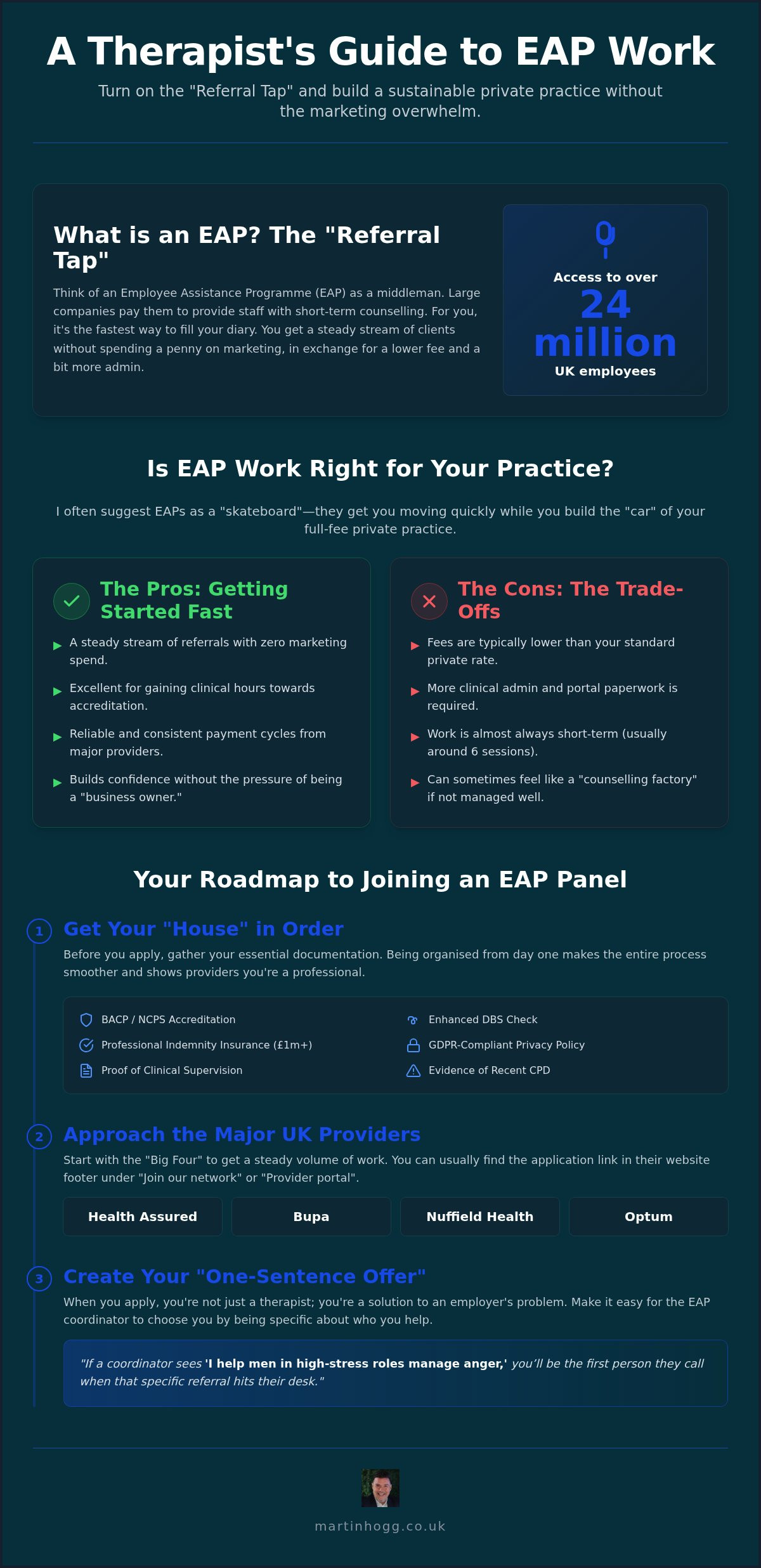
Think of an Employee Assistance Programme (EAP) as a helpful middleman between large corporations and your therapy room. For many therapists, this is what I call the "Referral Tap." It is arguably the fastest way to fill a random 10 am slot on a Tuesday without having to touch your SEO or worry about where your next client is coming from. If you are wondering What is an Employee Assistance Program?, it is essentially a benefit offered by employers to help staff deal with personal or work-related problems that might impact their job performance.
In the UK, this market is huge. Over 24 million employees have access to these services across 105,000 organisations. Major players like Health Assured, Bupa, and Optum are always looking for reliable practitioners to join their panels. The trade-off is straightforward: you get a steady stream of clients handed to you on a plate, but in exchange, you accept lower fees and a bit more paperwork than you would with a private client. It’s a brilliant way to understand how to work with EAP providers while keeping your diary healthy.
Is EAP work right for your practice?
Deciding to join a panel isn't just about the money; it’s about how you want your working week to look. When you are learning how to work with EAP providers, you have to weigh up the convenience against the constraints. I often suggest EAPs as a "skateboard" for new practices. They get you moving quickly while you build the more complex "car" of your full-fee private practice.
- The Pros: You don't need to spend a penny on marketing or spend hours on Canva. It’s excellent for racking up clinical hours if you are working towards accreditation, and the payment cycles are usually very reliable.
- The Cons: You will face more clinical admin than usual. The fees are typically lower than your standard private rate, and you are almost always constrained to short-term work, usually around six sessions.
If you enjoy solution-focused work and don't mind a bit of portal-hopping, EAPs can provide the stability you need to stop worrying about the bills and start focusing on the clinical work you love. It allows you to build confidence without the immediate pressure of being a "business owner" first and a therapist second.
The Step-by-Step Roadmap to Joining an EAP Panel
Most therapists I talk to find the initial application process a bit like trying to solve a Rubik's cube in the dark. It’s fiddly, but once you know the sequence, it usually clicks into place. If you want to know how to work with EAP providers effectively, you first need your "house" in order. For the major UK panels, being an accredited member of the BACP or NCPS is usually non-negotiable. They want to see that you’ve put in the hours and met the professional standards. You’ll also need your insurance sorted; most panels look for professional indemnity cover of at least £1 million.
It helps to understand why these companies exist. Independent research into EAP effectiveness shows that employers use these programmes to reduce absenteeism and support staff wellbeing. When you apply, you aren't just a therapist. You're a solution to an employer's problem. To make their life easier, create a "one-sentence offer." If a coordinator sees "I help men in high-stress roles manage anger," you’ll be the first person they call when that specific referral hits their desk. Understanding how to work with EAP providers means being organised from day one.
Essential documentation you will need
Don't wait for the application form to start digging through your filing cabinet. You'll need proof of clinical supervision and your supervisor’s credentials ready to upload. A valid, enhanced DBS check is essential, along with a clear, GDPR-compliant privacy policy for your practice. You also need to show you're keeping your skills sharp. Providing evidence of CPD for counsellors UK proves to the panel that you are a safe, current, and professional pair of hands.
Major UK EAP providers to approach
Start with the "Big Four" to get the volume moving: Health Assured, Bupa, Nuffield Health, and Optum. Most of these hide their application links in the website footer under "Join our network" or "Provider portal." While the big names provide the volume, keep an eye out for smaller, niche providers. They often pay slightly better rates if you have specific expertise in areas like trauma or workplace mediation. If you're feeling overwhelmed by the admin, joining a community like the Private Practice Success Membership can help you stay on track while you grow.
The Gritty Reality: Paperwork, Portals, and Avoiding Burnout
While the steady stream of clients is a relief, I have to be straight with you about "Portal Life." If you want to know how to work with EAP providers without losing your mind, you must accept that you aren't just a therapist anymore; you are also a part-time data entry clerk. Each provider has its own bespoke system. You'll spend a fair bit of time clicking through screens to confirm attendance, upload clinical outcomes, and submit invoices. I suggest setting aside a specific hour each week just for this admin. If you try to do it between every session, you'll end up frazzled before lunch.
Then there is the clinical challenge. Working in a six-session model requires a shift in mindset. It can feel a bit like a "counselling factory" if you aren't careful. The goal is to provide something meaningful and safe within a tight boundary. This is where solution-focused skills really shine. You aren't trying to unpack twenty years of childhood trauma in six weeks. You are helping that person function better in their daily life right now. It is rewarding work, but it is intense.
To keep your practice healthy, I recommend capping your EAP clients at about 30% to 40% of your total caseload. Relying on them for 100% of your income is a recipe for therapist burnout because the fees are lower and the admin is higher. While fees are usually fixed, don't be afraid to mention your specialist niches. If you have specific training in anger management or trauma, some smaller providers might be open to a slightly higher rate. Understanding how to work with EAP providers means knowing your own limits as much as their systems.
Staying efficient with EAP admin
Repetitive typing is the enemy of a happy therapist. I use templates for my initial clinical assessments and discharge summaries. You shouldn't be reinventing the wheel every time a new referral lands in your inbox. Having a set of standard phrases for common workplace issues like stress or interpersonal conflict saves hours. If you want to get your systems sorted, the Counsellor Efficiency Bundle has practical tools to help you manage your practice without the overwhelm.
Beyond the EAP: Building Your Own Visibility Blueprint
I’ve often said that learning how to work with EAP providers is like getting your first skateboard. It isn't the most sophisticated way to travel, but it gets you moving while you’re learning the ropes. The mistake many therapists make is staying on the skateboard forever. It’s a great tool for filling gaps in your diary, but it shouldn't be your entire business model. The real goal is to use that steady EAP income as a bridge. It gives you the financial breathing room to build the "Car"—a practice filled with direct-pay clients where you set the fee and the clinical direction.
The real magic happens when you use that EAP work to fund your own visibility. Understanding how to work with EAP providers gives you the space to experiment with your marketing without the panic of an empty bank account. You can afford to take your time and build something sustainable. Don't worry about being perfect from day one. I'm a firm believer that rough and ready content beats polished every time. Just start showing up and letting people know who you are and what you do.
Niche building is your secret weapon in this transition. If you are just another "general counsellor" on a directory, you are invisible. But if you are the "guy who works with men" or the specialist in workplace stress, you suddenly stand out. This makes you much more attractive to EAP panels too. They love specialists because it makes their matching process easier. At the same time, it makes you more visible on Google for people searching for help. You should start building your own marketing for therapists UK strategy today to ensure you aren't reliant on anyone else's portal forever.
Next steps for practice growth
If you are ready to take the training wheels off, you need to start thinking about your long-term visibility. I have put together some niche building secrets that will help you attract the kind of full-fee clients who value your specific expertise. If you want a bit more support and a community of people doing the same thing, come and join the Private Practice Success Membership. We focus on the practical, human side of growing a practice so you can get back to the clinical work you love.
Ready to Take the Next Step in Your Practice?
You've seen that EAPs can be a brilliant way to keep your diary ticking over while you find your feet. They are the "skateboard" that provides momentum, helping you manage the gap between qualifying and running a full-fee private practice. By understanding how to work with EAP providers, you turn on a referral tap that takes the immediate pressure off your marketing while you build your clinical confidence.
But remember, the goal is always to move toward a practice that you control completely. You want to be in a position where you choose your clients, set your fees, and work within your own clinical niche. It's about building a sustainable future where you aren't just jumping between portals, but actually growing a business that serves you as much as it serves your clients. I've helped over 500 UK therapists use the Practice Visibility Blueprint to do exactly that.
You have the clinical skills to help people. Now it’s just about getting the right systems in place to make sure those people can find you. It takes time, but with the right tools, you can build a practice that truly thrives. I'll see you on the inside.
Frequently Asked Questions
How much do EAP providers pay therapists in the UK?
Most EAP providers in the UK typically pay between £35 and £50 per session. While this is lower than your standard private fee, you have to weigh it against the fact that you have zero marketing costs and no time spent on the phone chasing leads. It’s a predictable income stream that helps keep your practice stable while you build your private work.
Do I need to be BACP accredited to work for an EAP?
You usually need to be an accredited member of the BACP, NCPS, or an equivalent professional body. Most major panels won't accept therapists who are just "registered" or "individual" members. They look for that accreditation as a badge of experience and safety. If you aren't there yet, treat it as a goal to reach while you build up your private clinical hours.
Can I see EAP clients in my own private practice room?
Yes, you can use your own room as long as it meets their standards for safety and confidentiality. When you are learning how to work with EAP providers, they will often ask for a description of your space. You'll also need to prove you are GDPR compliant, which means having your ICO registration and professional indemnity insurance ready to show them.
How long does it take to get on an EAP panel?
Getting on a panel can take anywhere from two weeks to six months. It really depends on their current demand in your local area or for your specific expertise. If you have a clear niche, like working with emergency services or specific trauma training, you might find the process moves much faster because you are solving a specific problem for the coordinator.
What happens if an EAP client wants to continue privately?
You must check your contract for a "non-compete" or "solicitation" clause before taking an EAP client into your private practice. Most providers forbid you from seeing their referrals privately for at least six to twelve months after the funded sessions end. It's vital to respect these boundaries. Breaking them can get you removed from the panel and damage your professional reputation.
Disclaimer
The information provided on this blog is for general informational purposes only. It is also not intended to be a substitute for professional medical or mental health advice, diagnosis, or treatment. Reading this content does not create a therapist-client relationship.


